Key facts
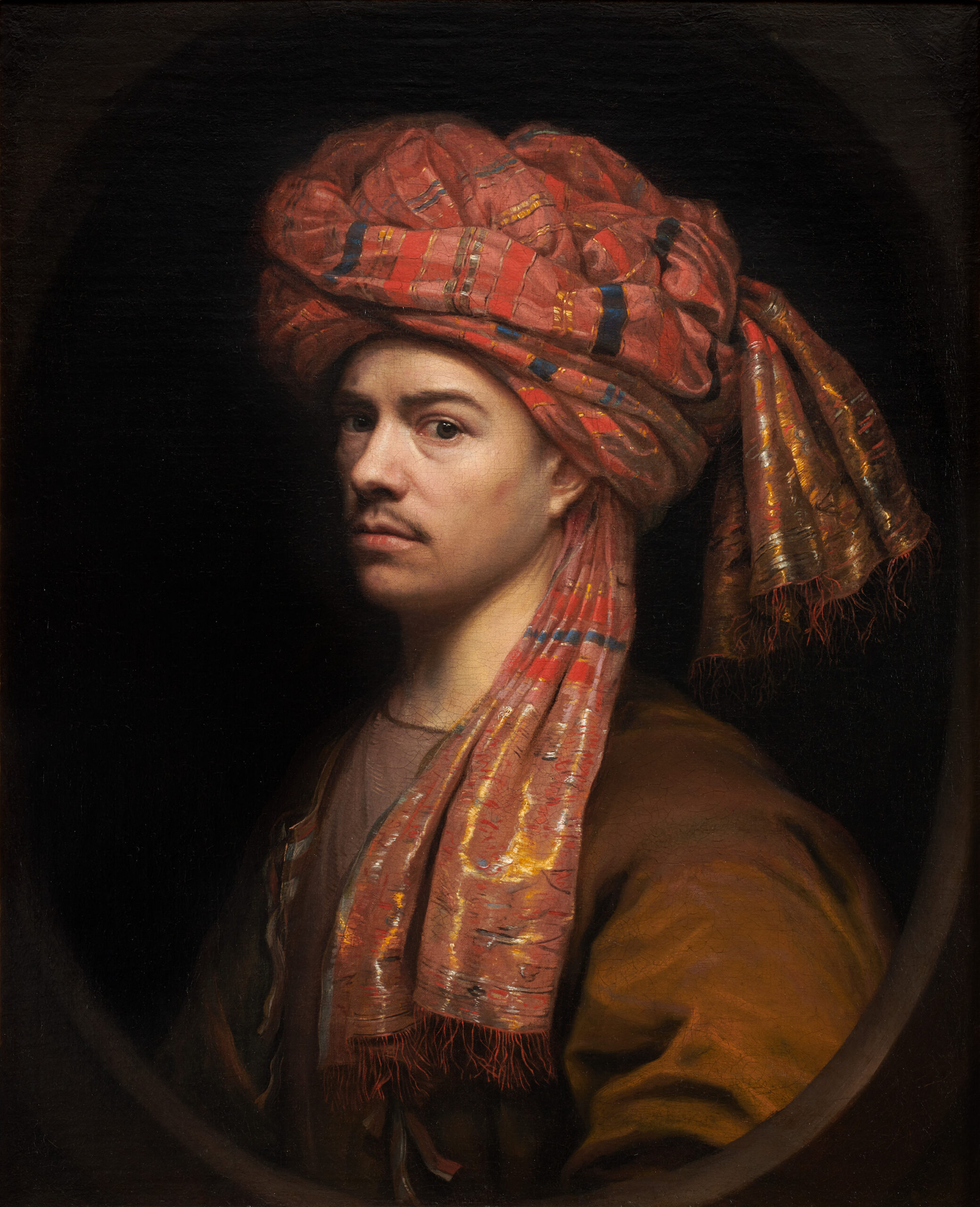
Painted between 1675 and 1677, Self-Portrait in a Turban is an oil on canvas by Wallerant Vaillant, an artist born in Lille in 1623 and active mainly in Amsterdam during the Dutch Golden Age. Trained in Antwerp under Erasmus Quellinus, he first made his name as a printmaker, notably through his role in popularising the mezzotint technique, before recent scholarship began to reassess the importance of his painted work. This canvas belongs to the tronie genre, favoured in the Dutch Republic, in which the sitter is costumed rather than faithfully portrayed. The turban, imported through Dutch trading posts, reflects the period’s fascination with the Orient. The work is held at the Clark Art Institute, in Williamstown, Massachusetts.
This portrait fascinates me. Its execution is almost photographic in quality: the rendering of the skin, its nuances and reflections, and above all the texture of the turban, remain remarkable even on close inspection. The Dutch Golden Age still has treasures left to reveal.
Vaillant is better known today for his prints, particularly his mezzotints. Yet this late canvas proves his painting was every bit as accomplished. I look at the sheen of the fabric, its almost tangible texture, the way light catches in the folds: it makes you want to reach out and check whether the cloth is really as soft as it looks.
This fashion for turbans and the Orient recurs throughout the work of Vaillant’s contemporaries. It reflects the fascination, in the Netherlands at the time, with goods brought back by the exotic trading posts and the nascent colonial trade. A single detail that says a great deal about the period, and about what this kind of painting meant for those who commissioned it.
What you notice first in this Self-Portrait in a Turban
Look first at the fabric. Dark red, shot through with gold and blue thread, it coils in heavy folds. Light catches on it, slips, and disperses into the fringes. Only then does the gaze move down to the eyes, which meet yours from an angle.
What lies beneath the surface
Behind the apparent simplicity of the bust, the technique builds up in layers. Vaillant constructs the turban through successive glazes, playing on the micro-reflections of gold thread woven into the silk. Each fringe seems to carry its own source of light. The skin, by contrast, receives the opposite treatment: smooth, almost without impasto. This contrast between coarse fabric and soft flesh creates an optical tension unique to oil painting.
Beneath the turban, the clothing stays plain: a simple shirt, an unadorned brown coat. All the luxury is concentrated on the head, as though the sitter’s identity were entirely bound up in this drapery. The near-black background absorbs any distraction. Painted between 1675 and 1677, this portrait belongs to the tronie genre, popular in the Dutch Republic: a head studied for its own sake, costumed rather than resembling. The turban comes from elsewhere, imported through the trading posts of the Dutch East India Company.
Wallerant Vaillant and his time
Wallerant Vaillant was born in Lille in 1623, one of five brothers who all became artists. Trained in Antwerp under Erasmus Quellinus, he settled in Amsterdam, where he built his reputation as a portraitist. He also painted at the court of Louis XIV, for Anne of Austria. Posterity remembers him chiefly for his mezzotints, a printmaking technique he helped popularise across Europe. His painted work, rarer, shows the same command of matter and light.
News
In recent years, research by art historian Nadine Rogeaux has helped reassess the place of painting within Wallerant Vaillant’s body of work, an aspect long overshadowed by his graphic art, particularly his mezzotints, a technique he was among the first to champion. This research is helping to broaden recognition of the painter beyond his reputation as a virtuoso printmaker.
At the Clark Art Institute, where this Self-Portrait in a Turban is held, 2026 marks a major moment for the museum’s historical collections: from June onward, the Clark is presenting a first look at the Aso O. Tavitian Collection, a gift of 331 works of European art received by the institution in 2024, and considered one of the most significant private collections of European art assembled in North America in the twenty-first century. Clark Director Olivier Meslay has welcomed this programming, which will allow the public to discover exceptional works from the donation.
Source: The Clark Art Institute
A question for you
What if this were not a self-portrait at all, but a tronie that Vaillant painted using himself simply because no other model was on hand?
About this work
- Self-Portrait in a Turban
- Wallerant Vaillant
- 1675–1677
- Oil on canvas
- 74 × 59.4 cm (29 1/8 × 23 3/8 in.)
- The Clark Art Institute, Williamstown
- https://www.clarkart.edu/ArtPiece/Detail/Self-Portrait-in-a-Turban