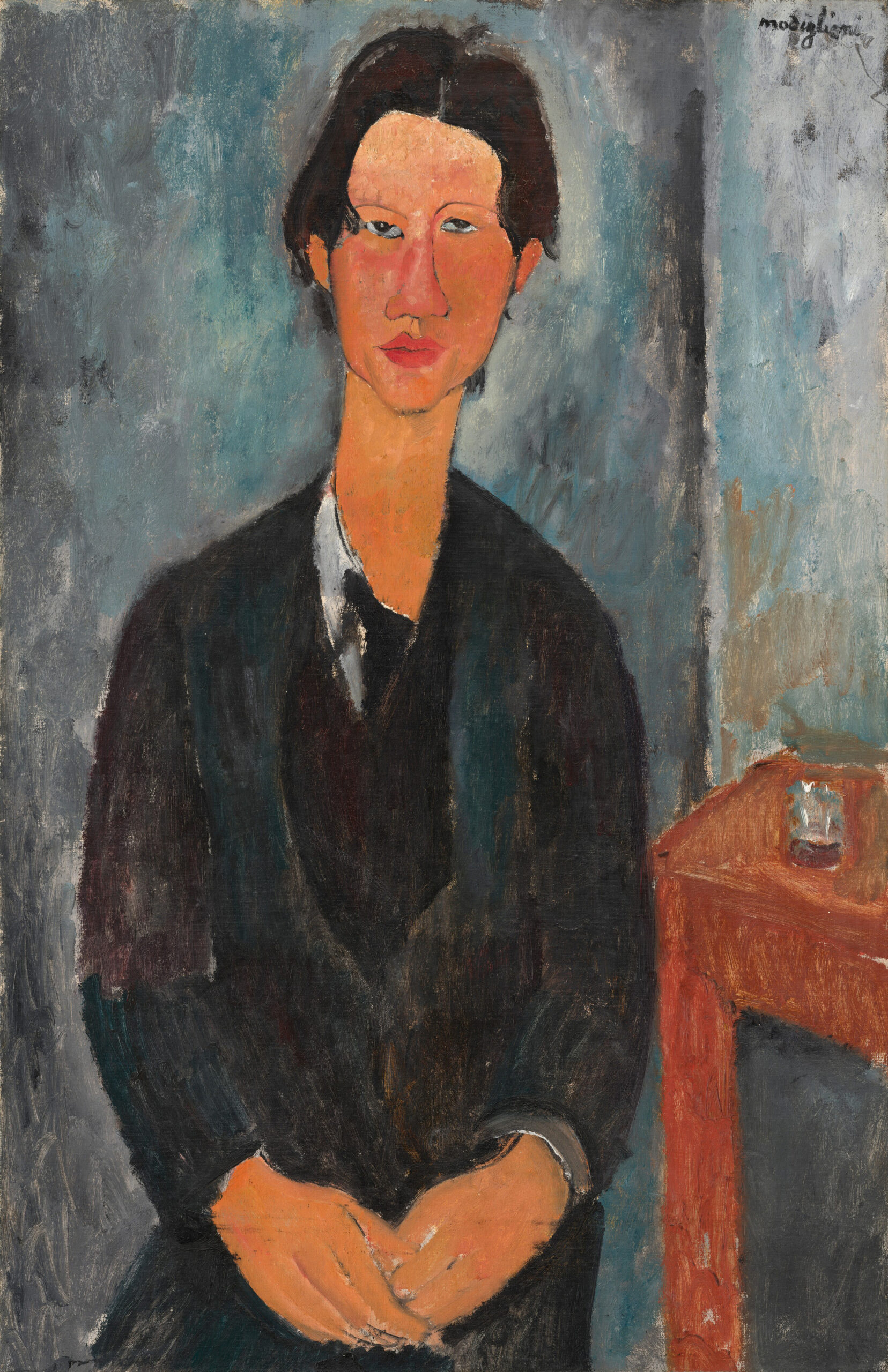
Two great artists of the early twentieth century face each other in this painting, and the first thing that strikes me is its warmth. Soutine’s gaze, far from theatrical or evasive, seems to rest with quiet confidence on the man painting him. I sense a genuine friendship between the two. Modigliani’s style remains instantly recognizable: the elongated lines, the simplified features, that characteristic economy of means.
But unlike his stylized nudes, or certain more impersonal portraits where the sitter seems almost interchangeable, Modigliani here lets Soutine’s bohemian character show through: that slightly unkempt look, that mixture of roughness and fragility he was known for. More than a mere commissioned portrait, I see this as the pictorial transposition of a real friendship, between two artists who then shared the same poverty and the same creative intransigence in Montparnasse.
You stand before a left hand folded over the other, almost awkward, resting on a black knee. Chaïm Soutine has been looking at you since 1918, his eyes slightly misaligned, his collar open at an orange-toned throat. Motionless for over a century.
What the canvas tells us
The brushwork stays broad, almost heavy in places. Modigliani builds this face in bold flat areas: orange ochre for the skin, dark brown for the unruly hair. A blue-grey for the background, left in reserve, vibrating around the figure. The neck stretches in the artist’s own manner, a direct legacy of his years as a sculptor alongside Brancusi. The half-closed eyes, one set noticeably higher than the other, break the symmetry expected of an academic portrait. To the right, a small red table and a sketched vase anchor the scene in a modest, almost austere interior. The shapeless black jacket consumes nearly the entire lower half of the canvas. This oil on canvas stands under a metre tall. Nothing here is smoothed over. Nothing is flattered. The very handling of paint seems to carry the roughness of the sitter himself.
What the era tells us
We are in Montparnasse, around 1918. Soutine and Modigliani are two figures of the École de Paris. They share the same poverty, the same freezing studios, the same dealer, Léopold Zborowski. Modigliani, ten years his senior, watches over this rougher-tempered younger man. It was he who introduced Soutine to Zborowski in 1916. He who joked about his own drunkenness: “everything dances around me as in a landscape by Soutine.” Near the very end of his life, he told his dealer: “Don’t worry, I’m leaving you Soutine.”
Born in 1884 in Livorno to a bourgeois family, Amedeo Modigliani settled in Paris in 1906. Painter, then sculptor under Brancusi’s influence, he returned to painting around 1914. He died in 1920, at thirty-five, of tubercular meningitis worsened by his excesses.
Current news
The National Gallery of Art continues to expand its holdings: in March 2026, the museum announced the acquisition of several hundred works, ranging from Civil War–era photographs to contemporary pieces by Dan Flavin and Barbara Kruger. A sign that a century-old collection keeps being written.
Source: National Gallery of Art
A question for you
💭 This portrait breaks with the conventions of the genre: no symmetry, no flattery. How many patrons of the period would have accepted such a face?
About this work
- Chaïm Soutine
- by Amedeo Modigliani
- 1918
- Oil on canvas
- 91.7 x 59.7 cm (36 1/8 x 23 1/2 in.)
- National Gallery of Art, Washington D.C.
- https://www.nga.gov/artworks/46522-chaim-soutine