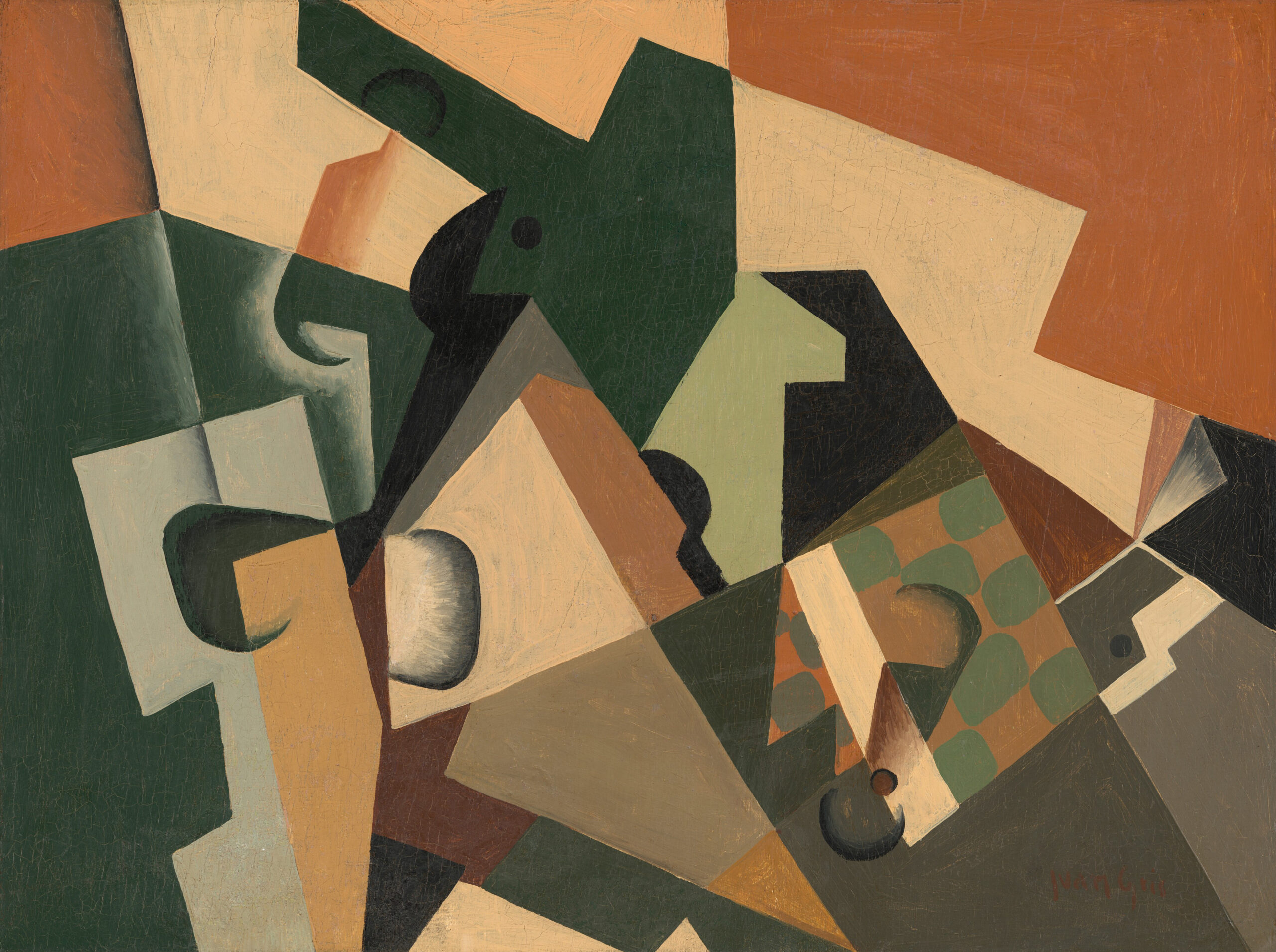
Paris, 1917. Europe tears its landscapes apart under shellfire. In his studio, Juan Gris sets his brush to a wooden panel and reinvents the world through a glass.
The Secret Grammar of Forms
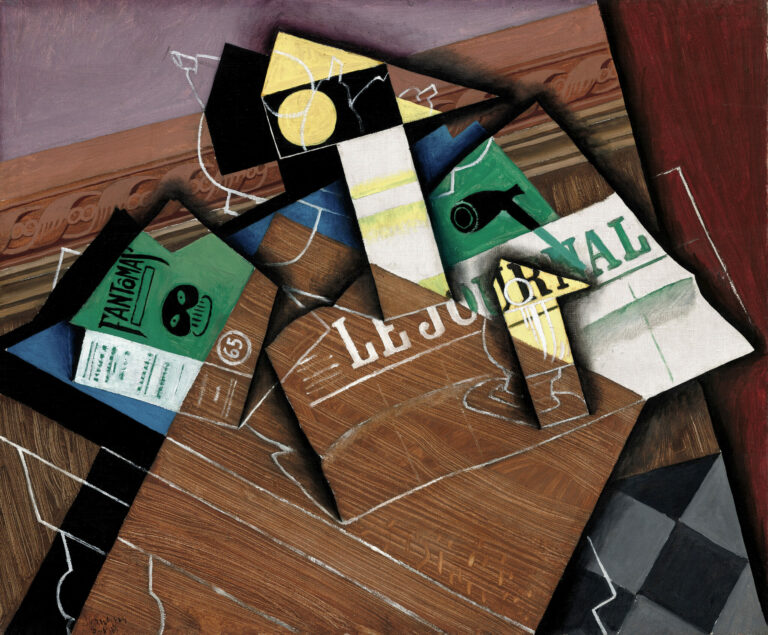
Geometric planes interlock, overlap, converse. Burnt orange, forest green, pale peach, taupe and deep black — the colours vibrate without clashing. Forms slide across one another. At the centre-right, a checkerboard holds the eye. Four rows of rectangles with rounded corners alternate sage green and terracotta brown. A wide parchment band crosses them vertically. The surface still reveals the traces of the brush on the wood. Juan Gris builds an image through the accumulation of strata — each plane a decision, each colour a note in a silent score.
Synthetic Cubism at Full Maturity
In 1917, Cubism was living its second revolution. Far from the fragmented Analytic mode of its beginnings, it was becoming Synthetic: fewer pieces, greater clarity. Juan Gris was the architect of that transition. Glass and Checkerboard illustrates this evolution perfectly. The checkerboard motif, omnipresent in Cubist still lifes, evokes Parisian cafés, board games, everyday life raised to the level of the sublime. The work anticipates the rigour of geometric abstraction that would dominate the decades to come.
Juan Gris
Juan Gris (1887–1927), born José Victoriano González in Madrid, arrived in Paris in 1906. He became the friend and neighbour of Picasso at the Bateau-Lavoir. His Cubism, more ordered and colourful than that of his elders, forged a singular identity. Glass and Checkerboard concentrates his mastery entire.
A Question for You
💭 If you covered the title, would you recognise a glass? Cubism forces us to unlearn how to look — and what if that were its greatest strength?
About this work
- Glass and Checkerboard
- Juan Gris
- c. 1917
- Oil on wood
- 29.85 × 41.28 cm
- National Gallery of Art, Washington
- https://www.nga.gov/artworks/166491-glass-and-checkerboard