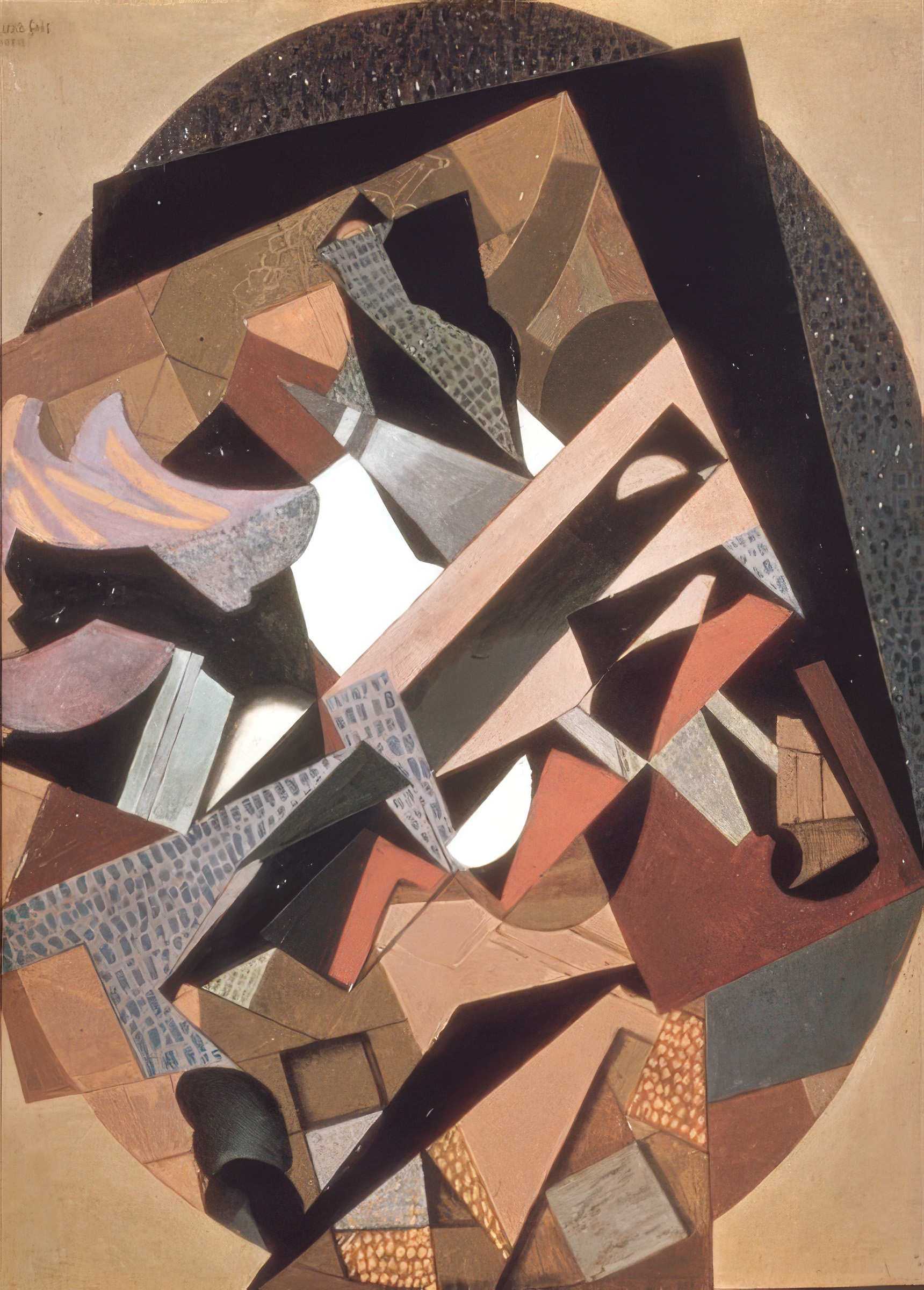
On first encountering this work in the collection of the Neue Nationalgalerie, I struggled to say what it depicted. The title offers little help: the forms are so broken apart and juxtaposed that the eye needs time to settle. This period, in which Cubism emerges in the wake of Cézanne and takes hold of artists such as Picasso and Juan Gris, remains a pivotal moment in the history of art: representation is no longer literal, but conveys instead the fragmented perception of an object seen from several angles at once.
Standing before the canvas, it took me a long while, and more than a few passes back and forth, to try to make out the objects arranged on this oval table. One can perhaps discern a glass, a folded newspaper, a pipe, though never with any certainty. In the end, I hold to a reading that is highly personal, and this is very likely what Gris was after: not so much showing an object as inviting the viewer to reassemble it.
Look first at that small grey grid, mottled like lizard skin, slipped between two flat brown planes. A trifle, almost an accident of matter. Around it, ochre and violet triangles interlock with no apparent logic. You look for something you can name. At first, you find only texture, a surface that resists.
What the surface conceals
This wealth of colored planes forms a still life painted in oil on canvas in 1915, by Juan Gris. Against a brown ground, zones overlap. Some are outlined with dotted lines. Others remain monochrome, in shades of brown, violet, and orange. Look again: the large oval in the background is in fact a tabletop, tilted through ninety degrees. A fruit bowl, a carafe, a glass can be made out, splintered into multiple facets. Certain surfaces mimic wood or marble grain, a device Gris favored during this period. Juan Gris is not attempting to deceive the eye. He offers a reconstruction, in which each fragment belongs to several viewpoints at once. The result reads, at first, as collage. Then, gradually, the table, the fruit, the carafe come into focus. The title, so understated, gives no hint of what follows. Synthetic Cubism, here, assembles more than it dismantles.
The artist and his time
Juan Gris, born José Victoriano González-Pérez in Madrid in 1887, settled in Paris in 1906. There he moved among Pablo Picasso and Georges Braque, with whom he shared a studio at the Bateau-Lavoir. Like them, he drew on Cézanne’s legacy to build a pictorial language grounded in fragmentation. The dealer Daniel-Henry Kahnweiler began supporting his work in 1913. This 1915 canvas, painted in the midst of war, marks a turning point. Cubism grows more structured here, almost architectural, as color reclaims its place. Gris moves gradually away from the austere grey palette of Analytic Cubism. The canvas already bears the traces of that shift.
Current exhibitions
Since April 2026, the Neue Nationalgalerie has been presenting “Ruin and Rush – Berlin 1910–1930,” devoted to the upheavals of the First World War and the Weimar Republic, the very period in which Juan Gris painted this work. The museum is also marking a particularly active year, with the first major Brancusi retrospective held in Germany in fifty years, in partnership with the Centre Pompidou.
Source: Neue Nationalgalerie
A question for you
💭 Cubism put an end to the single frontal viewpoint. How many viewpoints, in your view, does it take to exhaust a single object?
About this work
- Still Life
- Juan Gris
- 1915
- Oil on canvas
- 116 x 90 cm
- Neue Nationalgalerie, Berlin
- https://recherche.smb.museum/detail/961547/stillleben