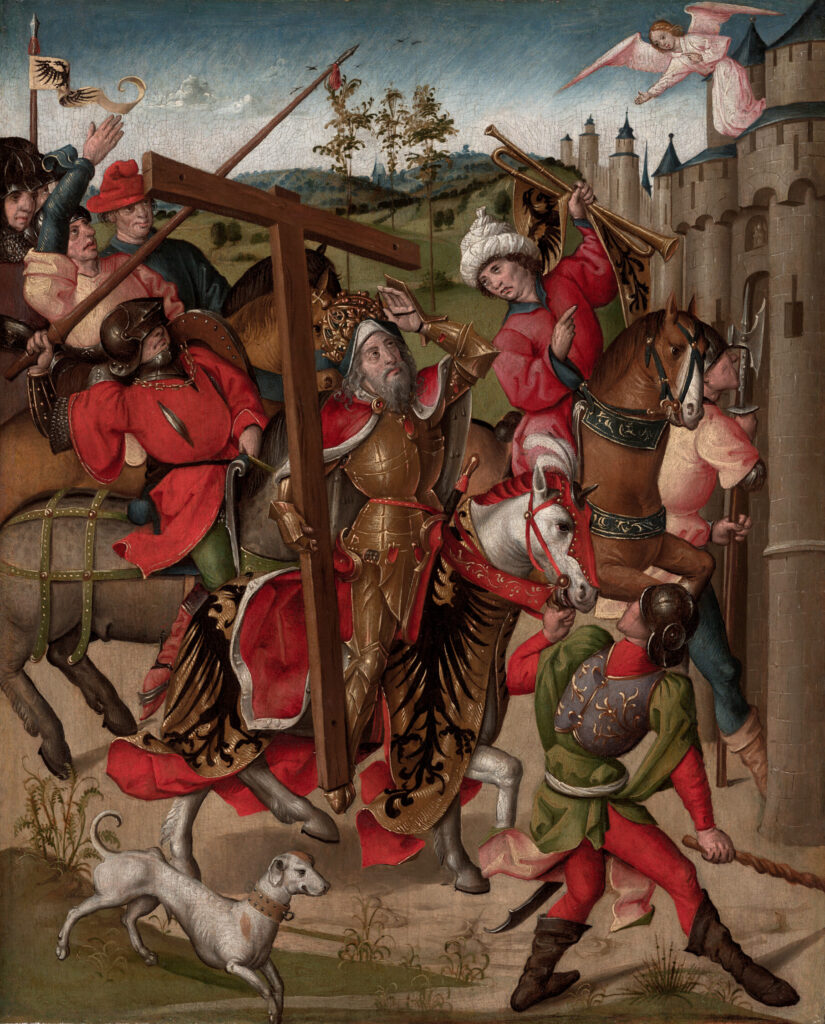
Jerusalem, 629. Emperor Heraclius approaches the gates of the Holy City. He carries the True Cross. An angel appears in the sky and blocks his path.
A procession brought to a halt
Look at this man in golden armour at the centre of the panel. His gaze rises toward the angel. The True Cross dominates the composition. The blazing reds of the tunics ignite against the pale blue sky. A musician sounds the trumpet. A white dog wanders in the foreground. The Netherlandish artist works in tempera and oil on panel. The faces are individualised, almost portrayed from life. The folds of the garments fall with a sculpted precision inherited from Early Flemish painting.
The angel’s lesson
This panel most likely formed part of an altarpiece dedicated to the Holy Cross. In the Middle Ages, this relic mobilises all of Europe. The story is powerful: Heraclius has defeated Khosrow, King of Persia, and recovered the True Cross. Yet his triumphal entry into Jerusalem is denied by a heavenly angel. His imperial pomp stands in stark contrast to Christ’s humble entry on a donkey. The double-headed eagle on the standard identifies Heraclius with the Holy Roman Emperor — a deliberate anachronism, a mirror held up to the Christian princes of 1470.
The artist
Active c. 1470 in the Southern Netherlands, this anonymous Netherlandish artist works within the Early Flemish tradition. He commands narrative painting, material detail, and facial expressiveness with equal assurance. This panel demonstrates his gift for dramatising sacred stories with force and clarity.
A question for you
💭 The Early Flemish masters were the first to harness oil paint to make armour gleam and fabrics shimmer. Look at the gilded metal of Heraclius — do you sense the difference from an Italian fresco of the same period?
📌 About this work
- Emperor Heraclius Denied Entry into Jerusalem
- Netherlandish artist
- c. 1470
- Tempera and oil on panel
- 67.6 × 54.2 cm
- The Art Institute of Chicago
- https://www.artic.edu/artworks/111609/emperor-heraclius-denied-entry-into-jerusalem
The Legend of Heraclius and the True Cross
This panel illustrates an episode from the medieval legend of the True Cross. In 614, the Persians under Khosrow II seized Jerusalem and carried off the True Cross, one of Christianity’s most venerated relics. The Byzantine emperor Heraclius (610-641) launched a war of reconquest, defeated Khosrow in 628, and brought the relic back to Jerusalem. But according to the legend, when he attempted to enter the city in triumph, clad in golden armour, an angel blocked his path: he must enter humbly, as Christ had entered on a donkey. Heraclius then stripped away his imperial attributes and walked in on foot, plainly dressed. This narrative, enormously popular in the late Middle Ages, was an invitation to meditation on Christian humility in the face of the pride of power.
A Panel That Forms Part of a Pair
The Art Institute of Chicago holds a second panel by the same artist from the same cycle: Emperor Heraclius Slays the King of Persia (number 111608), depicting the immediately preceding episode of the same story, Heraclius’s military victory over Khosrow. These two panels, painted around 1470 in the Southern Netherlands, most likely formed part of an altarpiece or decorative programme devoted to the history of the True Cross. The complete cycle was a common subject in Flemish and Burgundian art of the 15th century, linked to the devotion to the Cross and the calls for crusade that persisted throughout that period.
The Anachronism of the Double-Headed Eagle
The anonymous painter depicted Heraclius with the double-headed eagle standard, the symbol of the Holy Roman Empire in his own time (the 1470s), rather than the Byzantine Empire of the 7th century. This deliberate anachronism is a common device in late medieval painting: it allowed contemporary viewers to identify with the historical figures and to read the ancient narrative as a mirror of their own political situation. In the 1470s, the Christian princes of Europe were regularly called upon to unite against the Ottoman threat, a context that makes Heraclius’s lesson in humility strikingly relevant.