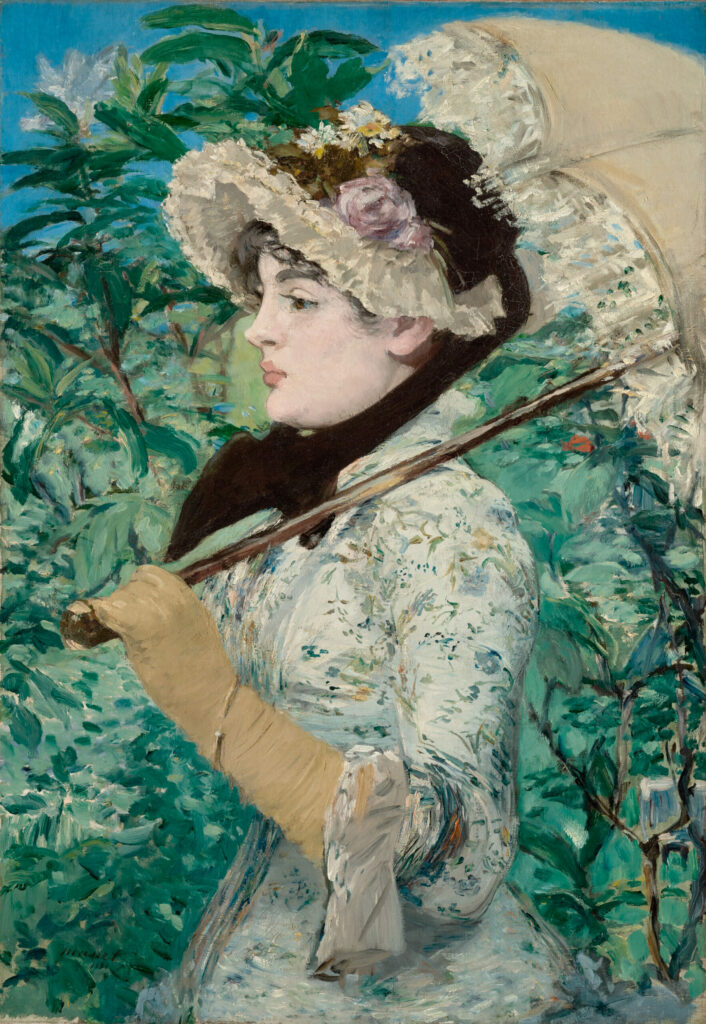
In this radiant artwork, Manet offers a striking vision of the modern Parisienne. His “Jeanne,” with her delicate profile, stands out against a vibrant background of spring greenery, creating a visual harmony of incomparable freshness.
The painter masterfully captures the lightness of the moment: a straw hat adorned with a rose, a dress with delicate floral patterns, yellow gloves, and a parasol held with grace. His brushwork, both spontaneous and controlled, conveys the very essence of seasonal renewal.
What particularly fascinates in this composition is the subtle tension between the codified elegance of the era and pictorial modernity. Jeanne Demarsy’s distant gaze evokes an enigmatic presence, while the play of light on her face reveals the contained sensuality of the Belle Époque. Manet abolishes the boundary between worldly portrait and seasonal allegory, transforming his model into a sublime incarnation of Parisian spring.
Additional Information
- Title: Jeanne (Spring)
- Artist: Édouard Manet
- Date: 1881
- Dimensions: 74 × 51.5 cm
- Location: The J. Paul Getty Museum, Los Angeles, Getty Center, West Museum Pavilion, Gallery W204
- https://www.getty.edu/art/collection/object/103QTZ
Édouard Manet (1832-1883), a pivotal figure between academic tradition and the Impressionist avant-garde, revolutionized the art of his time through his radical approach to painting. The enfant terrible of official Salons with works like “Le Déjeuner sur l’herbe” and “Olympia,” he always favored visual honesty over idealization.
“Jeanne,” painted in the final years of his life as illness was already weakening him, demonstrates a rediscovered lightness and reconciliation with the public. This painting, acclaimed at the 1882 Salon, marks the pinnacle of his art and the late recognition of a long-misunderstood genius who paved the way for modern painting.
Jeanne Demarsy and the Seasons Project
Jeanne (Spring) (1881) belongs to an ambitious project that Manet would not complete: a series of four paintings representing the Seasons, each embodied by a female figure. Only two canvases were realized, Spring and Autumn (1882). The model for Spring is Jeanne Demarsy, a young actress from the Théâtre du Vaudeville whom Manet had pose in a white-ruffled muslin dress, parasol in hand, among green foliage. Jeanne Demarsy wears a flower-trimmed hat and glances slightly to one side, in a pose that suggests allegory without freezing it into convention. The canvas (74 × 51.5 cm) is held at the J. Paul Getty Museum in Los Angeles. Manet showed Spring at the Salon of 1882, where it was well received, one of the rare public successes of his final years.
The Modernity of Allegory
What distinguishes Jeanne (Spring) from traditional allegorical representations of Spring is that Manet refuses mythological nudity and heavy symbolic attributes. His “Spring” is a contemporary Parisienne, dressed in current fashion, whose dress and hat are observed with the same attention as the flowers surrounding her. The allegory is present, the season embodied in a female figure, spring foliage in the background, but it is concealed beneath a representation of modern life that absorbs the iconographic code without making it explicit. This allegorical discretion is characteristic of Manet’s strategy: he engages with pictorial tradition while remaining firmly anchored in the present.
The Getty and American Recognition
Jeanne (Spring) is today one of the major works in the Getty Museum’s collection, an institution renowned for the exceptional quality of its 19th-century French paintings. The presence of this canvas in Los Angeles reflects the broader movement that, throughout the 20th century, led American institutions to assemble holdings comparable in richness to the great European museums. For Manet, whose showing at the Salon of 1882 was one of his last major public appearances before his death in April 1883, Jeanne (Spring) remains a defining work: the portrait of a modern woman in the light of a Parisian spring, painted by an artist who refused to age in style even when his body prevented him from doing otherwise.