Key Facts
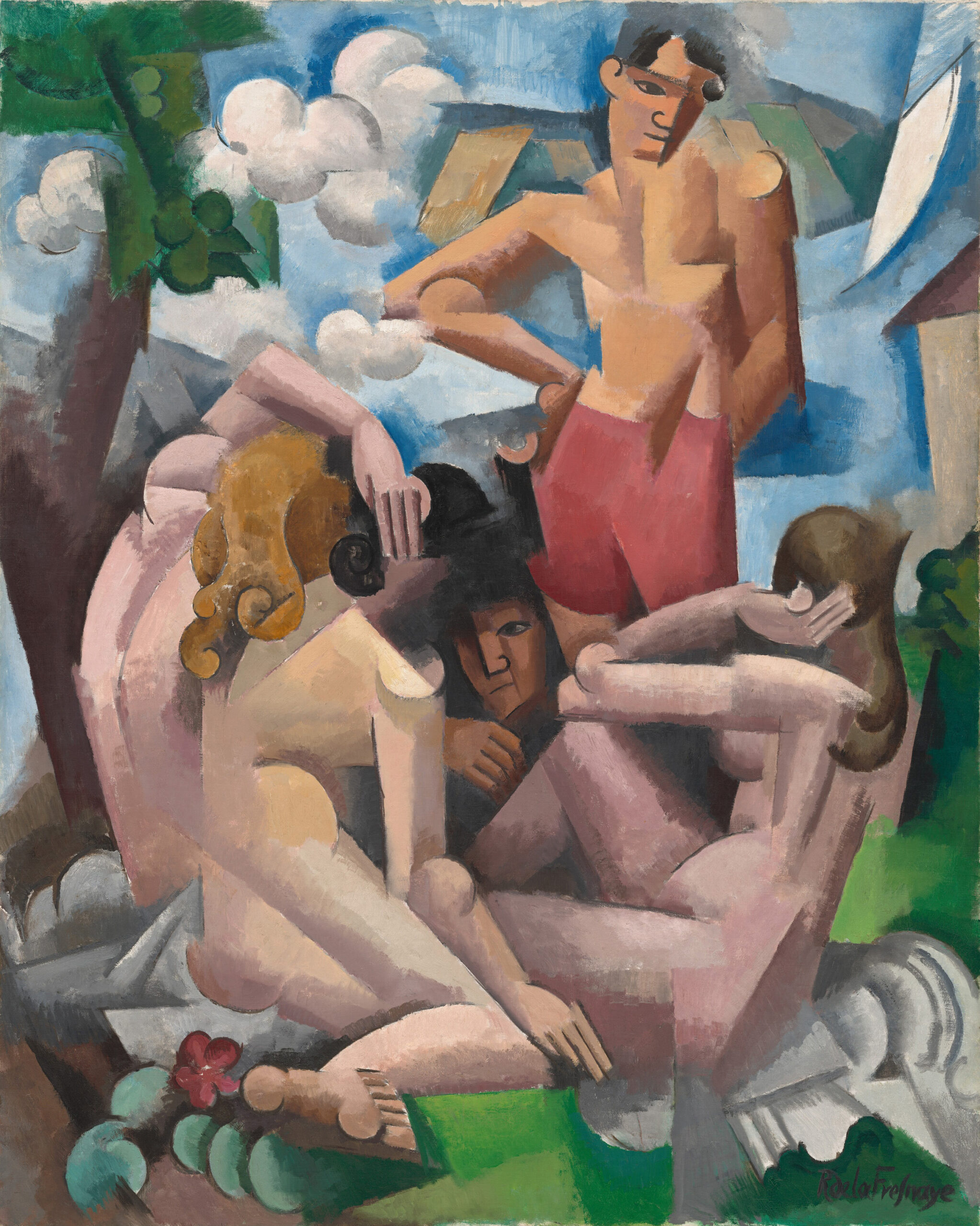
The Bathers is an oil on canvas painted in 1912 by Roger de La Fresnaye, now held at the National Gallery of Art in Washington. The work belongs to Cubism, the pictorial movement born at the turn of the twentieth century, of which La Fresnaye developed a personal, more colorful and more legible variant than that of Braque or Picasso. Trained under Maurice Denis and Paul Sérusier before joining the Puteaux group and the Section d’Or, the artist here builds a summer garden scene in which the figures are rendered through geometric planes. He died prematurely in 1925 at the age of forty, leaving a modest but singular body of work within Cubism.
This is the first time I have presented a work by Roger de La Fresnaye on Vmuseum. He is rarely encountered in collections or exhibitions, yet he interests me for more than one reason. First, because he studied under Maurice Denis and Sérusier at the Académie Ranson, two painters I hold in particular esteem. Second, because he died young, at forty, leaving behind a relatively small body of work: the illness he contracted during the First World War kept him from painting in his final years. But it is above all his personal brand of Cubism that moves me: a lively, colorful touch, yet softer and more legible than Braque’s or Picasso’s. The Bathers bears this out. We are looking at a light-hearted summer scene, in a wooded garden near a house whose gable is barely visible. Clouds and sky, foliage and figures, all rendered in this structured Cubism, blending rectangular and rounded forms.
A hand brushes against a blonde head of hair, barely detached from the arm supporting it. This tiny point of contact holds the whole canvas together. Around it, colors answer one another: the pink of skin, the red of a pair of shorts, the raw green of grass. You enter The Bathers through this small gesture, before the scene as a whole comes into focus.
The Bathers
Look at the construction. The bodies are not drawn so much as built. Every arm, every thigh becomes a plane, a facet cut as if with a knife. Roger de La Fresnaye painted this large-scale canvas in 1912, as the Puteaux group and the Section d’Or were in full ferment around him. His Cubism, however, keeps the figures legible. This bears no resemblance to the radical fragmentation of Braque or Picasso. A garden, bathers, a house whose gable can just be made out: the subject remains identifiable beneath the geometry. At 162 by 130 centimeters, the canvas asserts a strong physical presence. It belonged for many years to the Nathan Cummings Collection before entering the National Gallery of Art in Washington. The bather motif itself belongs to a long pictorial tradition. Cézanne, and a whole generation of painters, had taken it up before him. But where is the water? No pool, no river stands out clearly in the composition. La Fresnaye keeps the title of a bathing scene for a canvas that reads, above all, as a garden idyll. Summer shade and light are enough to sustain the illusion of the bath.
Roger de La Fresnaye and His Time
Roger de La Fresnaye was born in 1885 in Le Mans, into an aristocratic family. He studied at the Académie Julian, then at the École des Beaux-Arts, before joining the Académie Ranson in 1908. There, Maurice Denis and Paul Sérusier passed on to him the Nabi legacy. Around 1911, he turned to Cubism, joining the Puteaux circle alongside Gleizes, Metzinger, and Villon. He also exhibited at the Salon d’Automne and the Salon des Indépendants, as did many Cubists of his generation. The war broke this trajectory. Severely weakened, he painted less and less. He died in Grasse in 1925, at the age of forty. Roger de La Fresnaye left a modest yet distinctive place in the history of French Cubism.
In the News
In late August 2026, the National Gallery of Art announced that it had added roughly 190 works to its collection since March, spanning more than five centuries of artistic creation. Among them are the first painting by Ben Shahn to enter the collection, a major work by Wifredo Lam, and pieces by French Impressionist Marie Bracquemond and contemporary artist Christina Quarles. Museum director Kaywin Feldman said the new acquisitions offer “new points of entry into the practices of both established and lesser-known artists.” This ongoing activity confirms the National Gallery of Art’s active role, as the institution that holds La Fresnaye’s The Bathers, in continually expanding the artistic heritage available to the public.
Source: National Gallery of Art
A Question for You
What remains of Cézanne’s Bathers in this garden scene, painted twenty years later?
About This Work
- The Bathers
- Roger de La Fresnaye
- 1912
- Oil on canvas
- 162 x 130 cm (63 3/4 x 51 3/16 in.)
- National Gallery of Art, Washington, D.C.
- https://www.nga.gov/artworks/108617-bathers