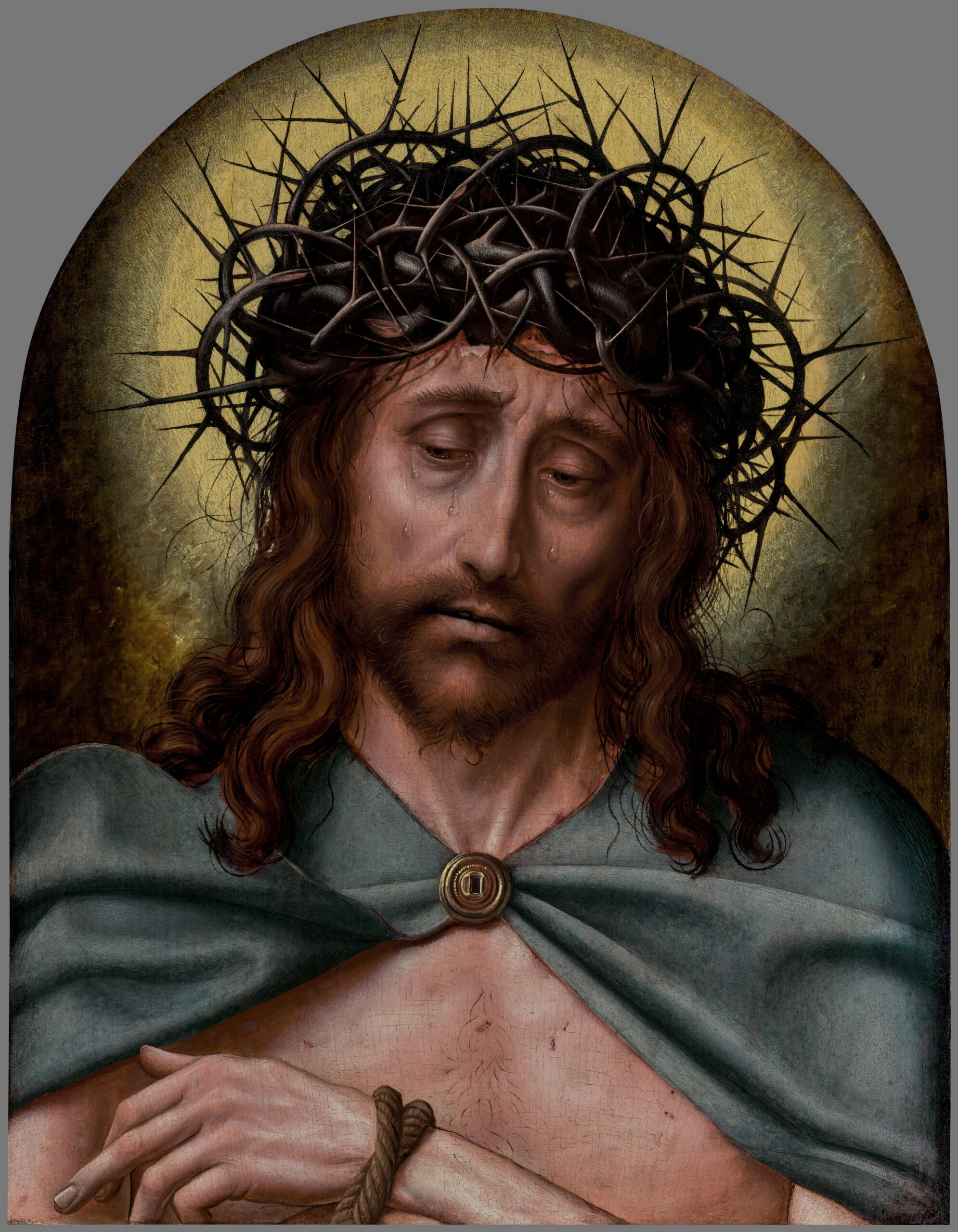
Antwerp, c. 1520. In his Flemish workshop, Quentin Metsys captures the most human instant of the divine. Christ weeps. No cross, no crowd — just a broken man, face to face with you.
What Your Eyes Discover
The face is haggard, the mouth slightly parted. Tears stream down pale cheeks. Notice the crown of thorns piercing the brow, thrown into sharp relief by the gilded luminous background. Blood traces furrows through auburn hair, along the neck, beneath a jewelled clasp. A gaunt wrist, bound with coarse rope, emerges from a grey-blue cloak. Every thorn, every tear, every rivulet of blood is rendered with an almost photographic intensity.
An Image of Devotion for Times of Crisis
In the early 16th century, Antwerp was the economic capital of Northern Europe — yet the Protestant Reformation was shaking consciences to their core. Confronted with religious doubt, the Man of Sorrows answered an urgent need: to make Christ tangible, vulnerable, human. This work is not narrative. It is contemplative. It is designed for an intimate, one-to-one encounter with redemptive suffering. Notice the subtle gesture of the left hand, perhaps directed toward an altar. The viewer is invited to step inside the scene.
Quentin Metsys, the Genius of Antwerp
Born c. 1466, Metsys founded the Antwerp school of painting. A blacksmith turned painter, according to legend, he fused the Flemish rigour of the Early Netherlandish masters with the Italian sensibility of Leonardo da Vinci. His precise draftsmanship and gift for pathos made him an undisputed master of Southern Netherlandish painting.
A Question for You
💭 Between the gilded background inherited from Byzantine icons and the tears painted with near-surgical precision, Metsys plays across two distinct time frames — which one catches your eye first?
About this work
- Christ as the Man of Sorrows
- Quentin Metsys
- c. 1520–1525
- Oil on panel
- 49.5 × 37 cm
- The J. Paul Getty Museum, Los Angeles
- https://www.getty.edu/art/collection/object/109P8R