Key facts
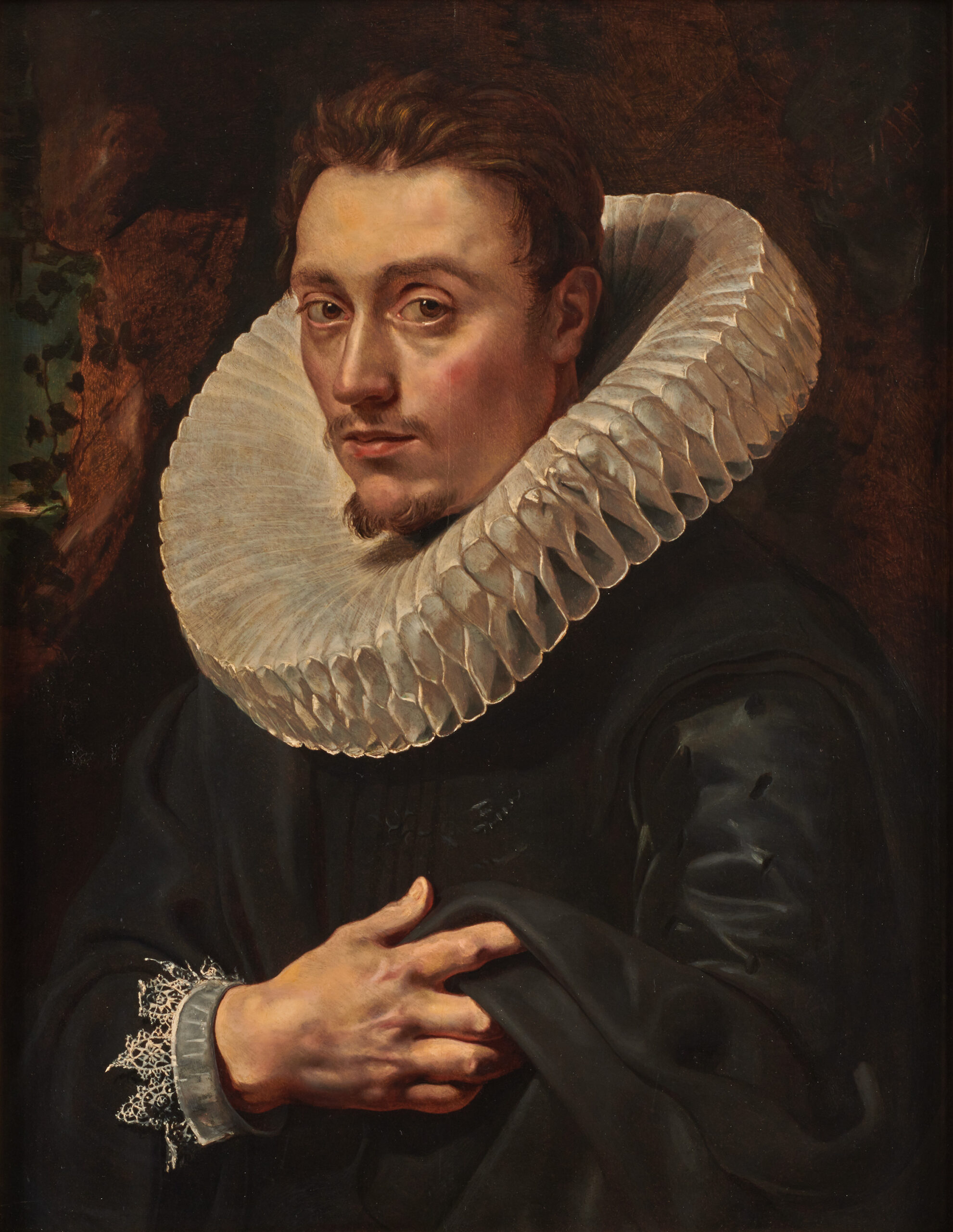
Portrait of a Young Man is an oil on panel painted by Peter Paul Rubens around 1613–1615 in Antwerp. The Flemish master of Baroque painting produced it a few years after his return from Italy. The sitter has not been identified. He wears a large white cartwheel ruff with tubular pleats, fashionable at the time, a black costume and lace cuffs. A rocky landscape covered with climbing foliage appears in the background. Portraits are relatively rare in Rubens’s output, which is dominated by large compositions. Since the gift of the Aso O. Tavitian collection in 2024, the painting has been held at the Clark Art Institute in Williamstown, in the United States.
To me, this is a very beautiful portrait of a young man by Rubens. What strikes me straight away when I look at it is the magnificent ruff around the sitter’s face. This white collar with its tight pleats was very fashionable in the early seventeenth century. Its sheer size leaves its mark on the painting, and it acts almost like a luminous platter presenting the face to the viewer. Rubens does not paint every fold meticulously: he suggests the material with a few touches of white and grey, and yet we can almost feel the lightness and stiffness of the starched fabric.
Everything is centred on this face and this ruff. The complexion is rendered with great softness, and the calm, direct gaze creates a real connection with whoever is looking at the painting. You have the feeling of standing before a real person rather than a mere formal likeness. The rest of the painting melts into a dark background, except for a hand resting on the arm, with a lace cuff. This detail echoes the ruff: the two light areas lead the eye from the face to the hand and give the portrait its balance.
What I particularly love here is the restraint. Rubens is often associated with grand Baroque compositions, full of movement and colour. This portrait shows another side of his talent: an intimate, restrained painting where everything rests on a few well-chosen elements. Altogether it is a portrait that is both elegant and alive, and I find it one of the artist’s most endearing works.
Look at the hand first. The thumb stretches across the black fabric. The other fingers grip the cloak and draw it against the chest. Right beside it, the lace cuff opens into small openwork patterns of an almost crystalline white. You can feel the weight of the cloth, the crispness of the linen, the warmth of the skin.
Beneath the surface: one ruff, two ways of painting
Now move up to the face. The pleated ruff forms a white wheel around the neck. Come closer: Rubens does not paint it in a single way. On the left, beneath the chin, the pleats are seen head-on. They become fine radiating streaks, laid down in thin, almost transparent layers. On the right, the pleats turn towards you. Each fold then receives its own modelling, with a ridge of thick white catching the light. One half suggests, the other sculpts. The support plays its part. On a smooth wooden panel, every touch of impasto keeps a crisp edge. The eye completes what the brush leaves unsaid, and the illusion works.
The light comes from the left. It gilds the forehead, flushes the cheekbone and lights two moist glints in the brown eyes. The moustache and goatee are made of a few fine, supple strokes. On the sleeve, the black satin gleams with touches of grey. The background is brushed in broad brown strokes, with no concern for finish. On the left, a rocky vista opens up, overgrown with climbing foliage. The Clark reads these as attributes of friendship and trust.
The ruff isolates the head as if on a ceremonial platter. It speaks of rank, of order, of the stiffness of starched fabric. The head half turns away. The gaze, however, comes back to find yours.
Finally, take in the whole picture. Three light areas are enough to build the painting: the face, the ruff, the hand. Everything else sinks into black and brown.
Peter Paul Rubens and his time
Rubens painted this panel around 1613–1615 in Antwerp. He had returned there a few years earlier, after more than a decade in Italy. The Flemish painter was then running a sought-after workshop and producing one large religious composition after another. In this spectacular Baroque output, portraits remain relatively rare. This one stands out for its economy of means: a bust, a hand, a dark background. We expect a Baroque painter to give us bodies in motion and dazzling colours. Here, all the energy flows into the lively fingers and the alertness of the gaze.
The sitter has not been identified. His black costume and ruff follow the fashion of the day. They indicate social rank without giving away a name.
The painting’s recent history is better known. The panel belonged to the collector Aso O. Tavitian. The Clark first exhibited it in 2011, in the exhibition Eye to Eye. In 2024, the Tavitian Foundation gave the museum 331 works, including this portrait. It is currently on view in the exhibition An Exquisite Eye, until 21 February 2027. Its catalogue entry can be consulted on the Clark Art Institute website. It will then move to the future Tavitian Wing, scheduled to open in 2028.
News: Rubens at 450 in 2027
In 2027, the art world will celebrate the 450th anniversary of the birth of Peter Paul Rubens (1577–1640). Antwerp will devote the whole year to him, with exhibitions, concerts and contemporary art projects. Among the highlights, the exhibition Rubens Meets (September 2027 to January 2028) will bring together Berlinde De Bruyckere, Tracey Emin and Luc Tuymans around his works in four Antwerp churches. From October 2027, the KMSKA will present Rubens and the World, devoted to the international influences on his art. Note, however, that the Rubens House will close for restoration during the anniversary year and will not reopen before 2030, although its renovated garden, library and the Rubens Experience will remain open. Earlier, in Vienna, the Liechtenstein Garden Palace will open the exhibition Peter Paul Rubens. In the Service of Freedom on 29 January 2027, running until the end of March. It will feature the Decius Mus cycle, eight paintings made in 1616–1617 and restored in a campaign launched in 2022. The cycle dates from barely two or three years after our Portrait of a Young Man.
Source: dhnet.be.
A question for you
Intimate Rubens or spectacular Rubens: which one do you prefer?
About this work
- Portrait of a Young Man
- Peter Paul Rubens (1577–1640)
- c. 1613–1615
- Oil on panel
- 66 × 52.1 cm (26 × 20 1/2 in.)
- Clark Art Institute, Williamstown (Massachusetts)
- gift of the Aso O. Tavitian Foundation (inv. 2025.1.49)