Key facts
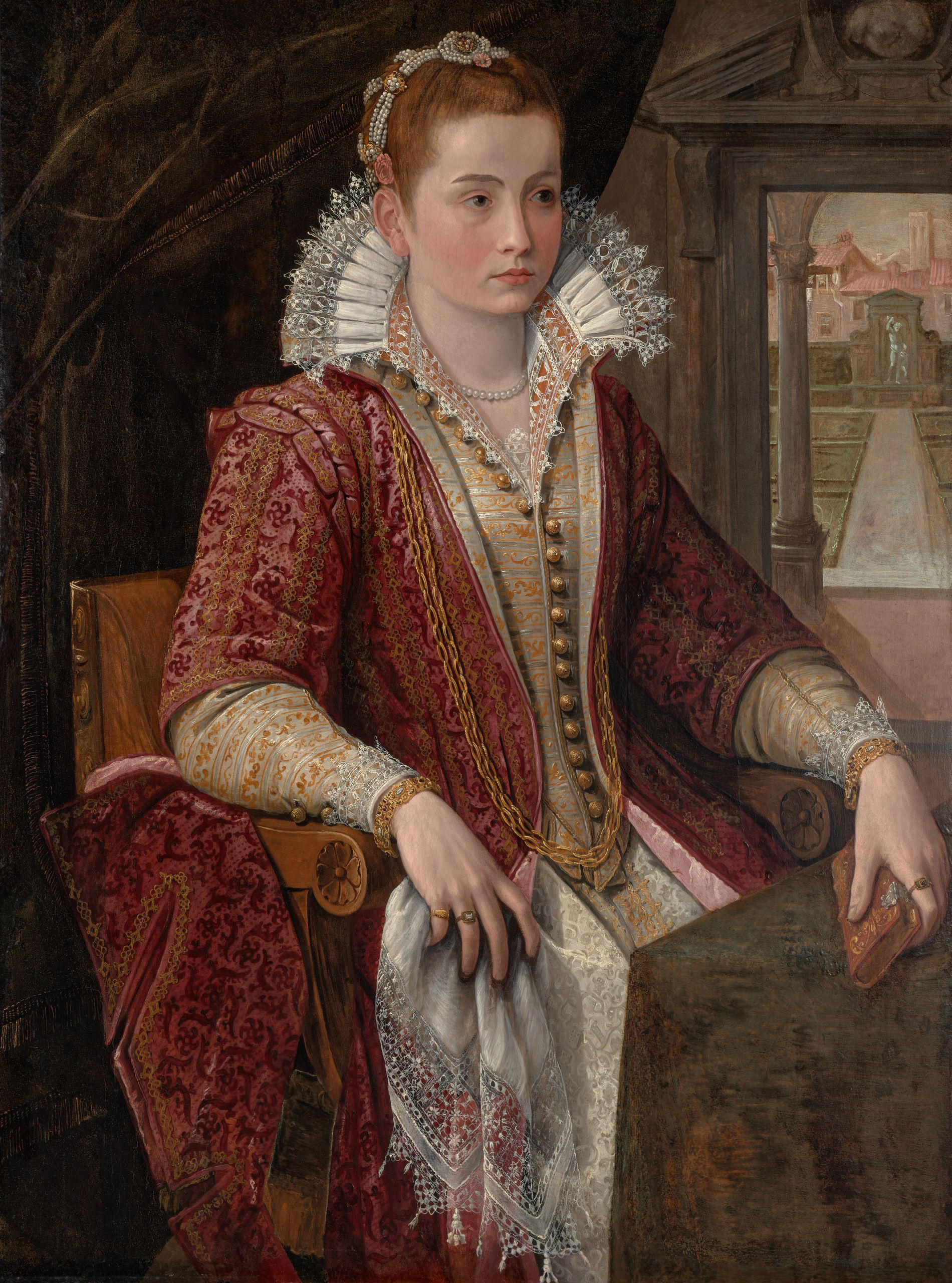
Held by the Baltimore Museum of Art, Portrait of a Young Lady is an oil on wood panel painted in Bologna around 1590–1600. The sitter remains anonymous. The painting, damaged over the course of its history, is attributed to Lavinia Fontana (1552–1614), a pioneer among professional women painters, or possibly to her father and teacher, Prospero Fontana. Long given to Paris Bordone, it entered the museum in 1938 through the bequest of Mary Frick Jacobs. Associated with Bolognese Mannerism, it depicts a learned woman, book in hand, dressed in gold embroidery and lace.
This is a truly beautiful portrait of a learned young woman from the late sixteenth century, and one of those that hold my attention the longest. Its attribution remains uncertain. The Baltimore Museum of Art leans toward Lavinia Fontana, while keeping open the possibility of her own father, Prospero Fontana, who was also her teacher. The painting’s history only deepens the mystery. In the nineteenth century, it was believed to be by Paris Bordone, and it was under that name that it was shown at the Royal Academy in London in 1871. It later joined the collection of Mary Frick Jacobs, who bequeathed it to the Baltimore museum in 1938. Part of the painting has also been damaged over time, which makes the specialists’ work even harder. Far from lessening my interest in it, all these mysteries only strengthen it.
What strikes me first is the richness of her attire. The gown is magnificent, embroidered all over in gold and finished with fine lace at the sleeves and an elaborate collar. I love knowing that this lace was probably made by women or girls from local orphanages or convents. Behind the luxury of the costume, a whole world of women’s work comes into view. Her hair is adorned with pearls, and she wears necklaces of pearls and gold. She holds a book in her hand, a sign of a thorough and refined education. This detail moves me in particular, because it shows a woman meant to be seen as cultivated, and not merely as beautiful. Behind her, an open door gives onto a distant garden and creates a vanishing point in the upper right that lets the composition breathe. To me, it is an emblematic expression of Bolognese art at the close of the sixteenth century. The fashion and setting also clearly tie the work to Bologna. Whether the brush was Lavinia’s or Prospero’s, it carries all the care the Fontana workshop took in painting the social standing and inner life of its sitters.
You are standing before a small book, almost nothing at all. It rests in a ringed hand, laid on a dark green table carpet. Its gilded edges catch the light. No one knows what words lie sleeping between its pages.
What Portrait of a Young Lady tells us
Look first at the other hand. It barely crumples a lace handkerchief, so fine that the pale skirt shows through beneath it. Rings follow one another along her fingers, gold and dark stones. Move up to the bust. A column of gold buttons closes the bodice, embroidered with arabesques. Over it, a crimson velvet mantle falls in heavy folds across the arm of the chair. A long double gold chain hangs down to her waist. At her neck, a single strand of pearls. Higher still, a lace collar rises like a corolla. Her red hair is threaded with pearls. The painter works in oil on a wood panel. This rigid support favors a smooth, meticulous touch. Notice how each stitch of lace can still be read, thread by thread. Yet the panel bears wounds. The composition has suffered, and the damage blurs the artist’s hand. The Baltimore Museum of Art’s catalogue entry says so plainly. On the right, an open door frames a garden with parterres, a statue, pink rooftops. The face remains pale and grave. Nothing smiles here. The splendor speaks; the young woman stays silent. Her gaze slides past you, never meeting yours.
What Lavinia Fontana’s era tells us
We are in Bologna, at the turn of the seventeenth century. The fashion and setting leave little doubt. At the time, the city supports women artists and patrons. The book speaks of education. The lace says something else. It was most likely made by the hands of women and girls from orphanages or convents. One woman’s luxury rests on the invisible labor of others. To take the measure of this portrait, stay in Baltimore. The Walters Art Museum holds a portrait by Lavinia Fontana painted around 1595, that of Ginevra Aldrovandi Hercolani. The widow of a Bolognese senator who died in 1593, Ginevra poses in mourning dress. Brocade, lace and pearls display the same rank. The vocabulary is identical, Bolognese Mannerism at its most refined. One difference changes everything. Ginevra has a name, a date, a recognized author. Our young woman has none of these. A woman may be painting a woman. Or it is her father, and everything shifts. Two museums in the same city answer each other. One offers certainties. The other keeps its questions.
Lavinia Fontana is born in Bologna in 1552. Her father, Prospero, trains her. In 1577, she marries Gian Paolo Zappi, who becomes her agent. She runs her own workshop and supports a family of eleven children. She also paints public altarpieces and female nudes, a first for a woman. She dies in Rome in 1614. Today her name returns to this panel, without definitive proof.
News: Lavinia Fontana rediscovered
Lavinia Fontana is at the center of a genuine revival of interest. In August 2026, the Nationalmuseum in Stockholm acquired a previously unknown work by the artist, The Mystic Marriage of Saint Catherine of Alexandria (1607). The altarpiece had been in an Italian private collection since the late nineteenth century. In Oslo, the Nasjonalmuseet is presenting the exhibition W̶o̶m̶a̶n̶ Painter from October 8, 2026 to February 7, 2027. It brings together 51 paintings by 19 women artists active in Northern Europe and Italy between 1550 and 1650, Fontana among them. Works by her father, Prospero Fontana, are also on display. The exhibition will then travel to the Galleria Borghese in Rome, from March 15 to May 30, 2027. The Baltimore Museum of Art, which holds this portrait, has also had a very busy 2026. Its exhibition Amy Sherald: American Sublime broke the attendance record for every exhibition the museum has presented in the twenty-first century. In March, it also opened a series of three exhibitions devoted to Matisse, the star artist of its celebrated Cone Collection.
Source: Nationalmuseum.
A question for you
If this portrait were painted today, what object would replace the book?
About this work
- Portrait of a Young Lady
- Lavinia Fontana (or Prospero Fontana, her father)
- c. 1590–1600
- Oil on wood panel
- 116.5 × 87.6 cm (45 7/8 × 34 1/2 in.)
- Baltimore Museum of Art
- The Mary Frick Jacobs Collection (inv. 1938.173)
- https://artbma.org/artwork/portrait-of-a-young-lady/