Key facts
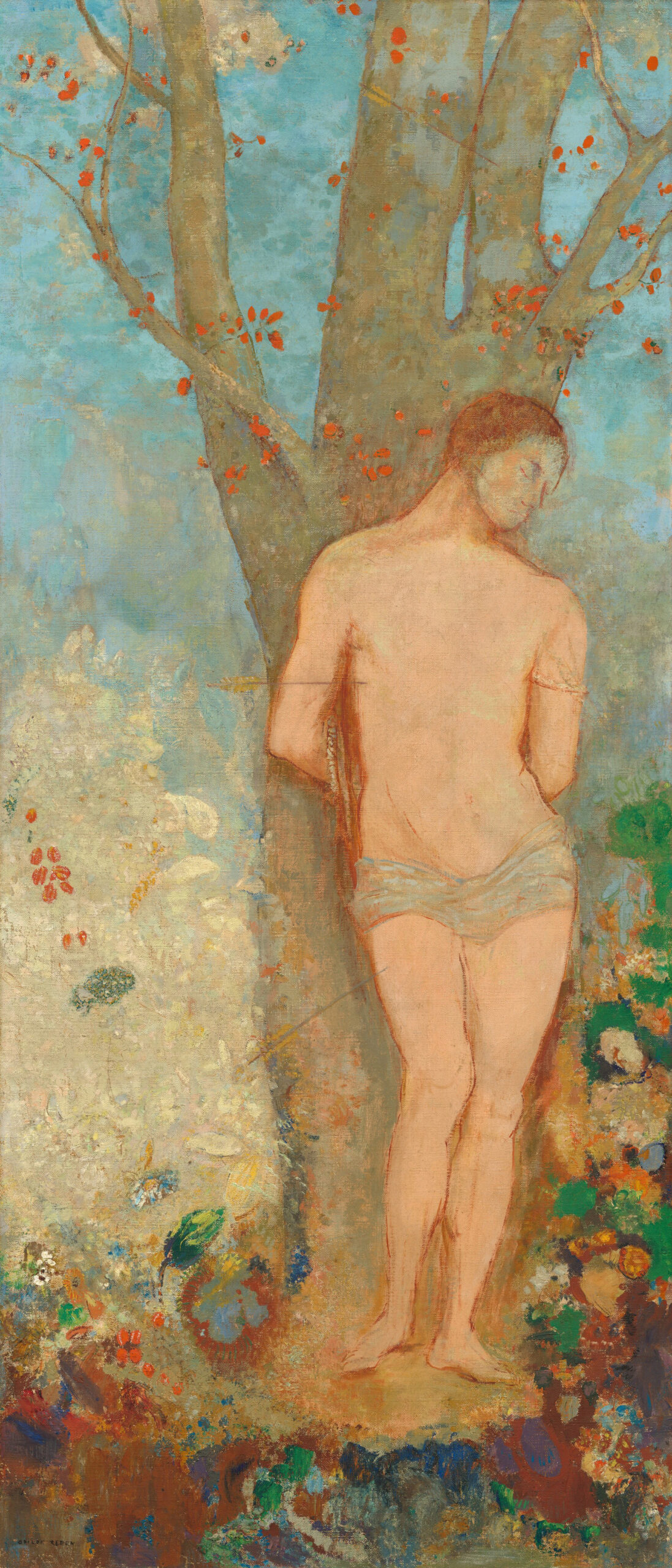
Painted between 1910 and 1912 by Odilon Redon (1840–1916), Saint Sebastian is held at the National Gallery of Art in Washington, thanks to the gift of the Chester Dale Collection in 1963. A leading figure of Symbolism, the Bordeaux-born painter depicts the martyr bound to a tree and pierced by slender arrows, set within a brightly coloured landscape. The painting belongs to the artist’s final period, devoted to colour after the “Noirs”, the charcoal drawings and lithographs of his early career. First owned by the Parisian collector Jules Chavasse, it was exhibited in New York as early as 1928, then at the Museum of Modern Art in 1947. The Musée des Beaux-Arts de Bordeaux holds another version of the subject, in pastel.
Saint Sebastian is one of the most frequently depicted saints in Western iconography. An officer of the Praetorian Guard who converted to Christianity, he is said to have been condemned under Emperor Diocletian, at the end of the 3rd century, to be shot with arrows. According to legend, he survived this first ordeal before finally being beaten to death. Yet since the Middle Ages, it is the image of the young man pierced by arrows that has prevailed, notably because he was invoked against the plague, whose blows the arrows symbolised. Renaissance painters, from Mantegna to Sodoma, made him the pretext for a battered body, riddled with arrows, where suffering is laid bare with almost anatomical precision.
Odilon Redon shows us the saint bound to the tree, but struck by only two arrows, very slender, almost like strokes of light. Sebastian seems barely touched by his wounds: no torn flesh, no face twisted in pain. That is precisely why I am so fond of this version. The tree he is tied to, the instrument of his torment, is painted with red leaves and surrounded by a flowering setting. It becomes a symbol of life and rebirth. To me, Redon does not paint the martyrdom but what it promises: the victory of the spirit over suffering. The very narrow, vertical format of the canvas, more than twice as tall as it is wide, heightens this sense of elevation and recalls altarpiece panels. Painted between 1910 and 1912, a few years before his death, the work belongs to the period when Redon, after his tormented “Noirs”, turned to colour and light. We sense an artist at peace, transforming a subject of violence into an almost serene vision. All of this enhances the hagiographic character of the work: more than a suffering man, it is already a saint we are contemplating.
Move closer to the saint’s right arm. An arrow passes through it, finer than a pencil line. Its golden feathers brush against the bark. Lower down, a second shaft runs diagonally towards the hip. You look for the wound. There is none. Not a drop of blood, no open flesh. The young man has closed his eyes. His head tilts towards his shoulder, like a sleeper’s. His hands are tied behind the trunk. Nothing cries out. Everything breathes. You are alone with him, and he does not see you.
Look closely at this Saint Sebastian
Now look at the paint itself. In places, the weave of the canvas shows through the colour. Redon lays down the oil in thin, almost rubbed layers. A reddish-brown line outlines the body, the knees, the ankles. It looks more like a heightened drawing than a painting. He learned this line in darkness. For years, he worked only in charcoal and lithography. These are his famous “Noirs”, peopled with monsters and apparitions. After 1900, he abandoned them. Colour then took over completely.
And what colour! The sky is turquoise, veiled with grey clouds. Red leaves dot the branches like embers. Below, the ground teems with greens, blues and oranges over a deep brown base. On the left opens a large white area, almost chalky. The saint’s skin wavers between pink and pale blue. A transparent cloth, the lightest of blues, wraps his hips. Look for the signature at the lower left: “ODILON REDON”, in small capitals, almost lost among the flowers.
The format matters too: 144 centimetres high by 62.5 wide. Your eye rises in spite of itself, from the bare feet to the treetop. Redon often painted lowered eyelids like these. The motif of closed eyes, drawn from religious painting, returns again and again in his work.
The title announces a torment. The canvas shows a garden. And yet the arrows are there.
Odilon Redon
Odilon Redon was born in Bordeaux in 1840 and died in Paris in 1916. A leading figure of Symbolism, he painted this Saint Sebastian at around seventy.
Now follow the painting’s journey. It first belonged to a Parisian collector, Jules Chavasse. The collection was dispersed at the Hôtel Drouot in June 1922. By 1928, the canvas was already on show in New York. In 1947, the Museum of Modern Art hung it in an exhibition on Symbolism in painting. A museum of modern art for a Roman martyr: the pairing is surprising. The collector Chester Dale bought it in 1950. He gave it to the National Gallery of Art in 1963.
News: 110 years since Redon’s death
2026 marks the 110th anniversary of Odilon Redon’s death, celebrated around the world. After the “Monet and Redon” pairing at the Mitsubishi Ichigokan Museum in Tokyo and the exhibition “Odilon Redon: Otherworldly Visions” at the Getty Center in Los Angeles (July–October 2026), The Museum of Fine Arts, Gifu, home to one of the world’s most important Redon collections, is showing “Redon and KOMAI Tetsuro” until 20 December. Of note for French readers: the Musée des Beaux-Arts de Bordeaux, in the artist’s hometown, also holds a Saint Sebastian by Redon, this time a pastel on paper, which invites further comparison.
Source: MusBA.
A question for you
How many arrows can you count? Look carefully, some of them are hiding.
About this work
- Saint Sebastian
- Odilon Redon
- 1910–1912
- Oil on canvas
- 144 x 62.5 cm (56 11/16 x 24 5/8 in.)
- National Gallery of Art, Washington D.C. (Chester Dale Collection, 1963.10.57)
- https://www.nga.gov/artworks/46532-saint-sebastian