Key facts
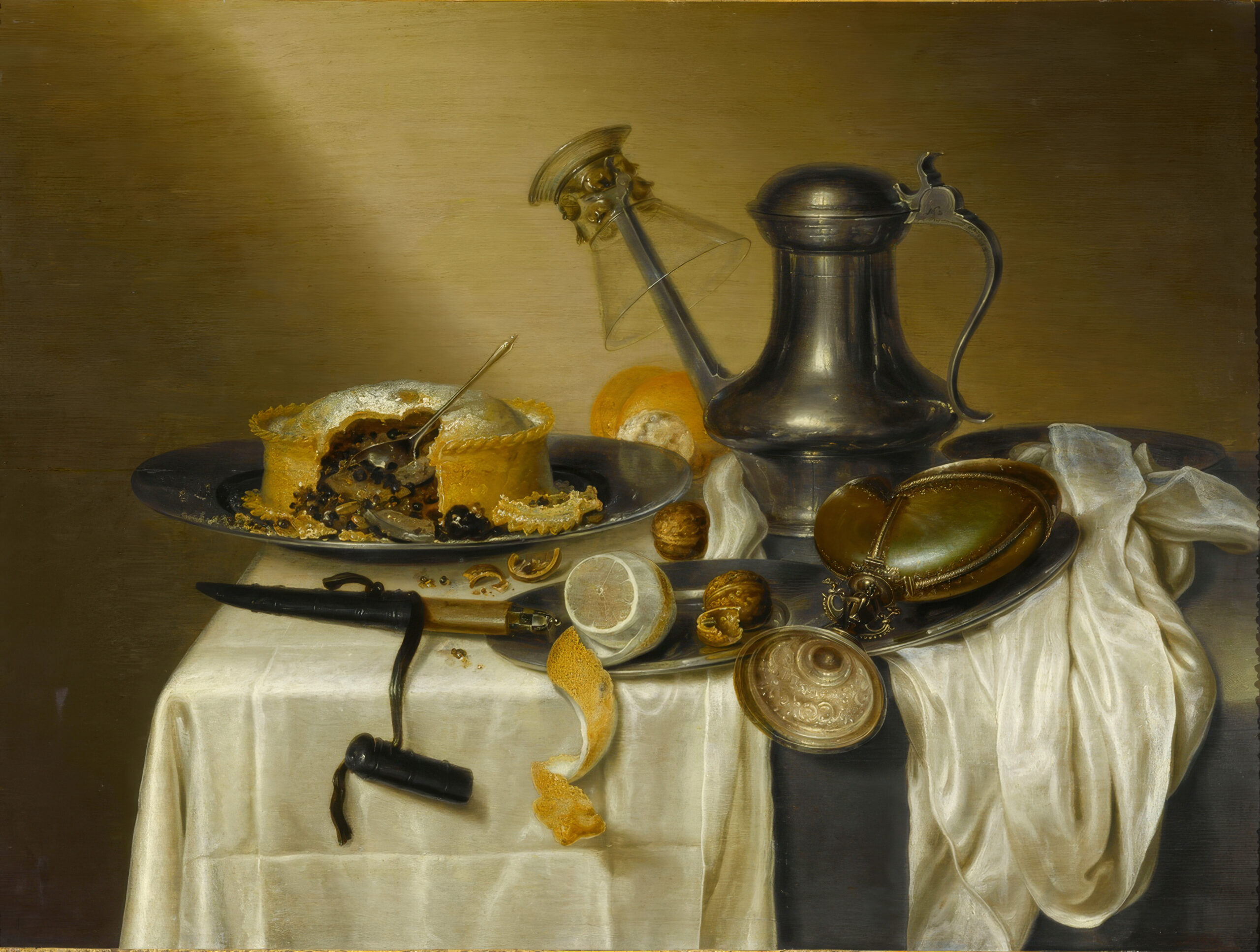
Painted in 1644, Still Life with Truffle Pie is an oil on panel by Maerten Boelema de Stomme, held at the Musée d’Arts de Nantes. It belongs to the monochrome still life, or banketje, a genre that emerged in Haarlem in the early seventeenth century and is associated with the Dutch Golden Age. The artist, active for only a few years in the middle of the century and close to Willem Claesz Heda, brings to it a meticulous rendering of surfaces: pewter, glass, nautilus nacre and a linen cloth. The painting is representative of his output and reflects the Northern taste for laid tables, poised between a celebration of mercantile luxury and a quiet reminder of vanitas.
Here is a truly fine still life. I must have been a little hungry the day I came across it in the collections of the Musée d’Arts de Nantes… Its author, Maerten Boelema de Stomme, remains little known and sparsely documented, and yet the work hits home. I find it strikingly lifelike: you can almost catch the aroma of the truffle pie in its crust. Everything is a matter of substance and light, the pewter and silver catching the glints, the white cloth whose folds artfully gather the brightness. I love these appetising still lifes, a plain celebration of the refined art of the table.
Look first at the spoon driven straight into the crust. The pie is broken open. Its dark filling spills onto the pewter. All around, luxury unfolds. A half-peeled lemon. Its spiral of rind left hanging. Has the meal only just ended?
What the surface conceals
Boelema de Stomme works in oil on panel. His palette narrows to ochres, greys and browns. This is what we call a monochrome still life, or banketje. The genre arises in Haarlem in the 1620s. Look at the handling of materials. Pewter drinks in the light. Glass lets it pass through. The white cloth holds it fast in its broken folds. Each object answers a single challenge: to render a surface. The peeled lemon slips in a sharper note. Beneath a table laid for pleasure, the motif of Dutch vanitas comes to the surface.
Maerten Boelema de Stomme and his time
Little is known of Boelema de Stomme. His byname, “de Stomme,” means “the Mute.” Tradition holds that he was deaf and mute. He works in Haarlem, in the wake of Willem Claesz Heda. His career spans only a few years, in the mid-seventeenth century. Few signed paintings survive. The one in Nantes, dated 1644, ranks among the most accomplished. A silent painter, a painting that whets the appetite.
Currently on view at the Musée d’Arts de Nantes
Worth knowing as you plan your visit: the Musée d’Arts de Nantes displays this Still Life with Truffle Pie in its permanent collections of early art, which hold more than 14,000 works spanning nine centuries. In summer (July-August 2026), the museum is open every day except Tuesday, with a late opening on Thursday from 7 to 9 p.m. (free admission) ; a good occasion to discover the Northern masters along the way.
Source: Musée d’Arts de Nantes
A question for you
💭 Where does the banketje end, in praise of Dutch luxury, and where does vanitas begin, a reminder of its fragility?
About this work
- Still Life with Truffle Pie
- Maerten Boelema de Stomme
- 1644
- Oil on panel
- 60.3 × 79.4 cm
- Musée d’Arts de Nantes
- https://www.navigart.fr/museedartsdenantes/artwork/boelema-de-stomme-nature-morte-au-pate-truffe-110000000006266