This Parisian spring, I wanted to bring you flowers. The season is bursting with colour, carrying that freshness and those scents that brighten the days. I perfectly understand the desire that seventeenth-century Flemish art lovers had to hang such bouquets on their walls, to keep their presence throughout the year.
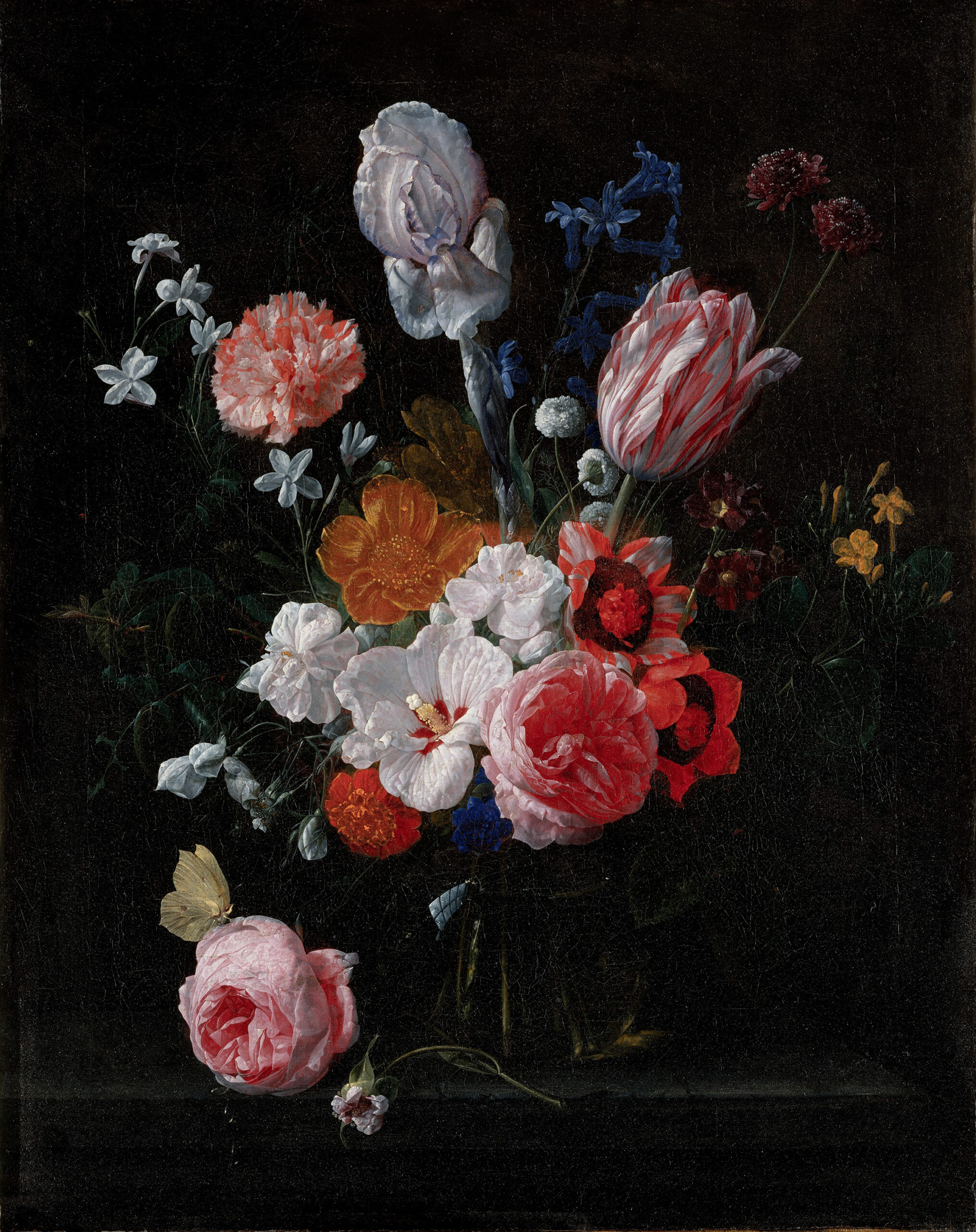
For that is precisely one of the secrets of these floral still lifes: Van Veerendael would gather on a single canvas flowers that never bloom together in nature, drawn from different seasons. An impossible bouquet, and therefore an eternal one.
But before we leave this painting, did you notice the reflection of a window on the crystal vase?That small miracle of painting, so discreet, says everything about the care and virtuosity of the artist. Enough to make our day.
Your eye stops first on the red-and-white striped tulip. It reigns, proud, at the heart of the bouquet. Then comes the lavender iris, the Dutch rose, the coral carnation. A butterfly has settled in the lower left. It seems in no hurry.
What lies beneath the surface
Against a background of near-black darkness, Nicolaes van Veerendael orchestrates an explosion of light. The touch is precise, meticulous. Every petal catches the light differently. Look at the crystal vase: a window reflection is painted there with absolute discretion. That is where the virtuosity resides. The composition brings together flowers from different seasons, spring iris, summer rose, autumn anemone. This bouquet never existed in nature. That is its power. The oil on canvas, a modest format (49.5 × 40.3 cm), concentrates a breathtaking botanical density. Every species is identifiable. This is painting in the service of living things.
Van Veerendael and the great Flemish tradition
Born in Antwerp in 1640, Nicolaes van Veerendael entered the Guild of Saint Luke at seventeen. He trained in the shadow of two giants: Daniel Seghers for compositional rigour, and Jan Davidsz de Heem for naturalistic fineness of observation. This 1662 canvas is an early work, and it already bears the double signature of his masters: the Flemish tradition of Jan Brueghel the Elder and the Dutch precision of De Heem. Van Veerendael produced little. He lived modestly. But every canvas counts.
📍 At The Met
The Bouquet of Flowers is held at the Metropolitan Museum of Art in New York. This spring 2026, the Met is at the centre of the art world with Raphael: Sublime Poetry (until 28 June 2026), the first major American exhibition devoted to the Renaissance master, a reminder that this museum remains the global benchmark for Old Master painting, Flemish art included.
Source: metmuseum.org/exhibitions/raphael-sublime-poetry
A question for you
💭 The butterfly resting on the rose, lower left, a simple decorative detail, or a hidden message about the fragility of all beauty?
About this work
- A Bouquet of Flowers in a Crystal Vase
- Nicolaes van Veerendael
- 1662
- Oil on canvas
- 19½ × 15⅞ in. (49.5 × 40.3 cm)
- The Metropolitan Museum of Art, New York
- https://www.metmuseum.org/art/collection/search/437867
The Impossible Bouquet and Its Symbolic Logic
This “impossible and therefore eternal bouquet” is a convention of 17th-century Flemish flower painting, responding to a logic that is at once practical and symbolic. Practical: the painter composes freely from drawings and studies accumulated across the seasons. Symbolic: by assembling flowers from every season, the bouquet escapes time and achieves a form of permanence that nature, in reality, denies to each individual flower. Veerendael is one of the most refined practitioners of this Antwerp tradition of flower bouquets, formed in the heritage of Daniel Seghers and Jan Davidsz. de Heem.
The Virtuosity of Glass and Reflection
A discreet detail reveals Veerendael’s technical mastery: on the wall of the crystal vase, a window is reflected, its lead lattice and the white light of the exterior barely visible. This reflection, invisible at first glance, perceptible on closer examination, is the silent signature of a painter who knows the laws of optics by heart and chooses to represent them with discretion rather than ostentation. It is also proof that the painting does not depict a generic bouquet but a specific object, situated in a specific space, at a specific moment of the day, even if the flowers themselves come from everywhere and nowhere. A butterfly resting in the lower left corner recalls the fragility and fleeting beauty of all these blooms gathered outside of time.