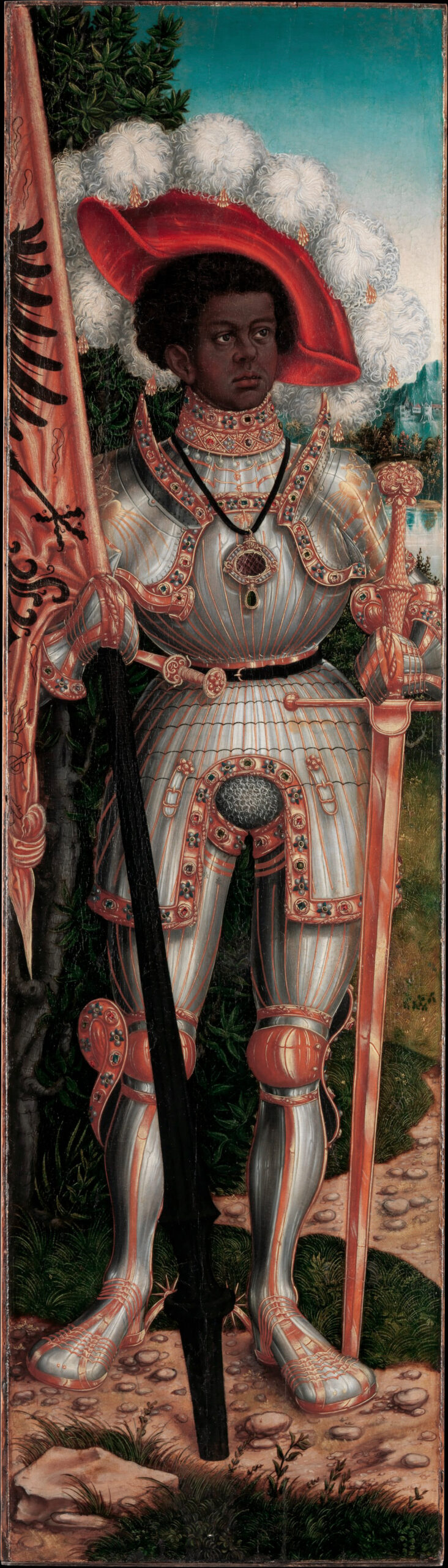
C. 1520. In Cranach’s workshop, a black knight in armour comes to life on a panel of linden wood.
He stands upright, motionless, sovereign. His gaze is grave, slightly averted. To his left, a heraldic banner. To his right, a gilded sword. Saint Maurice fills the entire space, from the rocky ground to the turquoise sky.
Armour as goldsmith’s work
The armour is the true subject. Cranach paints it with a jeweller’s precision: silver lames streaked with rose, gem-set buckles, chiselled gorget. The white and red plume of the helmet bursts into a generous bouquet. The saint’s dark complexion cuts sharply against the metallic brilliance of polished steel. The technique allows for those luminous glazes so characteristic of the German Renaissance.
An African saint at the heart of the Empire
Maurice, a Roman officer from North Africa, was martyred c. 280 AD for refusing to massacre Christians. His representation as a Black man first appears in Germany in the 13th century, under the influence of Emperor Frederick II, whose cosmopolitan court included Black soldiers and advisors. Cranach most likely worked from no living model: he drew inspiration from the famous reliquary statue of Saint Maurice preserved in the Dominican church at Halle.
Lucas Cranach the Elder
Lucas Cranach the Elder (1472–1553) is a major figure of the Northern Renaissance. Court painter to the Electors of Saxony and a close friend of Luther, he excelled in official portraiture, mythological scenes, and religious subjects. His highly productive workshop disseminated an elegant, instantly recognisable style — elongated silhouettes, vivid colours.
Think about it
💭 Between official portrait and sacred figure, this work blurs the boundaries of pictorial genre. Look at it again — do you see a saint, or a prince?
About this work
- Saint Maurice
- Lucas Cranach the Elder and workshop
- c. 1520–1525
- Oil on linden
- 137.2 × 39.4 cm (54 x 15 1/2 in.)
- The Metropolitan Museum of Art (MET), New York
- https://www.metmuseum.org/art/collection/search/439081