The Hague, early 18th century. Jan Van Huysum receives a prestigious commission: to paint fruit with the precision of a jeweler. On a smooth copper plate, he composes a vegetal symphony where every detail matters.
A Living Still Life
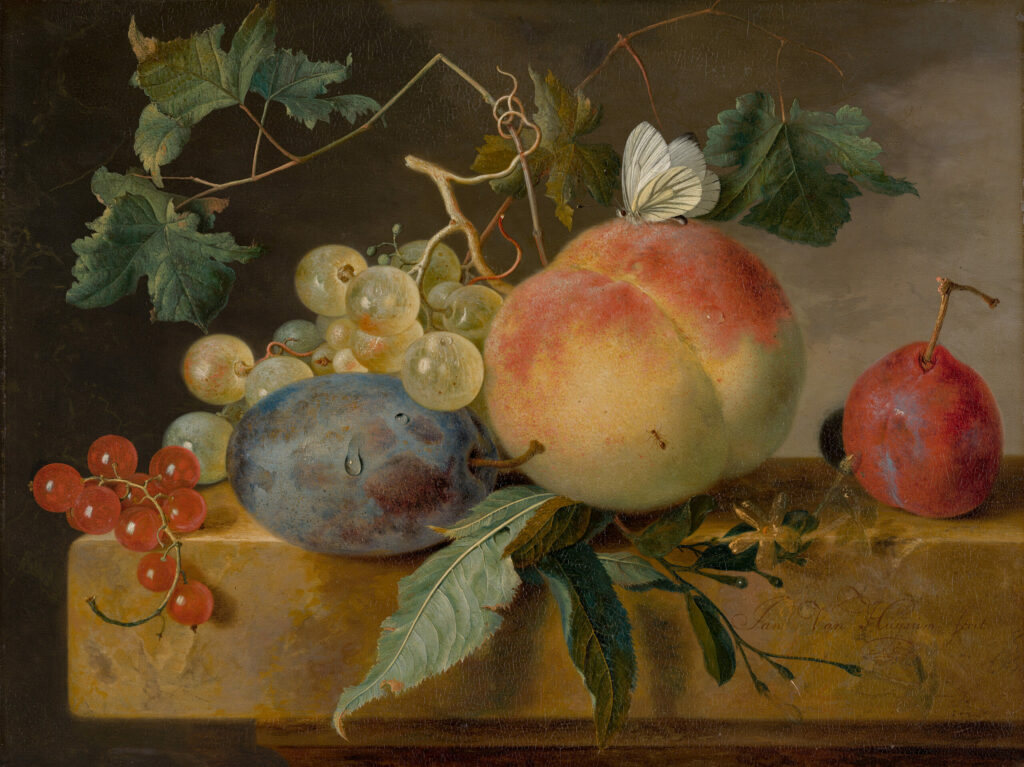
Look at this marble table: plum with bluish reflections, translucent grapes that seem saturated with light, scarlet berries. At the center, a monumental peach displays its pink-orange tones. Van Huysum works oil on copper, an ideal surface for capturing the velvety texture of the fruit’s skin. A white butterfly delicately alights upon it. A tiny ant climbs on the downy flesh. These insects are not there by chance: they remind us of the fragility of all life. Vine leaves wind elegantly, their veins rendered with botanical meticulousness.
The Golden Age of Dutch Still Life
In the 18th century, Amsterdam dominates world trade. Wealthy merchants commission paintings celebrating abundance and refinement. Van Huysum responds to this demand with unequaled expertise. This work initially forms part of a diptych with a floral still life of identical dimensions. The two panels, painted on copper, were intended to adorn a cabinet of curiosities. The small format (21 x 27 cm) invites an intimate, almost meditative contemplation.
Jan Van Huysum, Master of Details
Jan Van Huysum (1682-1749) reigns over Dutch still life painting. He perfects each painting over months, sometimes waiting for a specific flower to be in season before adding it. His obsession with detail and his asymmetrical compositions revolutionize the genre. The Mauritshuis carefully preserves this testament to his genius.
Think about it
💭 What story do these fruits tell about our relationship with time, ephemeral beauty, and simple pleasures?
About This Work
- Still Life with Fruit
- Jan Van Huysum
- 18th century
- Oil on copper
- 21 x 27 cm
- Mauritshuis, The Hague
- https://www.mauritshuis.nl/fr/decouvrir-la-collection/oeuvres-d-art/70-fruit-still-life