Key facts
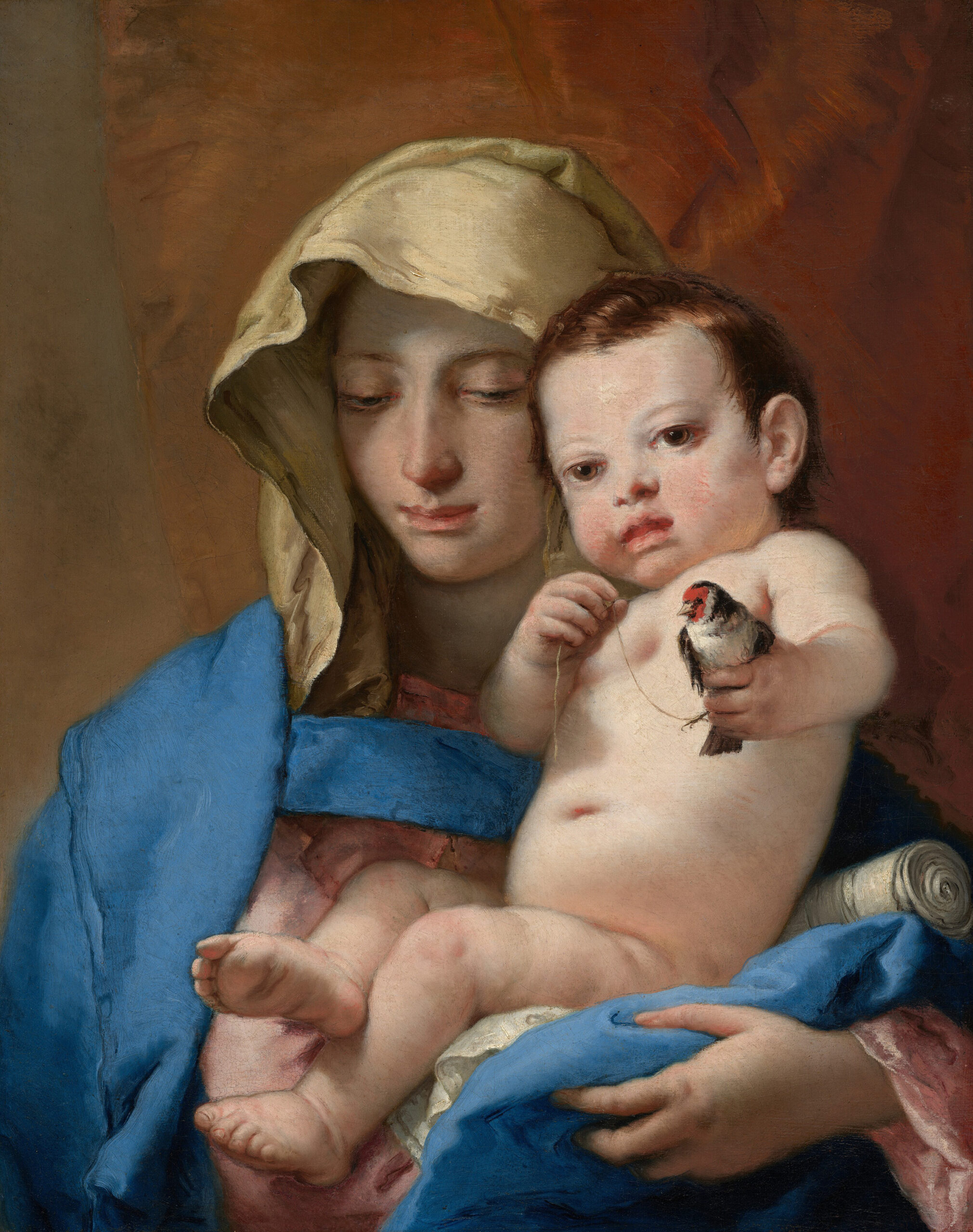
Madonna of the Goldfinch is an oil on canvas painted around 1767–1770 by the Venetian artist Giambattista Tiepolo (1696–1770), a leading figure of the Rococo. It dates from the painter’s final years, spent in Madrid in the service of King Charles III from 1762 onward. The painting shows the Virgin and Child at half-length. The Child holds a goldfinch tethered by a string, a bird that Christian tradition associates with the Passion of Christ. Its small format contrasts with the large fresco decorations that made Tiepolo’s reputation and suggests it was intended for private use. The painting has been in the collection of the National Gallery of Art in Washington since 1997, a gift of The Brown Foundation.
This Virgin and Child caught my eye. It is an inexhaustible theme in art history, and yet Tiepolo still manages to make it new. He takes it on here with complete mastery of his craft, at the end of his life, while working in Madrid. He depicts the Virgin at half-length, facing the viewer, holding the Christ Child in her arms. The Child, chubby, with copper-red hair, holds a goldfinch tethered at the foot by a fine little chain. I like the idea that this small captive bird might symbolize a child’s education and the shaping of character: the child learns to hold on without smothering, to care for something more fragile than himself. But the goldfinch also carries a more solemn meaning. It was said to feed among thistles and to have stained itself red while pulling a thorn from Christ’s crown. In the Child’s hands, it already foreshadows the Passion. I find this faint shadow over such a tender scene deeply moving. The motif of the child with a bird runs throughout art history, for example in Rubens’s Child with a Bird, or of course in Raphael’s famous Madonna of the Goldfinch. That said, what I love most here is the simplicity of the scene. No angels, no clouds, no grand setting like the spectacular ceilings that made Tiepolo famous. Mary is simply dressed in an azure-blue mantle over a pink robe, with an ecru veil on her head, before a plain golden-brown curtain. The painting’s small size (62 × 49.5 cm) invites intimate contemplation, almost private prayer. It feels as though the great fresco painter wanted, for once, to speak softly.
You are standing before a thread. A pale line, barely thicker than a hair, stretched between a child’s fingers and a bird’s foot. The whole painting hangs on this fragile line. Come closer.
What this Madonna of the Goldfinch tells us
Look first at the light. It glides over Mary’s veil, a cream-colored silk with an almost metallic sheen. The Virgin’s face stays in soft shadow. Her eyelids are lowered. The Child does not look at her. His gaze is elsewhere, solemn, his lips parted. His left hand clutches the red-masked goldfinch. His right hand pinches the string that holds it.
Then follow the colors. The azure blue of the mantle, the pink of the robe, the cream of the veil: three bright notes against a warm background. Mary’s hands support the Child without gripping him. Her fingers barely sink into the blue. Everything is tender, except that small, serious face.
Now look closely at the surface of this oil on canvas. The blue mantle is laid in with broad brushstrokes, the handling left visible. The reddish-brown background vibrates with quick streaks. The flesh, by contrast, is modeled more smoothly, rosy at the cheeks and knees. Against the Child’s hip, a rolled cloth catches a final flash of white. This is the quick hand of the ceiling painter, brought down to eye level.
What Tiepolo’s era tells us
We are in Madrid, in the late 1760s. Tiepolo has lived here since 1762, summoned by Charles III to paint the ceilings of the Royal Palace. He was sixty-six when he arrived. His sons Domenico and Lorenzo assist him. Around him, taste is changing. Neoclassicism, championed at court by Anton Raphael Mengs, is gaining ground over the exuberance of the Rococo.
The contrast in scale is striking. At the Royal Palace, Tiepolo paints the vast ceiling of the Throne Room. Here, the canvas is just 62 centimeters high. Such a format calls for private devotion, far from the ceremonies of court.
The symbol, for its part, has deep roots. According to Christian legend, the goldfinch stained itself with blood while pulling a thorn from Christ’s crown. The tethered bird is not Tiepolo’s invention. The motif recurs throughout art history.
Giambattista Tiepolo is born in Venice in 1696. He becomes the great decorator of Rococo Europe, from Venice to the grand staircase of the Würzburg Residence. He dies in Madrid on March 27, 1770, without ever seeing his lagoon again.
News: Giandomenico Tiepolo in Vicenza
In Italy, the spotlight is on the son of Giovanni Battista Tiepolo. From October 9, 2026, to January 17, 2027, the Gallerie d’Italia in Vicenza is devoting a major exhibition to Giandomenico Tiepolo for the tercentenary of his birth. It brings together 68 works, from the years when he assisted his father on major decorative projects to the works of his full maturity, including the Mondo Novo on loan from the Museo del Prado. It is a fine opportunity to rediscover the family workshop, which had followed Giambattista to Madrid, where he painted this Madonna of the Goldfinch in his final years.
Source: Intesa Sanpaolo.
A question for you
Raphael, Rubens, Tiepolo: which child with a bird do you prefer?
About this work
- Madonna of the Goldfinch
- Giovanni Battista Tiepolo
- c. 1767–1770
- Oil on canvas
- 62 × 49.5 cm
- National Gallery of Art, Washington, D.C.
- https://www.nga.gov/artworks/101678-madonna-goldfinch