Key facts
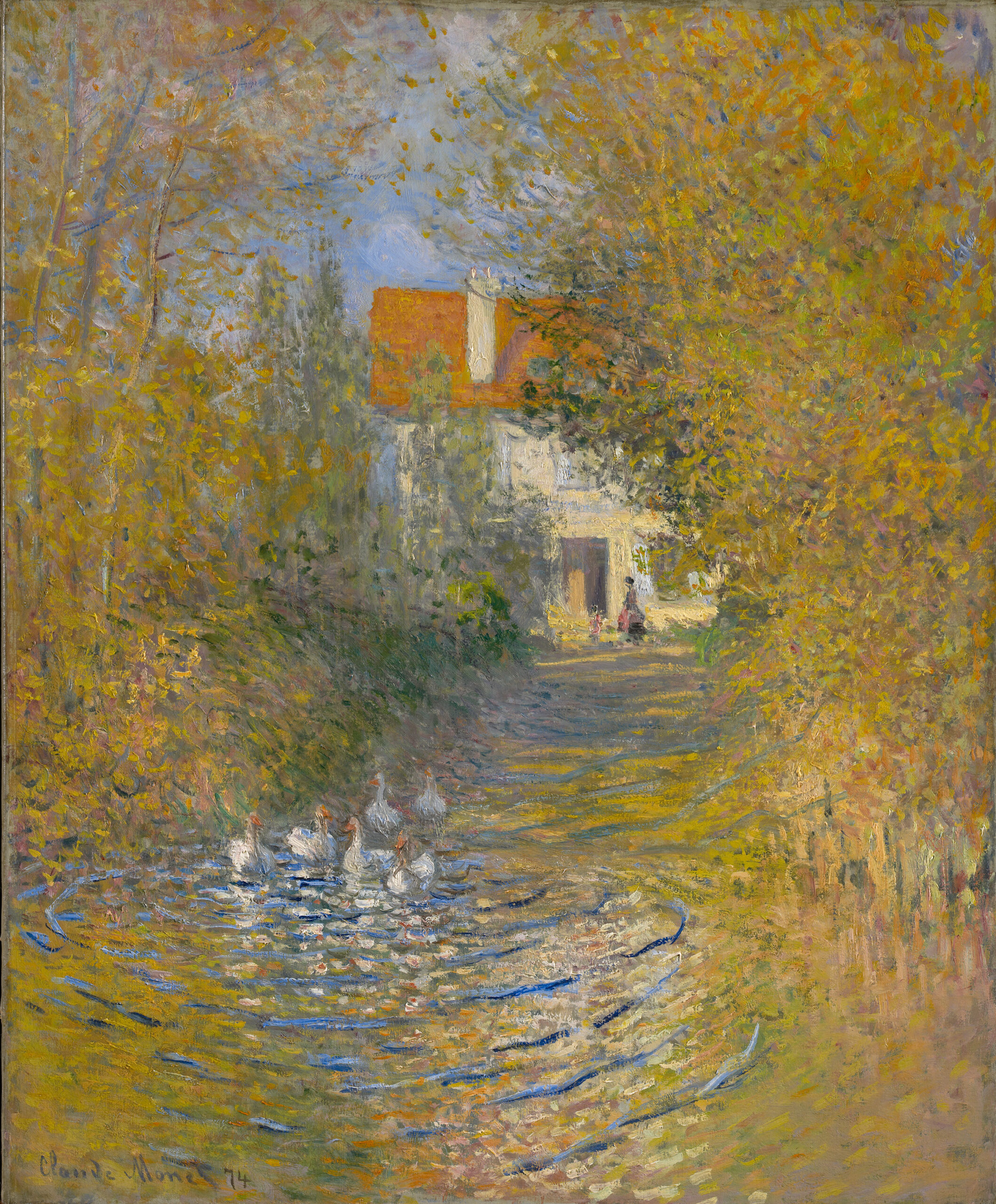
Painted in 1874 by Claude Monet, The Geese belongs to the early days of Impressionism, a movement of which the artist was one of the founding figures. The canvas depicts an autumn grove where several geese glide across a pond, before a path leading to a secluded house. Made a few months after the first Impressionist exhibition of 1874, it exemplifies Monet’s experimental technique: thick strokes, juxtaposed colours, and the dissolution of contours in favour of light. Its vertical format and tightly framed composition, both less usual in his output, make it a milestone in his pictorial research. The work is held at the Clark Art Institute in Williamstown, Massachusetts.
Another Monet! Yes indeed: I came across this one while browsing the collections of the Clark Art Institute, and I could not resist sharing it with you. What struck me at once was the density of the paint and the near-monochrome character of the canvas. I see in it a foreshadowing of the Cathedrals: the same tight framing, the same palette pared down to a few shades, straining towards a precise moment of light. Here, the scene is a wooded grove. The geese float on the pond, and the narrow perspective opens far off onto a house and two barely distinct figures. It is this thickness of the pigment that I love, which makes palpable a rural scene at once peaceful and alive. I would go so far as to say one hears the rustling of the leaves and feels the softness of the sun filtering through the trees.
Look
Come closer. The paint is thick, unctuous, laid down in tight commas. In the foreground, the water ripples in streaks of blue and white. Geese glide across it, pale flecks on the dark mirror. Their wakes crease the surface. All around, the autumn foliage blazes. Golds, yellows and touches of orange jostle across the whole canvas. A path climbs towards the background. There stands a whitewashed house, a roof of red tiles, a dark doorway. Two tiny figures can be made out, a woman, a child. Sunlight falls in warm pools along the path. The sky, high above, scarcely breaks through the branches.
Understand
Claude Monet paints The Geese in 1874. A few months earlier, in April, the first Impressionist exhibition was held. The painter shows his canvases there alongside Renoir, Degas and Pissarro. Critics mock this painting they judge unfinished. The word Impressionism is in fact born of a jibe. Monet, for his part, pursues his quest without wavering. He seeks to capture the light, the moment, the vibration of the air. Here, everything dissolves into juxtaposed strokes and impasto. Forms are suggested, never fixed. The vertical format is surprising, rarer in his œuvre. The composition tightens the space and guides the eye towards the background. Monet thus founds a new pictorial grammar. It rests on the refusal of contour and faith in pure colour. This density already heralds the great series to come.
Feel
Close your eyes, then open them again. Calm rises from the canvas. One almost hears the lapping beneath the geese’s feet. The foliage rustles, heavy with sun. A scent of loam and fresh water seems to drift towards us. It is an ordinary corner of the countryside, a pond, some birds, a house. Monet makes of it a suspended moment, outside time. The autumn light envelops everything, warm and golden. The title announces geese. Yet it is the light that fills the whole canvas. Look again at those two figures in the distance. They inhabit the scene without ever disturbing it. You are no longer a spectator. You have become a stroller. Here, time slows, then falls silent.
Monet in Le Havre exhibition
In 2026, the art world marks the centenary of the death of Claude Monet (1840-1926). In France, the André Malraux Museum of Modern Art (MuMa) in Le Havre devotes to him the exhibition Monet in Le Havre, from 5 June to 27 September 2026, as part of the Normandy Impressionist Festival. It revisits the painter’s formative years up to 1874, the year of the first Impressionist exhibition and of The Geese. The Clark Art Institute, which holds this painting, is among the exhibition’s lenders.
Source: MuMa Le Havre
A question for you
💭 Two years before his first series, Monet already pares his palette down to a single golden dominant: a simple rural scene, or a laboratory for the Cathedrals to come?
About this work
- The Geese
- Claude Monet
- 1874
- Oil on canvas
- 73.7 x 60 cm
- Clark Art Institute (Williamstown, Massachusetts)
- https://www.clarkart.edu/ArtPiece/Detail/The-Geese