Key facts
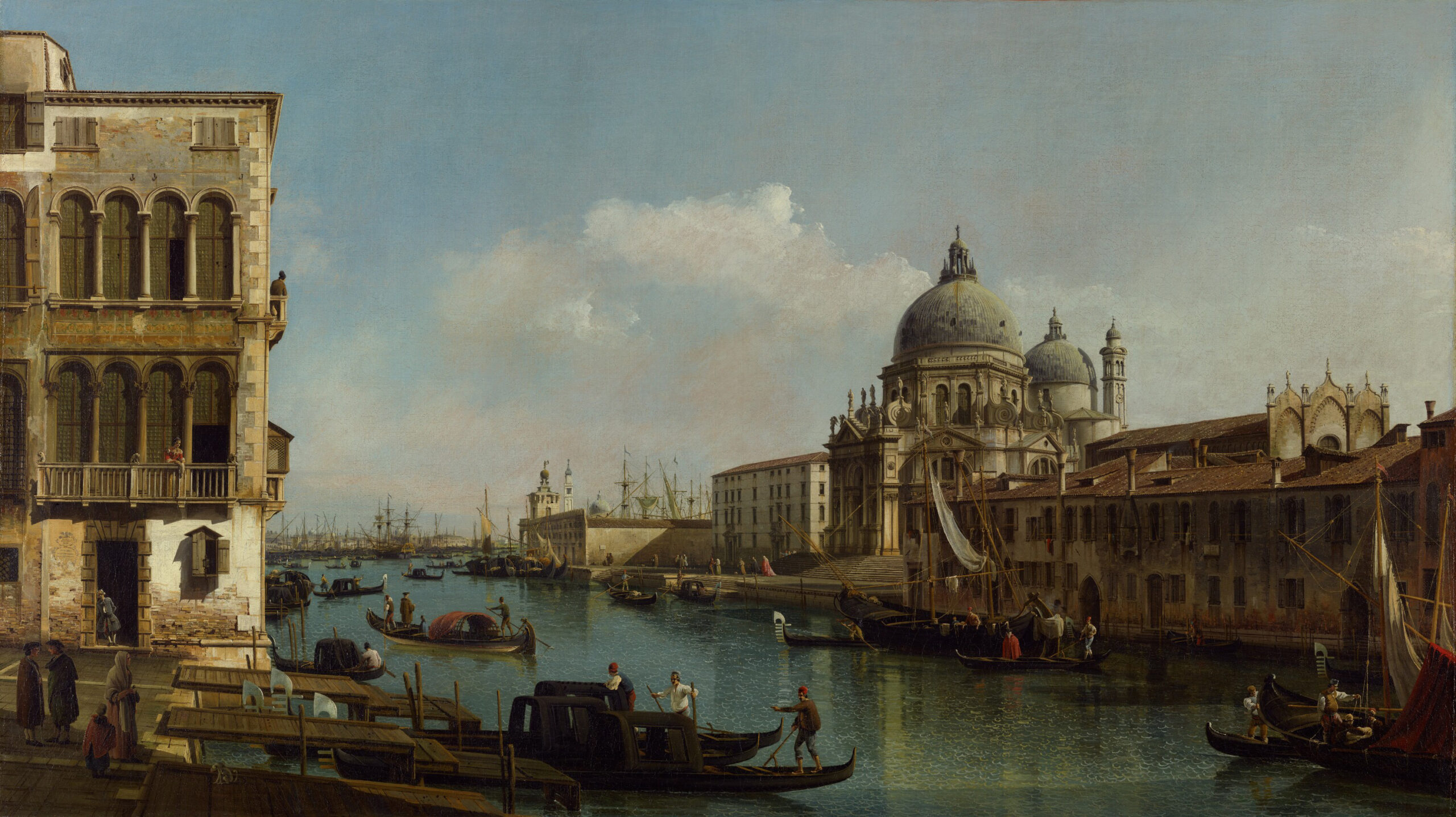
Painted around 1743 by the Venetian artist Bernardo Bellotto, View of the Grand Canal: Santa Maria della Salute and the Dogana from Campo Santa Maria Zobenigo belongs to eighteenth-century Venetian view painting. The nephew and pupil of Canaletto, Bellotto created this cityscape for travellers on the Grand Tour. The canvas shows the Palazzo Pisani-Gritti, the Dogana and the basilica of Santa Maria della Salute on a sunny morning. It already displays the young painter’s own style, with a cooler palette and stronger shadows than his uncle’s. Bellotto went on to pursue his career in Dresden, Vienna and Warsaw. The painting is held at the J. Paul Getty Museum in Los Angeles.
I definitely have a longing to travel to Venice, and this view by Bellotto answers it with precision. It is a particularly lively veduta, rich in detail, on a large canvas 2.37 m wide. This kind of painting was a souvenir for wealthy eighteenth-century travellers making their Grand Tour: the postcard before its time. Bellotto is barely in his twenties, but he learned his craft from his uncle Canaletto, the great specialist of this cityscape. What strikes me is the light on the dome of the Salute and on the tip of the Dogana, and all the life of the Grand Canal in the foreground: boats, gondolas, boatmen at work. The good thing is that Venice has changed little since then: you find the same architecture and the same bustle on the water. Of course, the painter rearranges reality a little to compose a beautiful view, but the impression of truth is there. For me it is a delight and a lovely invitation to travel! I remember walking past there on my way to visit the Pinault Foundation at the Punta della Dogana.
A spot of red on a stone balcony. A woman leans towards the water. You can almost feel the warm stone under her elbows. Below, the morning sun strikes the façade of the Palazzo Pisani-Gritti. Water laps against the wooden landing stages. The black gondolas wait, pressed against one another.
Venice in cold light on a sunny morning
Look at the sky. The white clouds are light. Then look at the shadow. It falls sharp, almost cutting, across the houses on the right bank. Bellotto paints a sunny morning. Yet his palette stays cool and silvery, leaning towards grey and blue. Specialists see this as his own signature, far from Canaletto’s warmer light. His contrasts are sharper too. Like his uncle, he relies on optical devices, such as the camera obscura, to record the city. Then he recomposes it. A veduta constructs a view; it does not photograph it.
In the centre, the Dogana raises its globe, crowned by a golden Fortune that turns with the wind. On the right, Santa Maria della Salute is mirrored in the canal. Its Baroque dome answers the Gothic façade of the abbey of San Gregorio. Under the arches of the palace on the left, look for the small devotional shrine. People would pause there for a brief prayer as they departed or arrived. The palace still stands: today it is the Gritti Palace hotel.
Bernardo Bellotto, a nephew under his uncle’s name
Bernardo Bellotto is born in Venice in the early 1720s. He trains in Canaletto’s workshop and joins the Venetian painters’ guild as early as 1738. Together, uncle and nephew paint views for Grand Tour travellers. Bellotto later leaves for Dresden, Vienna and then Warsaw. Abroad, he sometimes signs himself “de Canaletto”. He bears his uncle’s name, with a light that is not his uncle’s. His highly precise views of Warsaw were used to rebuild the city after the Second World War.
News: Canaletto and Bellotto together in Vienna
In 2026, Bernardo Bellotto was celebrated in Vienna: the Kunsthistorisches Museum devoted the exhibition “Canaletto & Bellotto” to him and his uncle Canaletto, from 24 March to 6 September 2026, curated by Mateusz Mayer. The exhibition began in Venice, then followed Canaletto to England and Bellotto to Vienna and Dresden, focusing on the veduta as a pictorial genre. Bellotto’s large views of Vienna, including Vienna Viewed from the Belvedere Palace (1759/60), were cleaned especially for the occasion. The catalogue, published by Hirmer, is available in English and German. At the Getty, the eighteenth century remains on the programme: the Getty Center is presenting “Joshua Reynolds’s Portrait of Mai and 18th-Century Portraiture” from 15 September 2026 to 14 March 2027, a good opportunity to rediscover the View of the Grand Canal in the European painting galleries.
Sources: KHM Vienna and The J. Paul Getty Museum.
A question for you
If you could step into the painting, would you board a gondola or stay on the balcony and watch?
About this work
- View of the Grand Canal: Santa Maria della Salute and the Dogana from Campo Santa Maria Zobenigo
- Bernardo Bellotto
- about 1743
- Oil on canvas
- 139.1 × 236.9 cm
- The J. Paul Getty Museum, Los Angeles
- 91.PA.73
- https://www.getty.edu/art/collection/object/103RJP