Key facts
Painted jointly by two Flemish artists, The Tower of Babel at the KMSKA, the Royal Museum of Fine Arts Antwerp, brings together Tobias Verhaecht (1561-1631), a landscape specialist, and Jan Brueghel the Elder (1568-1625), author of the details. This oil on panel illustrates the episode from Genesis in which God confuses the language of the builders. It takes up a subject already treated by Pieter Bruegel the Elder, notably in Vienna in 1563, and belongs to the Flemish world-landscape tradition. Its date of execution remains uncertain, but it predates Jan Brueghel’s death in 1625.
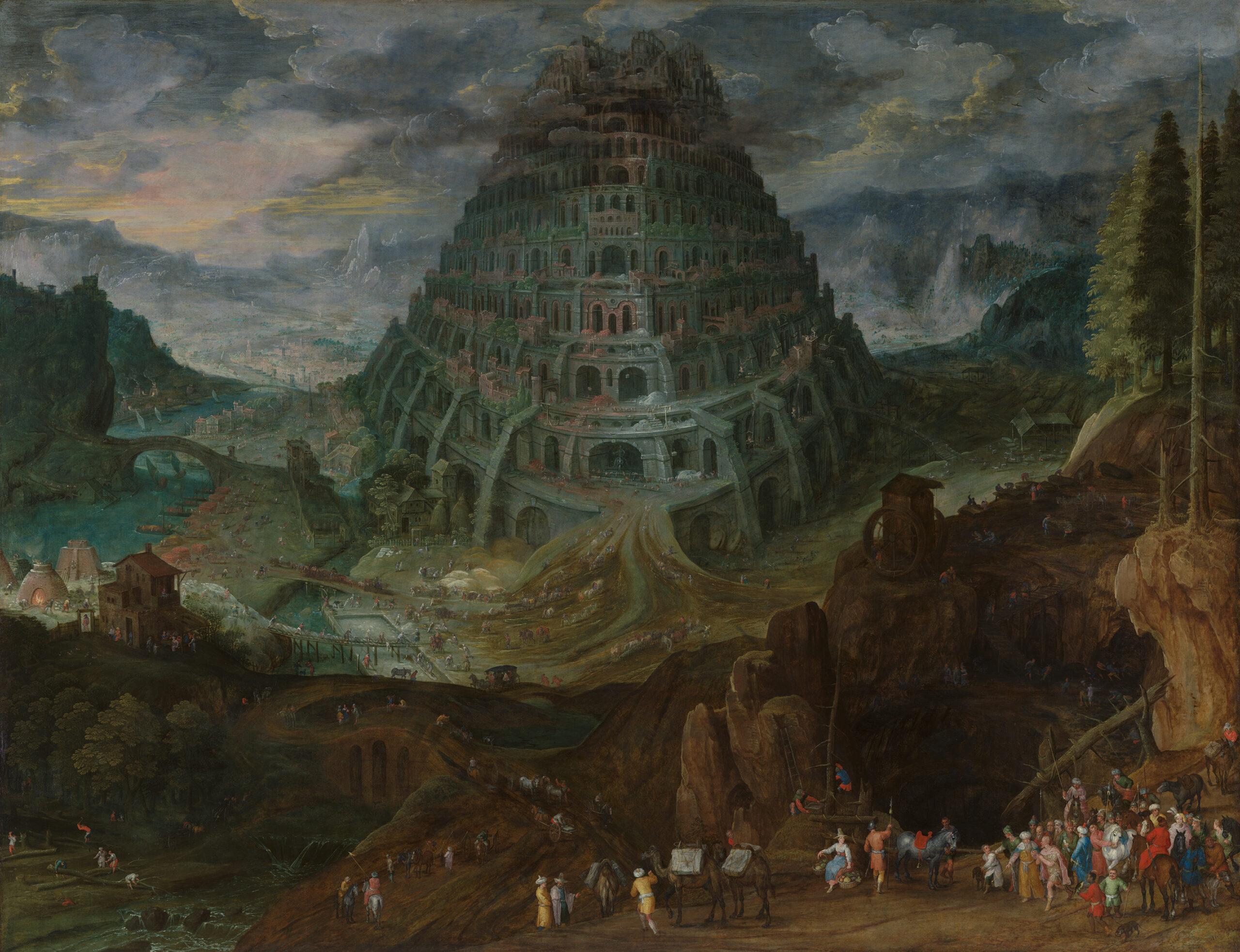
Jan Brueghel the Elder, nicknamed “Velvet Brueghel” for the quality and finesse of his painting, presents here the biblical episode of the Tower of Babel, taken from Genesis. At 172 × 225 cm, the painting is almost monumental, matching the scale of the tower itself, and that choice is interesting. All the details of the story are here: an earth quarry for making bricks, kilns firing them, and the tower itself, grand and gigantic, left unfinished because God confused the language of men, making them speak different tongues. The colours are beautiful and the effect majestic. The figures, tiny and very numerous, are crushed by the size of the structure, which conveys the sheer excess of the undertaking. That is what I love about this painting: you can linger over it for a long time, among the workers in action, the landscapes, the port and its boats, and the tower itself, a true architectural feat. This attention to detail recalls that Jan is the son of Pieter Bruegel the Elder, who painted several Towers of Babel, including the one in Vienna (1563). But his miniaturist touch and his mastery of colour are his own.
In the land of Shinar, after the Flood, men fire bricks to reach the sky. One would expect a tragedy. Instead one finds an industrious hive: kilns, boats, workers, and a king who does not see the storm coming.
The Tower of Babel, a Building Site Under the Clouds
Observe the tower: it rises in tiers, arcade upon arcade, grey-green beneath the clouds. Colossal, but not triumphant. All around it, life swarms. On the left, a brick kiln glows red beside an arched bridge and a river where boats glide. On the right, a large wooden wheel and a quarry cut into the rock. Oil on panel allows this precision: workers, carts and sailing ships remain legible despite the scale. The colours stay muted, deep greens and browns. A stormy sky weighs on the summit.
Jan Brueghel the Elder and Tobias Verhaecht: Two Hands, One Tower
Two hands share this panel, and the sources do not all agree. According to the KMSKA magazine, Tobias Verhaecht sets the building in a world landscape, in the manner of Patinir. His tower recalls the Colosseum. Jan Brueghel the Elder adds the tiny details. The KMSKA collection page, for its part, names only Brueghel. The Bible does not name the master builder; Jewish tradition places Nimrod there. In the right foreground, the king visits the site, turban on his head, sceptre in hand. He does not see the black clouds above him.
Jan Brueghel the Elder (1568-1625) is the youngest son of Pieter Bruegel the Elder. His colour and miniaturist touch made his reputation. He often entrusts the figures to other painters. Here, it is he who peoples another’s setting. Tobias Verhaecht (1561-1631), a landscape painter, was Rubens’s first teacher. Two Flemish painters, one single building site.
News: Jan Brueghel the Elder in Milan
Jan Brueghel the Elder in the spotlight in Milan in 2026. From 29 September 2026 to 31 January 2027, the Palazzo Reale in Milan presents “I Brueghel. Le origini dei generi pittorici in Europa” (“The Brueghels. The Origins of Pictorial Genres in Europe”), the first major Italian exhibition devoted to the Flemish dynasty. More than eighty paintings, drawings and prints trace three generations of artists: Pieter Bruegel the Elder, his son Pieter Brueghel the Younger, who spread his father’s models on a large scale, and Jan Brueghel the Elder, a cosmopolitan artist who won prestigious patrons during his stays in Italy, including Cardinal Federico Borromeo. The exhibition shows how the family helped establish the genres that structure European painting: landscape, still life, scenes of peasant life and battles. A year earlier, the Musée de Flandre in Cassel devoted a retrospective to Jan Brueghel the Elder for the 400th anniversary of his death.
Source: Palazzo Reale, Milan
A Question for You
On this doomed building site, someone has hung out the washing and fed the chickens. Have you spotted them?
About This Work
- The Tower of Babel
- Jan Brueghel the Elder (with Tobias Verhaecht)
- Oil on panel
- 172 × 225 cm
- KMSKA, Royal Museum of Fine Arts Antwerp (inv. 947)
- https://kmska.be/fr/chefdoeuvre/la-tour-de-babel