
Key facts
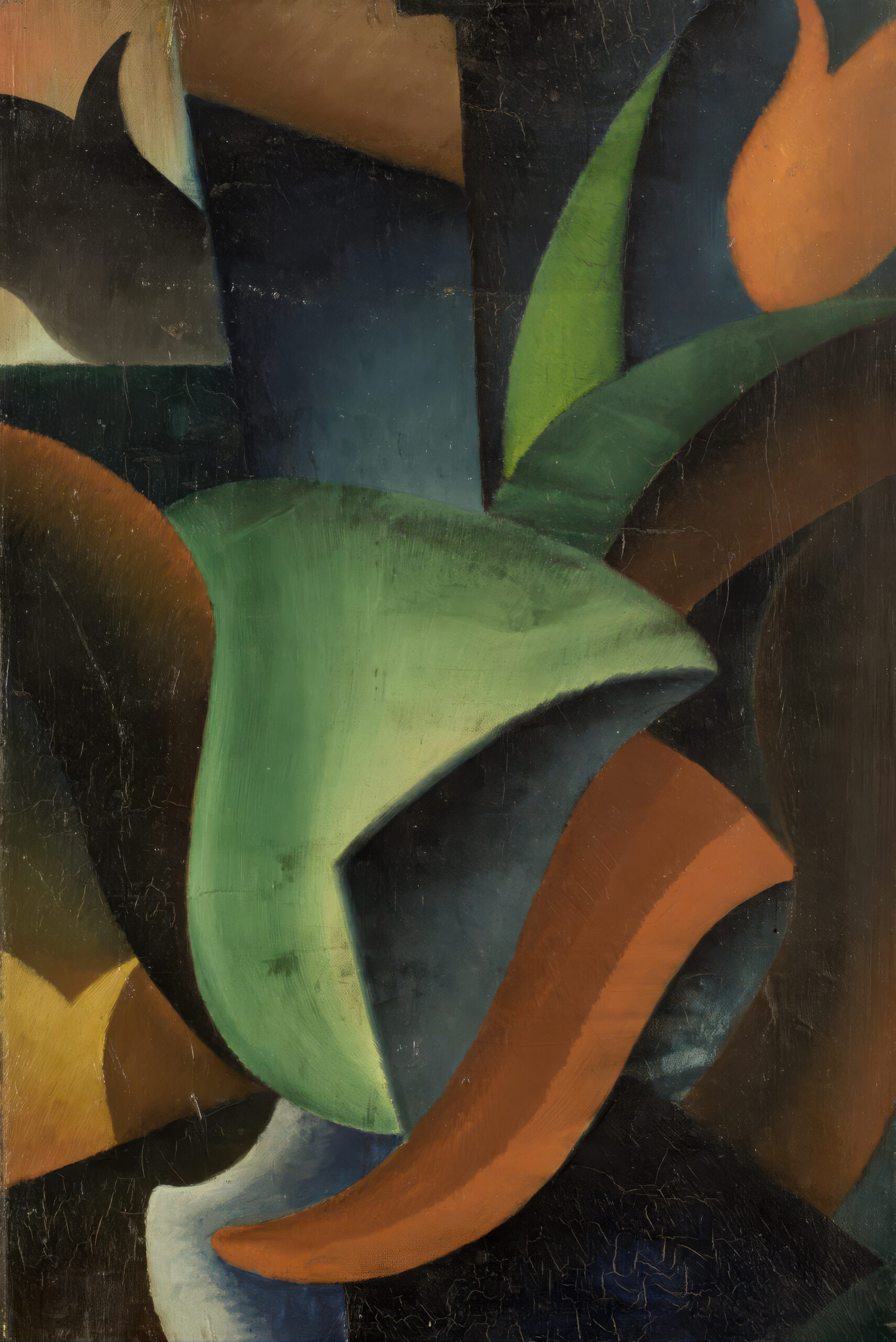
Painted around 1919-1920 by Ernst Schütte (1890-1951), Tulips pushes a traditional floral motif toward abstraction. The painter breaks the flowers down into interlocking planes of colour, spread across the entire surface of a small oil on canvas measuring 45 by 30.5 centimetres. The work belongs to post-war Berlin’s classical modernism and was shown as early as 1920 at the Freie Secession summer exhibition. It sheds light on a little-known side of its author, who was also a theatre set designer discovered by Max Reinhardt. Its home at the Neue Nationalgalerie in Berlin places it today within the museum’s classical modern art collection.
Standing before this small vertical canvas (45 × 30.5 cm), I see less a still life than a pure exercise in abstraction on a floral motif. The tulips dissolve into planes of colour that fill the entire surface right to the edges; the flower is barely legible any longer, as though shattered by a kaleidoscope. My first instinct, “you can sense the set designer”, proved right: Schütte was also a scenery painter, discovered by Max Reinhardt, later head of the stage design class at the Hochschule in Berlin. This stagecraft sensibility surfaces in the firmness of the framing and the construction through planes of colour. No timid experiment, either: as early as 1920, these Tulips were hanging at the Freie Secession summer exhibition in Berlin, just as the city was tipping into the ferment of the 1920s.
You look for tulips. The canvas gives up almost none. Ernst Schütte grinds his flowers into shards of colour.
Looking at the Surface
Look first at the large green plane, at the centre. It curves like a giant leaf, swollen with shadow. The brush models it, makes it bulge toward us. Come closer: the paint keeps the trace of the gesture. Around it, orange and brown planes coil into crescents. In the upper right, a single tulip keeps its russet flame. The background alternates night blues and deep earth tones. Everything is full, right to the edges. Schütte pushes the still life to the brink of abstraction. The petals become facets, interlocking like stained glass. The oil on canvas plays on contrasts: acid green against burnt orange. A thin white edge, at the bottom, still breathes. The web of cracks tells of the century gone by. Notice the tension: the title says flowers, the canvas says geometry.
Understanding the Era
Schütte paints these Tulips in 1919-1920. Berlin is emerging from the war, drained and feverish. The Weimar Republic has just been born. The city dances and wavers at once. In the studios, abstraction is gaining ground. Forms break free of the real. In 1920, the canvas enters the Freie Secession summer exhibition. This group then brings together Berlin’s modernists. Schütte shows a still life that refuses to stay tame. The flower, that most decorative of motifs, becomes a field of experiment. The small format, 45 by 30.5 centimetres, contrasts with the ambition of the gesture. An easel-scale intimacy, doubled with avant-garde daring. Today, the Neue Nationalgalerie files the work under its classical modern art.
Ernst Schütte is born in Hanover in 1890. He lives in Berlin until 1951. Painter, draughtsman, illustrator, architect: he is above all a man of the theatre. Max Reinhardt discovers him in 1925. Schütte designs sets at the Deutsches Theater, then in Vienna and Salzburg. From 1945 to 1951, he heads the stage design class at the Hochschule in Berlin. He dies in Berlin the same year. This theatre feeds his painting. His set designer’s eye surfaces in every plane of these Tulips.
Exhibition at the Neue Nationalgalerie in Berlin
As we write these lines, the Neue Nationalgalerie in Berlin — which holds these Tulips — is devoting the exhibition “Ruin und Rausch. Berlin 1910–1930” (25 April 2026 – 3 January 2027) to its classical modern art collection. Drawing on its own holdings, it brings to view the contrasting Berlin of the 1910s and 1920s — the very one Ernst Schütte moves through as he paints this still life in 1919-1920, between the upheavals of the First World War and the ferment of the young Weimar Republic.
Source: Neue Nationalgalerie
A question for you
💭 In 1920, Schütte fragments his tulips into facets of colour, when the Parisian avant-garde of Cubism is already ten years old: does provincial Germany merely absorb the avant-garde, or reinvent it in its own way?
About this work
- Tulips
- Ernst Schütte
- 1919/1920
- Oil on canvas
- 45 × 30.5 cm
- Neue Nationalgalerie, Berlin
- https://search.smb.museum/object/obj-962754


