Key Facts
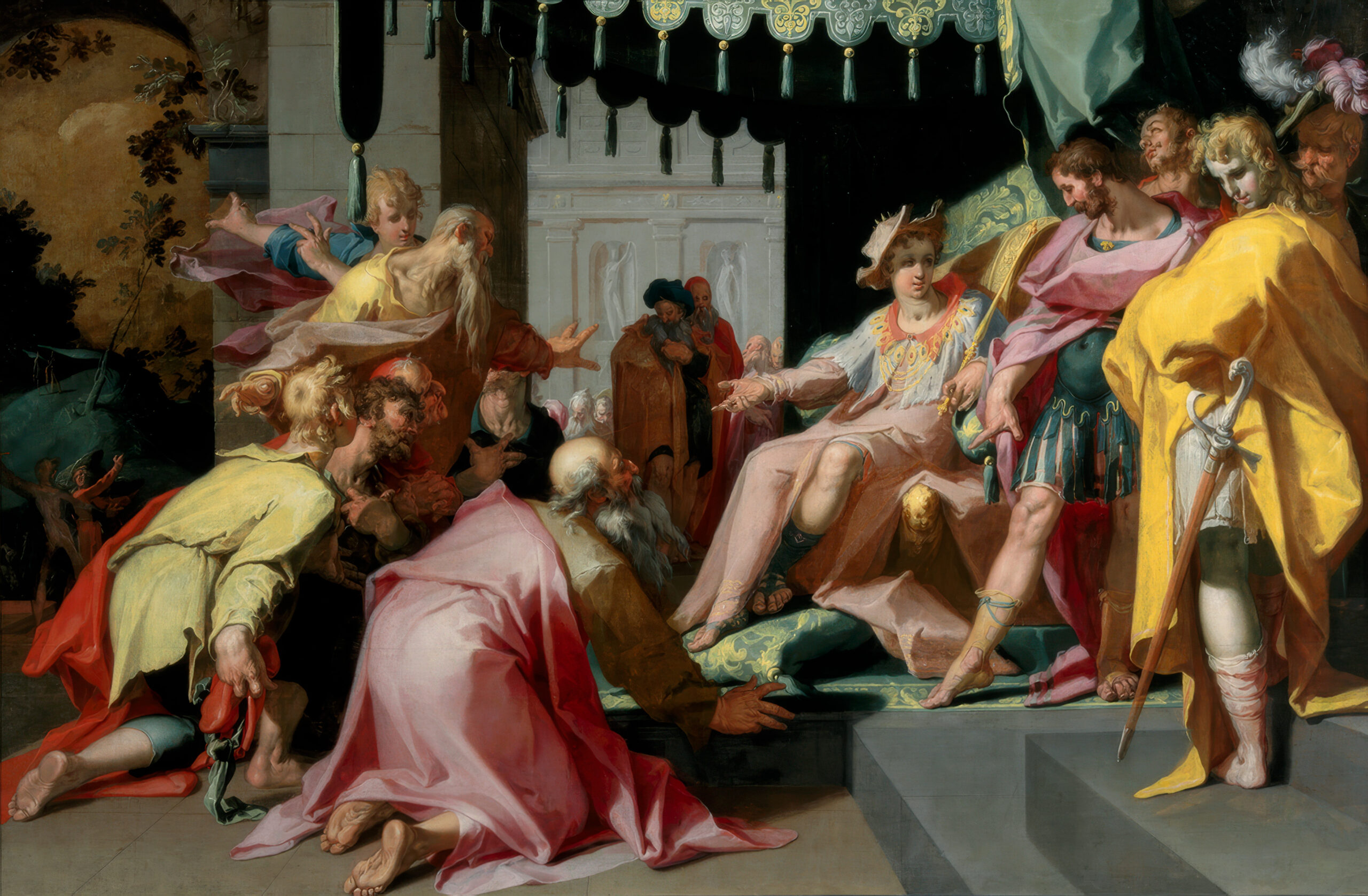
Joseph and His Brothers, painted by Abraham Bloemaert around 1595-1600, depicts the moment the Viceroy of Egypt receives the half-brothers who have come to beg for grain, unaware that they stand before the very boy they once sold into slavery. The canvas, held at the Centraal Museum in Utrecht, dates from Bloemaert’s earliest years in the city, where he would become the founding figure of its school of painting and the teacher of many of the Utrecht Caravaggisti, among them Gerard van Honthorst. The work belongs to the Mannerist idiom, with its elongated figures and acid palette, and stages a reversal of fortune at the heart of the Genesis narrative: the slave made powerful, the brothers now reduced to supplicants.
This is a familiar biblical scene, treated here almost as a piece of history painting. What strikes me most is the reversal it captures: Joseph, sold into Egypt by his own half-brothers, has risen to Viceroy after winning Pharaoh’s trust through his gift for interpreting dreams. It is his brothers who now need him, who now come to plead.
What I admire most is the handling of colour and the expressiveness of the figures: Bloemaert makes this reversal palpable, the brothers kneeling and prostrate before a Joseph who dominates them, in gaze and in bearing alike. That tension, between forced humility and reclaimed authority, gives the scene its dramatic force.
A fold of pink drapery falls across the steps of the throne. A hand grips it, caught somewhere between prayer and demand. Utrecht, around 1595-1600: Abraham Bloemaert paints the instant a family’s hierarchy turns on its head.
Gesture and matter
Look at the hands first. The brothers’ hands are gnarled, reaching toward the ground. They search for a support that never comes. Joseph’s hand stays open, almost weightless. His authority seems to cost him nothing. And yet his body, too, twists. Utrecht Mannerism demands its elongated torsos even of the victor. Bloemaert builds an inverted pyramid. The crowd of petitioners crowds to the left, in ochre and brown. Joseph, to the right, stands apart in pale pink and white. The light itself refuses to take sides.
A hierarchy overturned
The story comes from Genesis. Joseph, sold by his brothers, arrives in Egypt as a slave. There he interprets Pharaoh’s dreams. That gift raises him to the rank of Viceroy. Famine then grips the whole Mediterranean world. His brothers, starving, travel to Egypt without knowing who awaits them. Bloemaert paints this precise moment of recognition and reversed dependence. Around 1595-1600, the artist has only just settled in Utrecht. Mannerism still holds sway there, with its sharp colours and stretched bodies. The canvas measures over two metres across. A scale of this kind was reserved for prestigious commissions. Who commissioned it remains unknown. The subject itself was much prized: Joseph’s clemency embodied an ideal of just rule.
Abraham Bloemaert
Bloemaert was born in Gorinchem in 1564. He settled permanently in Utrecht in 1593, two years before painting this canvas. There he became the city’s guiding figure, training an entire generation: Honthorst, Van Poelenburch and Terbrugghen all passed through his studio. His own style would later shift from Mannerism toward a more restrained classicism. Elizabeth Stuart, Queen of Bohemia in exile, visited his studio in 1626.
In the news: Utrecht Caravaggism takes centre stage
In 2026, the Centraal Museum stages its first major retrospective devoted to Gerard van Honthorst, another leading figure of Utrecht Caravaggism, running from 25 April to 13 September. The exhibition brings together some sixty paintings on loan from the Louvre and the Galleria Borghese.
Source: Centraal Museum
A question for you
Bloemaert paints a scene of forgiveness using the tools of Mannerism, a style prized precisely for its artifice: can sincerity and exaggeration truly coexist on the same canvas?
About this work
- Joseph and His Brothers
- Abraham Bloemaert
- c. 1595-1600
- Oil on canvas
- 141.3 x 211 cm
- Centraal Museum, Utrecht
- https://collectie.centraalmuseum.nl/details/collection/4750