Key facts
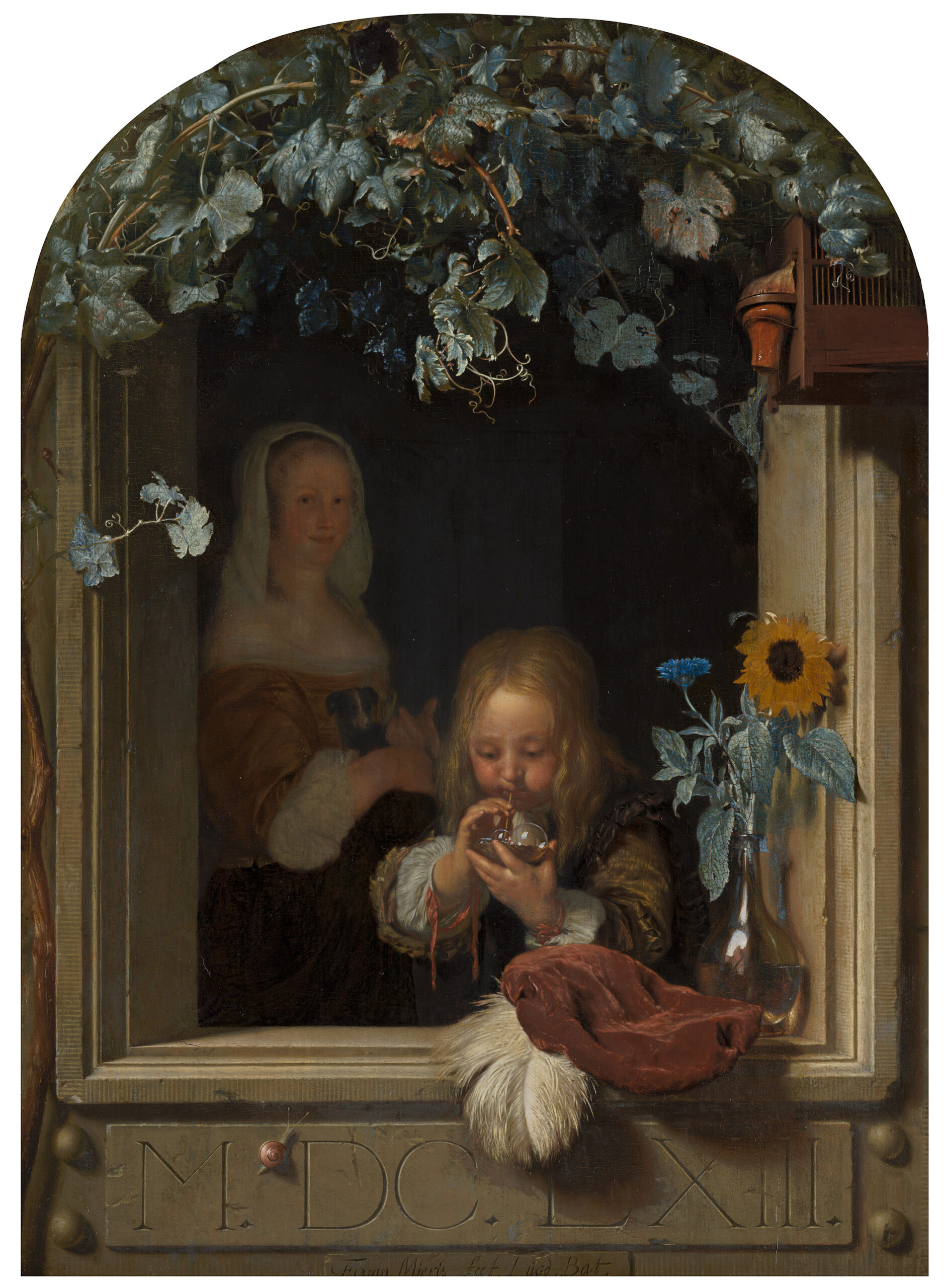
Painted by Frans van Mieris the Elder in 1663, Boy Blowing Bubbles belongs to the Leiden school of fijnschilders, a movement within Dutch Golden Age painting known for its technical minuteness. The work depicts a child blowing soap bubbles from a window, a recurring subject in seventeenth-century Dutch moral painting, where the bubble symbolises the fragility of existence. The painting once belonged to the collection of William V, Prince of Orange, before entering the Mauritshuis in The Hague in 1822. It illustrates Van Mieris’s international reputation as a pupil of Gerrit Dou, whose meticulous work was especially sought after by eighteenth-century collectors.
Such finesse, in such a small format. That’s precisely why we speak of “fijnschilders” (literally “fine painters”): the shell in which the brush is dipped, the fabric of the collar, even the transparency of the bubble itself are rendered with almost microscopic precision. I admire this attention to detail, and the choice of scene is just as interesting. Between genre scene and moralising scene, one can read it however one likes: the bubble bursting as a symbol of life’s fragility, right down to the sunflower in the background, which has been read as a reach toward the heavens. Personally, I choose the genre reading, the joyful side of carefree childhood, reinforced by the gaze of the figure in the background, who could well be his mother. I find these Dutch Golden Age paintings endlessly rich in what they offer and how varied they are, and I keep coming back to them with pleasure.
Look at the bubble, held between the child’s fingers. An almost transparent sphere, stretched at the end of a straw, where the inverted reflection of the window can just be made out. Van Mieris paints the exact instant air takes shape, right before it bursts.
This Boy Blowing Bubbles
This precision is no accident of the brush. Van Mieris belongs to the Leiden fijnschilders, painters who built up oil glazes in layers so fine that no trace of the brush shows through. The red velvet cap resting on the windowsill, the white and black feathers trimming it, the glass of the flask on the right: each material demands a different treatment of light. Around the child, the setting is also thick with hidden meaning. The vine trailing around the scene may evoke wine and its excesses; the sunflower in the vase, the soul’s elevation toward heaven; the hanging birdcage, innocence held captive. Nothing in this painted window is neutral.
Frans van Mieris the Elder and his time
Frans van Mieris the Elder worked in Leiden, where he trained in the studio of Gerrit Dou, leading figure of the fijnschilders. He painted this work in 1663, as indicated by the inscription carved into the stone ledge. The painting later entered the collection of William V, Prince of Orange, before joining the Mauritshuis in 1822.
News from the museum
From 15 October 2026 to 17 January 2027, the Mauritshuis is partnering with the Museo Nacional Thyssen-Bornemisza in Madrid for an unprecedented museum exchange: 25 masterpieces from Madrid (Van Eyck, Dürer, El Greco, Bronzino…) travel temporarily to The Hague, while 25 highlights of the permanent collection head to Spain. This Boy Blowing Bubbles by Van Mieris, currently on display in Room 11, remains among the works visitors can (re)discover during this period.
Source: Mauritshuis
A question for you
How do you read this scene: a carefree child’s game, or a metaphor for the fleeting nature of life?
About this work
- A Boy Blowing Bubbles
- Frans van Mieris the Elder
- 663
- Oil on wood panel
- 25.2 x 18.3 cm
- Mauritshuis, The Hague
- https://www.mauritshuis.nl/fr/decouvrir-la-collection/oeuvres-d-art/106-a-boy-blowing-bubbles