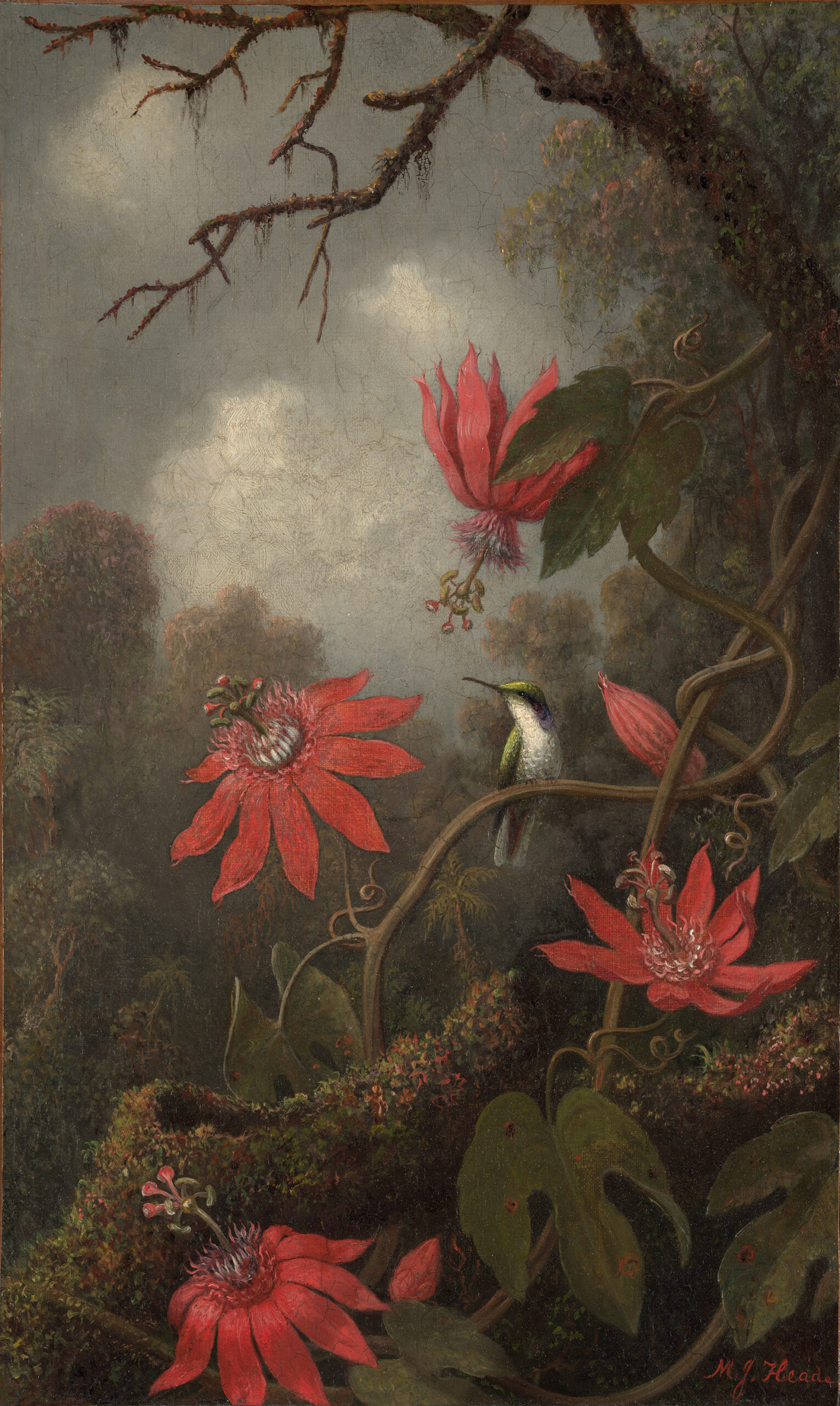
c. 1875. A hummingbird holds still on its branch. Around it, scarlet passionflowers bloom in the tropical mist. Martin Johnson Heade captures this instant suspended between two wingbeats.
A Light Rising from the Depths
Look at that small white-and-green body at the centre of the composition. The black-eared fairy (Heliothryx aurita) turns its slender beak toward a flower. Heade works with scientific precision. The red petals vibrate against the grey-green ground of the forest. Mist blurs the trees. The tendrils of the vine curl with botanical grace. Every detail is sharp, almost tactile. Light from the sky filters between dark leaves. The atmosphere is dense, humid, alive.
Art in the Service of Science
This work is born in an intellectually charged context. Heade knew the writings of Charles Darwin. He understood the interdependence between fauna and flora. The hummingbird and the passionflower (Passiflora racemosa) share the same Amazonian ecosystem: one cannot exist without the other. In painting this relationship, Heade moves beyond the simple still life. He aligns himself with American Luminism, a movement seeking to capture natural light with intensity and truth. His travels in South America, between 1863 and the 1870s, fed directly into this series of paintings.
Martin Johnson Heade
Martin Johnson Heade (1819–1904) was one of the great masters of the Hudson River School. A portraitist turned landscapist, he specialised in tropical still lifes from 1862 onward. His series on hummingbirds remains his most singular and most admired body of work.
A Question for You
💭 Look at this motionless hummingbird: did Heade paint nature, or did he reinvent it?
About this work
- Hummingbird and Passionflower
- Martin Johnson Heade
- c. 1875–1885
- Oil on canvas
- 50.8 × 30.5 cm
- The Metropolitan Museum of Art, New York
- https://www.metmuseum.org/fr/art/collection/search/11052