Key facts
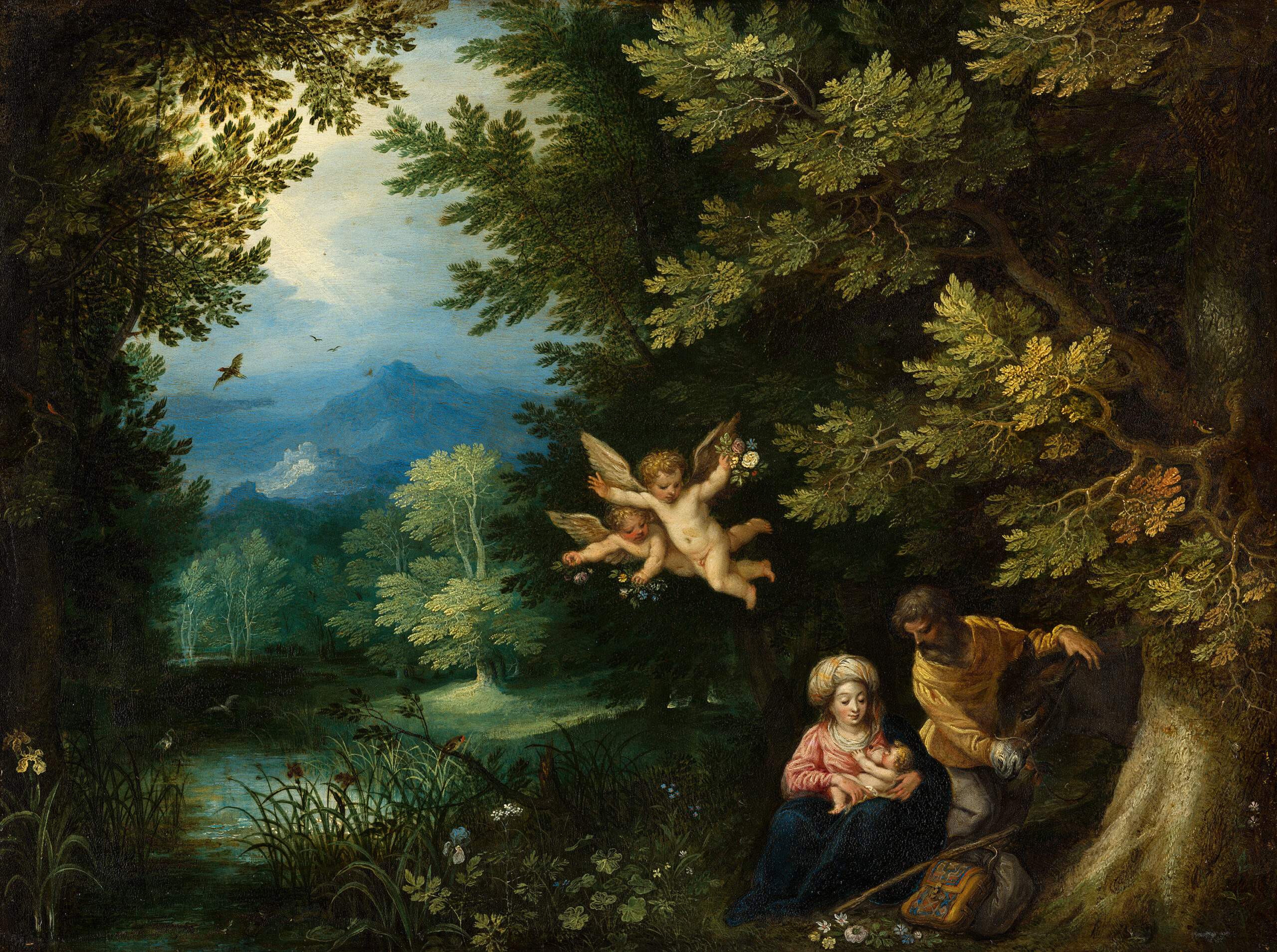
Rest on the Flight into Egypt, painted around 1595 by Jan Brueghel the Elder and Hans Rottenhammer, exemplifies the specialist collaborations common in Flemish workshops at the close of the sixteenth century. Rottenhammer, trained in Venice, painted the angels and the Holy Family; Brueghel the Elder, son of Pieter Bruegel the Elder, added the wooded landscape, the flowers and the donkey. The work, a small oil on copper held at the Mauritshuis in The Hague, dates from Brueghel’s Italian sojourn between 1590 and 1596, a period in which his reputation as a landscape painter took shape, before his return to Antwerp and his later collaboration with Rubens.
Here is an idyllic vision of this biblical scene. I recognise at once the richness of Jan Brueghel the Elder’s landscapes, in the treatment of the foliage, where the greens dissolve into blue as the land recedes, that atmospheric perspective so characteristic of him, and one also found in the tapestries of the period. What still strikes me every time I stand before this panel is its scale, almost miniature (barely 22 x 29 cm), and the support: copper, which allows for glazes of extraordinary refinement and a luminosity that borders on enamel, something never achieved on canvas or wood.
As for the scene itself, it is deeply human: Mary nurses her child while Joseph tends to the donkey, and modest bundles rest at their feet. Only the angels, upper right, introduce an incongruous note and remind us that we remain, after all, within the sacred register. One can also sense Rottenhammer’s hand in the treatment of the figures, finer and more composed than Brueghel’s own, often more exuberant, a mark of this typical pairing of Flemish specialists in landscape and figure. What I love here is the lushness of the vegetation and the quality of the colour, which lend the scene an almost intimate softness, far removed from the grand religious solemnity one might expect of the subject.
You are drawn first into a dense forest, dark in places. Two angels suspended in mid-air catch the eye before the Holy Family itself, tucked into the lower right corner, dwarfed by the vegetation. This deliberate imbalance holds the gaze for a moment, before it settles on the human figures below.
What the surface conceals
Copper changes everything. Brueghel the Elder and Rottenhammer are working on a smooth, grainless plate, over which the brush moves without resistance. The layered glazes gain in transparency; light seems almost to pass through the paint layer itself. This small format, 22 by 29 centimetres, belongs to a genre favoured by Roman collectors at the turn of the seventeenth century: the cabinet picture, made to be held in the hand and examined closely. Such copper panels circulated widely across Europe at the time, prized for their portability. Rottenhammer painted the angels and the Holy Family first. Brueghel then took over the plate, adding the dense undergrowth, the flowers, the donkey. Two hands, one single scene, a partnership forged in Rome. This dialogue between two specialities, landscape and figure, was common practice in Flemish workshops of the period. The taste for small format extended well beyond Rome, into Dutch collections of the following century.
Jan Brueghel the Elder and his time
Jan Brueghel the Elder was born in Brussels in 1568, son of the painter Pieter Bruegel the Elder. He spent time in Italy between 1590 and 1596, in Rome and then Milan, where he came to know Cardinal Federico Borromeo. This Italian period shaped his manner: minutely observed landscapes, the velvety touch that would earn him his nickname. Rottenhammer, a German painter trained in Venice, moved in the same Roman circles at the time. Their collaboration reflects a common sixteenth-century practice: one specialist for the landscape, another for the figures. Rottenhammer died in Augsburg in 1625, after a career devoted largely to miniature painting on copper. Back in Antwerp from 1596, Brueghel became one of the most sought-after painters of his day, close to Rubens.
News at the Mauritshuis
The Mauritshuis is not resting on its historical treasures: the museum continues to actively expand its collection. Its latest acquisitions are two paintings by Frans Hals, Girl Singing and Boy Playing the Violin, painted around 1628. Acquired jointly with the Frans Hals Museum in Haarlem at an auction in New York, both works are remarkable for the Haarlem master’s virtuosity in capturing movement and expression, qualities also present, in their own quieter way, in the family scene painted by Brueghel and Rottenhammer earlier in the century. Until 5 November 2026, they can be seen in Room 13, in a display devoted to genre painting, that moment in the Dutch Golden Age when artists gradually turned away from religious subjects towards scenes of everyday life, musicians, drinkers, domestic moments caught in passing. It is an opportunity, for anyone visiting the Mauritshuis, to extend the discovery and take the measure of the full range of Flemish and Dutch painting gathered in this intimate museum, from the sacred to the everyday.
Source: Mauritshuis
A question for you
How many paintings of this kind, worked on by two hands, a landscape specialist and a figure specialist, passed through the seventeenth-century Flemish world without art history ever retaining more than a single name?
About this work
- Rest on the Flight into Egypt
- Jan Brueghel the Elder and Hans Rottenhammer
- c. 1595, Mauritshuis
- Oil on copper
- 22 x 29.1 cm
- Mauritshuis, The Hague
- https://www.mauritshuis.nl/en/our-collection/artworks/283-rest-on-the-flight-into-egypt