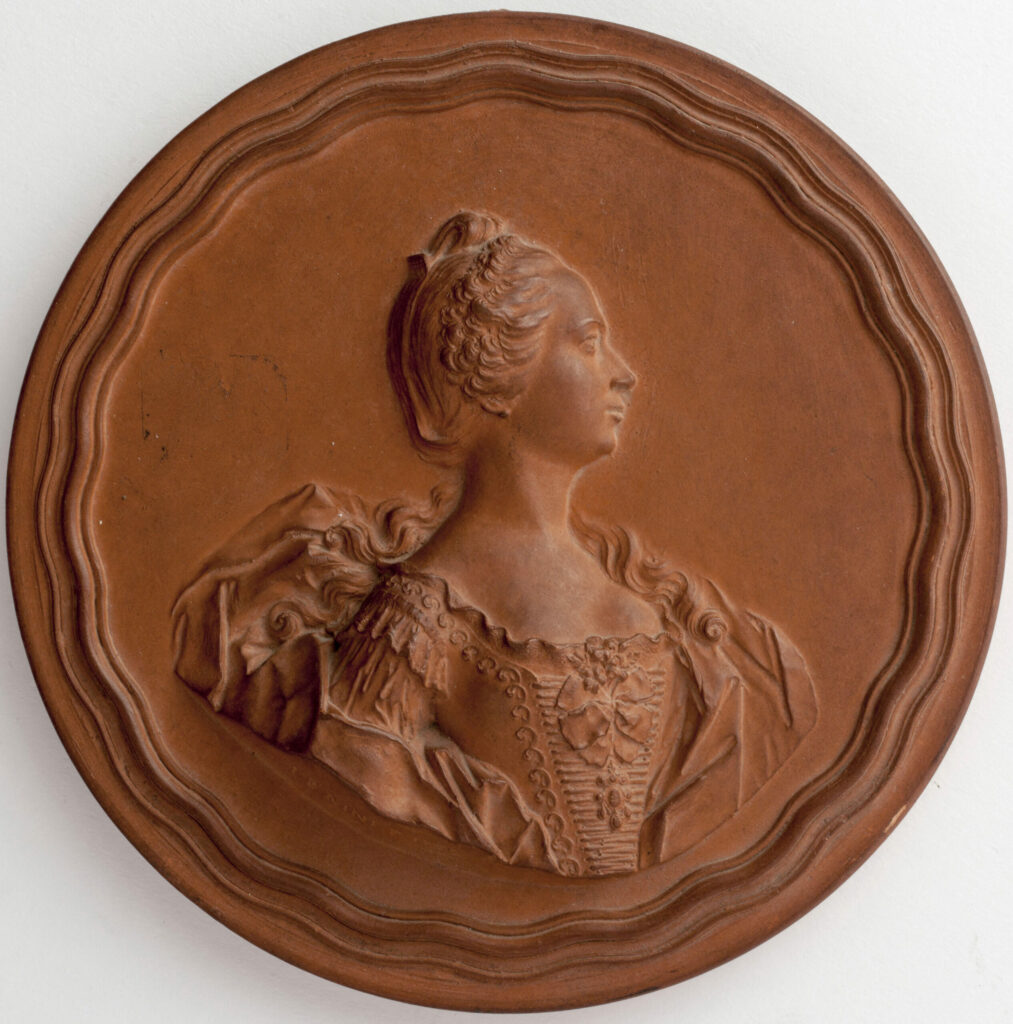
In this medallion depicting Marie Alcock, Giovanni-Battista Nini demonstrates his exceptional mastery of terracotta portraiture.
The profile, treated with exquisite delicacy, emerges from the background with striking presence. The circular composition, emphasized by a wavy border characteristic of the artist’s early works, highlights the fineness of the modeling. The virtuosic treatment of details, from the elaborate hairstyle with soft locks falling on the shoulder, to the lace of the bodice and the folds of drapery, reveals Nini’s extraordinary sensitivity to textures. The facial expression, both noble and natural, testifies to his ability to capture the personality of his subjects.
Thanks to inscriptions on examples in Ecouen and Edinburgh, Marie has been identified as the daughter of Michel Alcock, a steel industrialist from Birmingham who established a royal manufactory in La Charité-sur-Loire around 1764.
Additional Information
- Marie Alcock by Giovanni-Battista Nini, 1762
- Diameter: 15.2 cm
- Paris Museums, Carnavalet Museum, History of Paris
- https://www.parismuseescollections.paris.fr/fr/musee-carnavalet/oeuvres/marie-alcock
Giovanni-Battista Nini (1717-1786) was one of the most remarkable medallists of the 18th century. Of Italian origin, this versatile artist first trained in engraving and sculpture in Bologna before traveling to Spain. Settling in France from 1758, he specialized in creating terracotta medallion portraits, developing a unique technique that earned him great renown.
His installation at the Château de Chaumont-sur-Loire in 1772, where he directed the pottery and glassware manufactory for Jacques-Donatien Le Ray, marked the pinnacle of his career. His medallions, produced in multiple copies, constitute a valuable testimony to the society of his time.
Nini, from Theatre to Terracotta
Giovanni Battista Nini (1717-1786) is an atypical figure in the 18th-century French art world. Born in Italy, he trained in Bologna before spending time in Spain and settling in France from 1758. His speciality, the terracotta medallion, sits at the intersection of sculpture, engraving, and portraiture: it involves capturing a contemporary likeness in low relief, within a circular format designed to be hung or framed, with the precision of a coin and the warmth of a hand-modelled material. Nini produced his medallions in multiple casts, giving them a wider reach than traditional painted portraiture. In 1772, he was appointed director of the pottery and glassware manufactory at the Chateau de Chaumont-sur-Loire, institutional recognition of a firmly established reputation. His most celebrated work in this format is the portrait of Benjamin Franklin, produced in several versions between 1777 and 1779, which brought the genre international attention.
Marie Alcock and the English Industry in France
The young woman portrayed in 1762 is Marie Alcock (1740-1824), daughter of Michael Alcock, an English industrialist from Birmingham who had relocated to La Charité-sur-Loire in 1756 to establish a hardware manufactory there. The presence of British entrepreneurs in the French provinces at this period was a documented phenomenon: England held a considerable technological lead in certain manufacturing sectors, and several industrialists were drawn to France by favourable conditions granted by the crown. The Carnavalet Museum medallion, preserved in Paris, depicts Marie Alcock in profile, with an elaborate hairstyle and carefully rendered dress. The Victoria and Albert Museum in London holds an ivory version of the same effigy, dated 1765 and signed by an engraver of uncertain identity, attesting to the wider circulation of the model beyond the original terracotta.