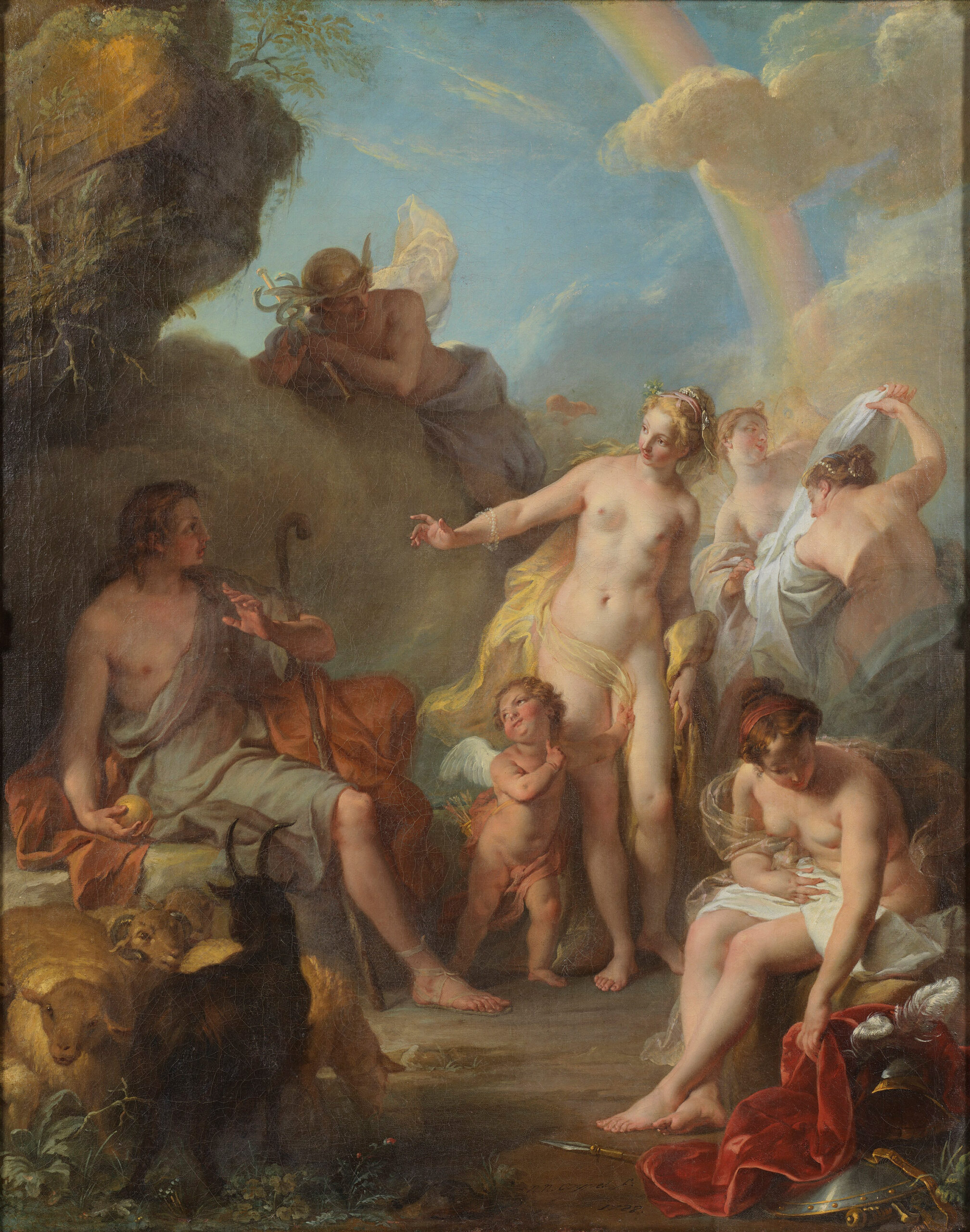
What strikes me in this canvas, as so often in mythological painting, is the way myth becomes a pretext for celebrating feminine beauty. Coypel makes no attempt to conceal this: Paris is consigned to shadow while the three goddesses command the full light of the composition. It is an eloquent compositional choice, one that speaks volumes about how the female figure was perceived and represented in eighteenth-century art. This is precisely the kind of question I explore in my study on the place of women in art, available on VMuseum, examining both the male gaze in representations of the female body and works produced by women artists throughout art history. I hope it will offer you new ways of reading these paintings.
A single extended arm. Venus gestures toward Paris, and every warm tone in the canvas follows that movement. The eye cannot resist. It tracks the light, creamy, golden, that bathes the goddess at the centre. Everything else in the picture exists in relation to her.
Beneath the surface
Noël-Nicolas Coypel painted this Judgement of Paris in 1728, at the height of the late French Baroque. The brushwork is fluid, the flesh luminous, the drapery almost liquid in quality. Look closely at Minerva, to the right: she gathers her helmet and shield, already resigned to defeat. Juno and Iris recede into the clouds behind. Mercury watches from a distance. Paris holds the apple in near-darkness. The light is not his. Coypel has constructed a mythological scene in which the pretext of judgement gradually gives way to the study of the female body. Each goddess functions as a model. The myth provides the framework. The flesh is the subject.
The artist and his era
Noël-Nicolas Coypel was born in 1690 into a dynasty of painters. His father Noël, his half-brother Antoine: painting was a family inheritance. He was received into the Académie Royale in 1720. His subjects were mythology, goddesses, and the body. He died in 1734 at the age of forty-four, leaving a small but concentrated body of work. French Baroque painting owes to him some of its most sensually charged compositions.
Nationalmuseum – Current programme, 2026
The Nationalmuseum in Stockholm, where this canvas is held, is presenting two major temporary exhibitions until 9 August 2026: Fantasy and Reality – The Art of Johan Tobias Sergel and Badin – Beyond Surface and Mask. Both are rooted in the eighteenth century and offer a broader context in which to situate Coypel’s work. An opportunity to see the painting in the gallery.
Source: nationalmuseum.se/en/exhibitions
A question for you
💭 What if it were not Paris who was choosing, but Coypel who was designating, through myth, what his era wished to look at?
About this work
- The Judgement of Paris
- Noël-Nicolas Coypel
- 1728
- Oil on canvas
- 101 × 82 cm
- Nationalmuseum, Stockholm
- https://collection.nationalmuseum.se/en/collection/item/17796/