Key facts
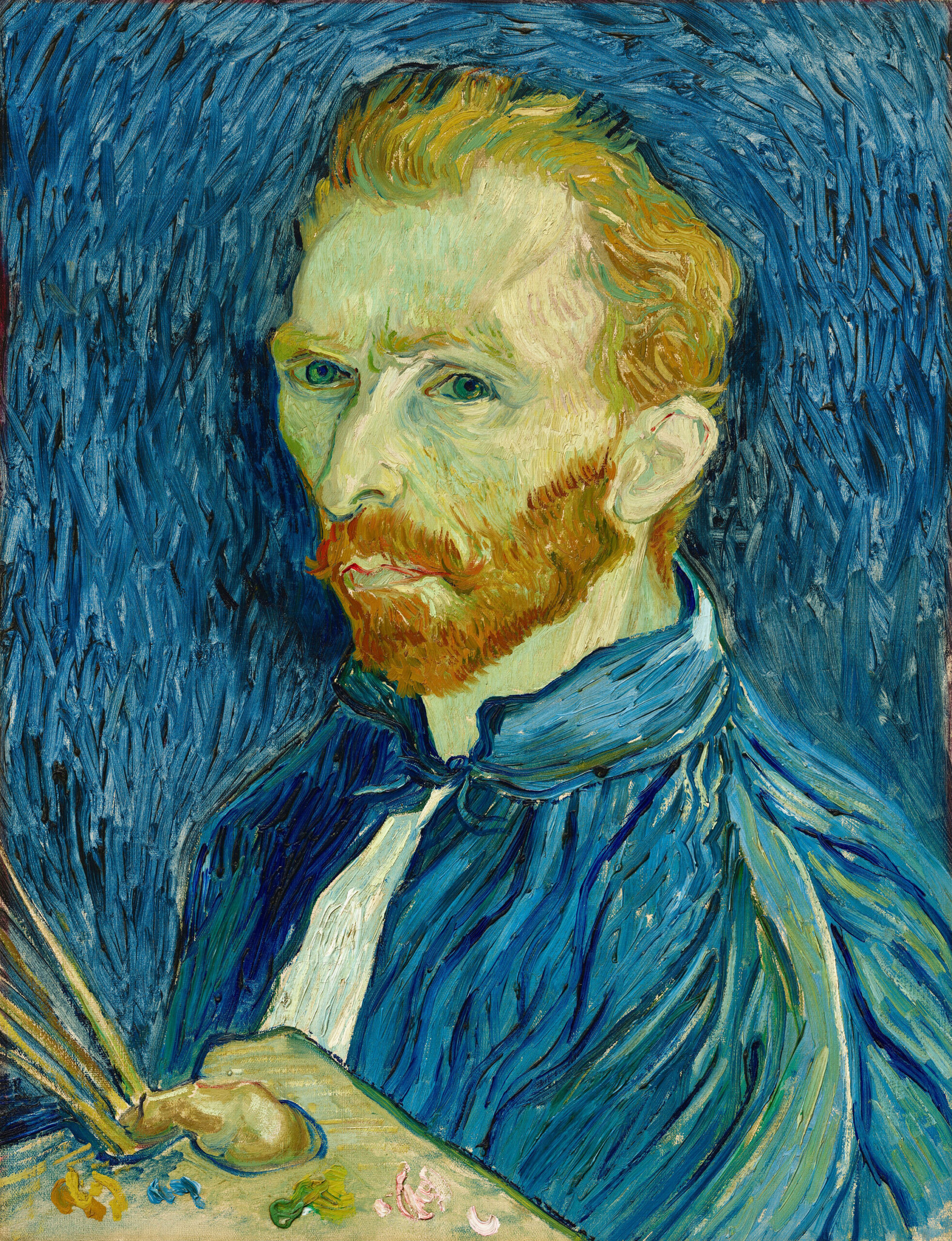
Painted by Vincent van Gogh between August and September 1889, this oil-on-canvas Self-Portrait dates from his voluntary stay at the Saint-Paul-de-Mausole asylum in Saint-Rémy-de-Provence. The Dutch painter, a leading figure of Post-Impressionism, depicts himself holding his palette and brushes, set against a background of swirling brushstrokes. The painting belongs to a series of three self-portraits made within a few weeks. It falls between the Oslo self-portrait, painted while he was ill, and the one in the Musée d’Orsay. Held by the National Gallery of Art in Washington, it is among the last of the 36 self-portraits the museum attributes to the artist. Van Gogh shows himself at work, just after emerging from a severe crisis.
This is a self-portrait of great intensity that I am sharing with you today. Van Gogh painted it in 1889 in Saint-Rémy-de-Provence, not far from Arles, where he was being treated at the Saint-Paul-de-Mausole asylum. He had barely come through a severe crisis, and you can feel it. I love this pictorial density, these thick, nervous brushstrokes that leave no room for rest. I also love the choice of intense colors: the blue of the painter’s smock, the orange of the beard and hair, the background that seems to vibrate around him. A strong tension emanates from the figure, who firmly grips his brushes and palette, as if to assert that he is, first and foremost and despite everything, a painter. The gaze is piercing and tense. The greenish tones heighten the pallor of the gaunt face, marked by illness. Even the background seems caught up in this movement: the brushstrokes follow the outline of the head and shoulders, like a wave surrounding him. Everything conveys the tension within the figure, but also his determination to keep painting. In September 1889, he wrote to his brother Theo that he was working on two portraits of himself, “for lack of another model.” That is what I love here: a fragile man who looks at himself unflinchingly and paints himself, above all, as an artist.
Look first at the bottom of the canvas. On the palette, a few dabs of pure paint are waiting: yellow, blue, green, pink, white. They hold the tones of the entire painting. Then move upward. The hand grips the brushes. The blue smock folds in broad brushstrokes. The face turns in three-quarter view. And the eyes, narrowed, hold you.
Saint-Rémy, late summer 1889: what this self-portrait conceals
We are at the Saint-Paul-de-Mausole asylum in Saint-Rémy-de-Provence. In mid-July 1889, Van Gogh suffers a violent crisis. For weeks he does not go outside, not even into the garden. When he picks up his brushes again, he becomes his own model.
Look at the handling of paint. The oil paint is laid on in thick impasto, almost sculpted. In the background, long strokes follow the outline of the head and shoulders. They form a kind of shifting halo. The National Gallery notes that this background was originally more violet. A red pigment in the mixture has faded over time. Today, blue dominates.
Look at the colors too. The orange of the hair and the rust of the beard stand against the blue of the background. They are complementary colors: each intensifies the other. Between them, the face looks paler still. Touches of green and yellow hollow the cheeks. The pallor of the skin comes from this juxtaposition as much as from illness.
This painting belongs to a short series. Between August and September 1889, Van Gogh paints three self-portraits within a few weeks. The first, now in Oslo, shows a man averting his eyes, his head slightly bowed. Van Gogh himself describes it to Theo as an attempt made while he was ill. Long disputed, it was only authenticated in 2020 by the Van Gogh Museum. The last, in the Musée d’Orsay, stands out against a background of arabesques reminiscent of The Starry Night. The Washington portrait sits between the two. Look at the mouth, closed and tight. Nothing moves in this face, while everything swirls around it. The gaze returns to us. The palette returns to the hand. He paints himself as a painter at work. And yet no canvas appears in the frame.
Van Gogh and his time
Born in 1853, the Dutch painter Vincent van Gogh is one of the great figures of Post-Impressionism. In late 1888, in Arles, a crisis leads him to cut off his ear. In 1889, he voluntarily admits himself to the asylum in Saint-Rémy. He stays there for thirteen months. According to the National Gallery, he paints more than 140 paintings there, including The Starry Night. The museum counts 36 self-portraits in his body of work, and this one is among the last. He dies in 1890. During his lifetime, he receives almost no recognition. Today his Saint-Rémy canvases are among the most famous in painting. His self-portraits now travel from museum to museum. This one has been lent to Pasadena, Paris and London, among other places.
News: Van Gogh reunited in Otterlo
To see Van Gogh in Europe this winter, head to Otterlo, in the Netherlands. Until January 3, 2027, the Kröller-Müller Museum presents Van Gogh, All Our Paintings, which brings together the museum’s 88 paintings by the artist. It is the first time since 1984 that the entire collection can be seen in one place. Most of these works were acquired between 1908 and 1930 by Helene Kröller-Müller, the museum’s founder. The exhibition is organized around faith, hope and charity, values that Van Gogh sought to express through painting after giving up his ambition to become a preacher. Highlights include The Potato Eaters, The Sower, L’Arlésienne and the Portrait of Joseph Roulin. Like our Washington self-portrait, these last two date from his decisive years in the South of France. Admission to the exhibition is included in the museum and park ticket, but you need to book a time slot online, at no extra cost.
Source: Kröller-Müller Museum.
A question for you
That swirling background: do you see it as scenery or as a state of mind?
About this artwork
- Self-Portrait
- Vincent van Gogh
- 1889
- Oil on canvas
- 57.79 × 44.5 cm (22 3/4 × 17 1/2 in.)
- National Gallery of Art, Washington, D.C.
- https://www.nga.gov/artworks/106382-self-portrait