Key facts
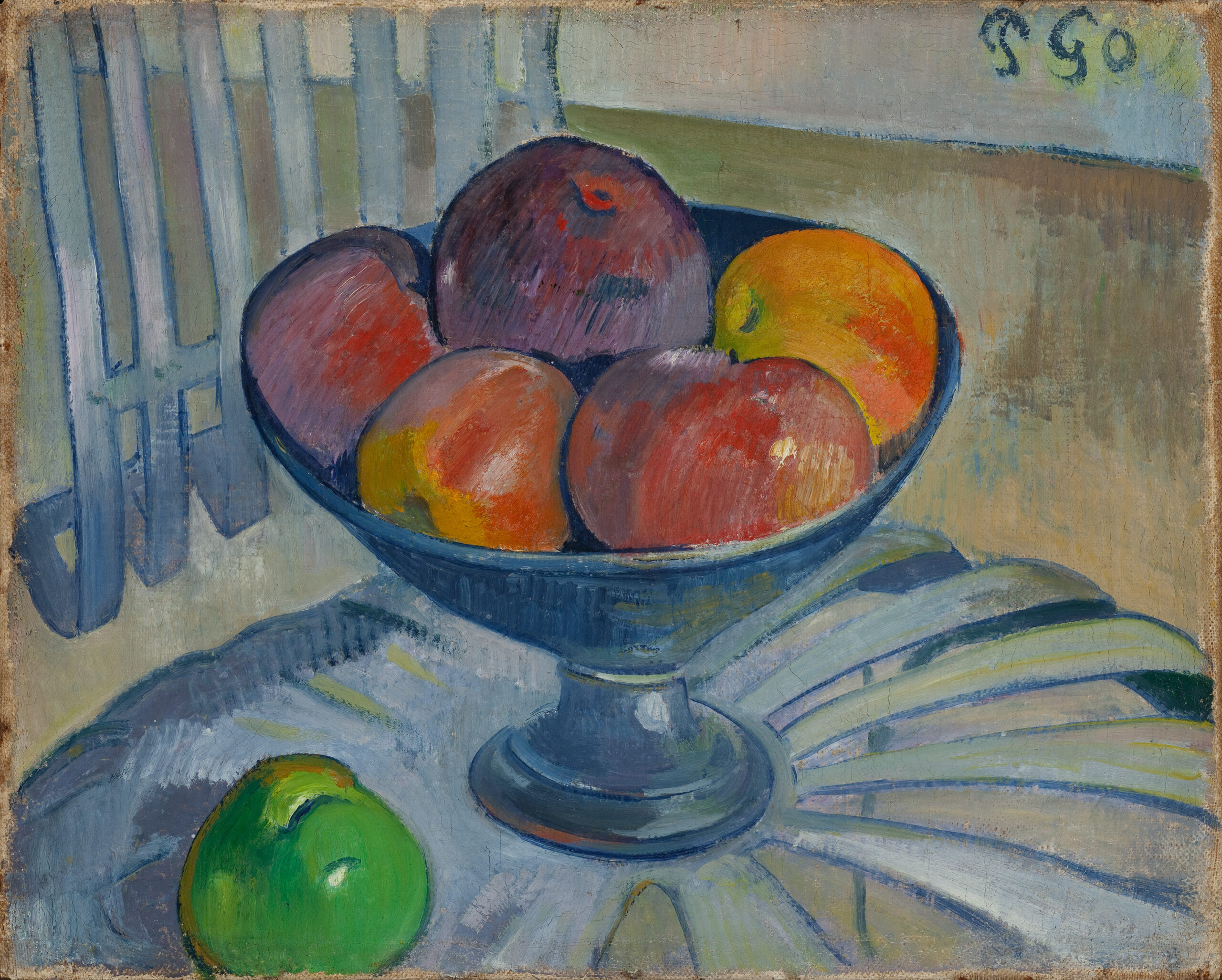
Painted around 1890 by Paul Gauguin (1848–1903), Fruit Dish on a Garden Chair is a small oil still life held by the Los Angeles County Museum of Art (LACMA). It dates from the period when the artist, working between Paris and Brittany, was developing Synthetism, a language of simplified, outlined forms that moves away from Impressionism. Its slanting brushstrokes and tilted picture plane recall the art of Paul Cézanne, whom Gauguin admired and collected. Given to the museum in 1954 by the actress Merle Oberon, the painting is on view in the exhibition Collecting Impressionism at LACMA until January 3, 2027.
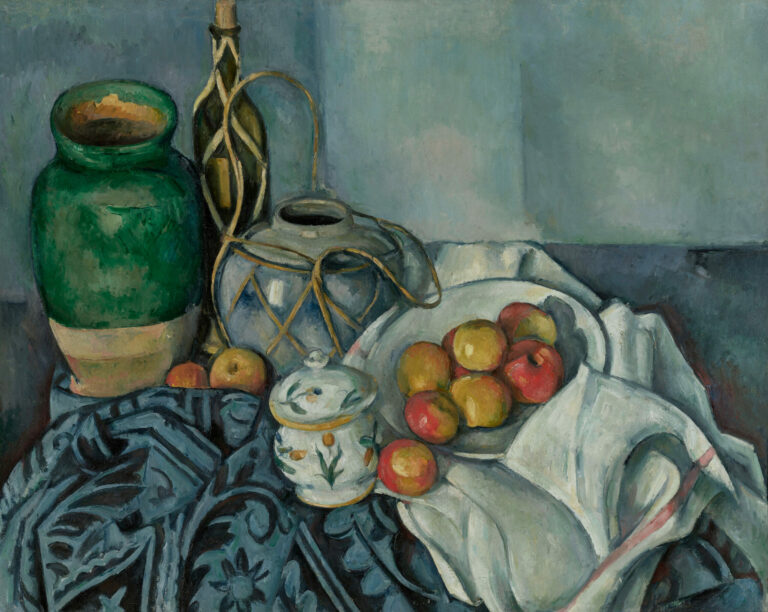
It is a simple still life that Paul Gauguin offers us on this small canvas, barely 28 × 36 cm. It caught my eye while I was browsing LACMA’s online collections. What strikes me first are its vivid colors: the blue of the bowl against the reds, purples and oranges of the fruit, and that green apple set apart. I also love its tight framing and the title, which takes us out into the garden, onto a chair turned into a table for a moment. We are in the middle of apple season, and this painting takes on its full meaning. But behind the simplicity of the subject, it is Gauguin’s whole work on color that we read here. Around 1890, we are already beyond Impressionism: the forms are simplified and outlined, and the painter plays on a tension between the volume of the fruit and the pull of flat color. It is hard not to think of Cézanne. Gauguin owned his Still Life with Fruit Dish, a painting he cherished so much that he wrote he would part with his last shirt before parting with it. This little fruit dish seems to me to carry some of that admiration.
Seeing Fruit Dish on a Garden Chair
A speck of vermilion. In the hollow of the large purple apple, a red touch glows like an ember. Come closer. The skin of the fruit is not smooth. It bristles with parallel hatching, laid on at a slant. All around, the blue bowl encloses the fruit in a dark line. The chair back rises on the left, in pale blue slats. At the top right, the signature “P Go” floats on a ground of ochre and verdigris. Along the edges, the weave of the canvas still shows through.
Understanding Paul Gauguin
Around 1890, Paul Gauguin lives between Paris and Brittany. Since 1886, in Pont-Aven, he has been at the heart of a group of artists devoted to Synthetism, which reduces sensations to their essentials. Yet look closely at how the fruit is painted. These short, slanting strokes recall Cézanne’s “constructive stroke.” Gauguin, then a stockbroker, had acquired several canvases by the master of Aix around 1880. The National Gallery in London holds another still life by Gauguin, probably from 1890. Its truncated diagonal brushstrokes and flattened perspective point directly to Cézanne. Here, the method is the same. The seat tips toward us. We see the bowl from above and the chair back head-on. Two viewpoints coexist within 36 centimeters. Gauguin adds his own gesture: a blue outline that encloses each form like the lead came of a stained-glass window.
Feeling
Rest your hand on this green apple, alone outside the bowl. It feels cool, heavy, freshly picked. The blue of the bowl cools the whole scene. The reds, in turn, warm it. You can sense autumn: the crisp air, the low light, the weight of the fruit in your palm. The title promises a garden. The canvas shows not a single leaf. Only the chair keeps the memory of the outdoors.
News: on view at LACMA until January 2027
Fruit Dish on a Garden Chair is currently on view in the exhibition Collecting Impressionism at LACMA, in the Resnick Pavilion, from December 21, 2025, to January 3, 2027. The exhibition traces how the museum built its Impressionist collection, from early acquisitions of American and California Impressionism to gifts from major Hollywood collectors. Art emerges as a tool of cultural legitimization that grew alongside the institution and the city. Gauguin’s painting, given in 1954 by the actress Merle Oberon, is a perfect example. The exhibition also highlights recent acquisitions, including The Artist’s Garden, Vétheuil (1881) by Claude Monet and Tarascon Stagecoach (1888), the first painting by Vincent van Gogh to enter the museum’s collection. It is curated by Leah Lehmbeck, with David Bardeen. The visit comes during a landmark year for LACMA. On April 19, 2026, the museum opened the David Geffen Galleries, designed by Peter Zumthor, where works are displayed on a single level, with no hierarchy between cultures or periods. With this building, LACMA now has 220,000 square feet of galleries, compared with 130,000 in 2007.
Source: LACMA.
A question for you
In 1954, a Hollywood star gives this small Gauguin to a still-young museum. Why would a collector donate a painting rather than keep it or sell it?
About this work
- Fruit Dish on a Garden Chair
- Paul Gauguin
- c. 1890
- Oil on canvas
- 28.58 × 35.56 cm (11 1/4 × 14 in.)
- Los Angeles County Museum of Art (LACMA)
- https://collections.lacma.org/object/17338