Key facts
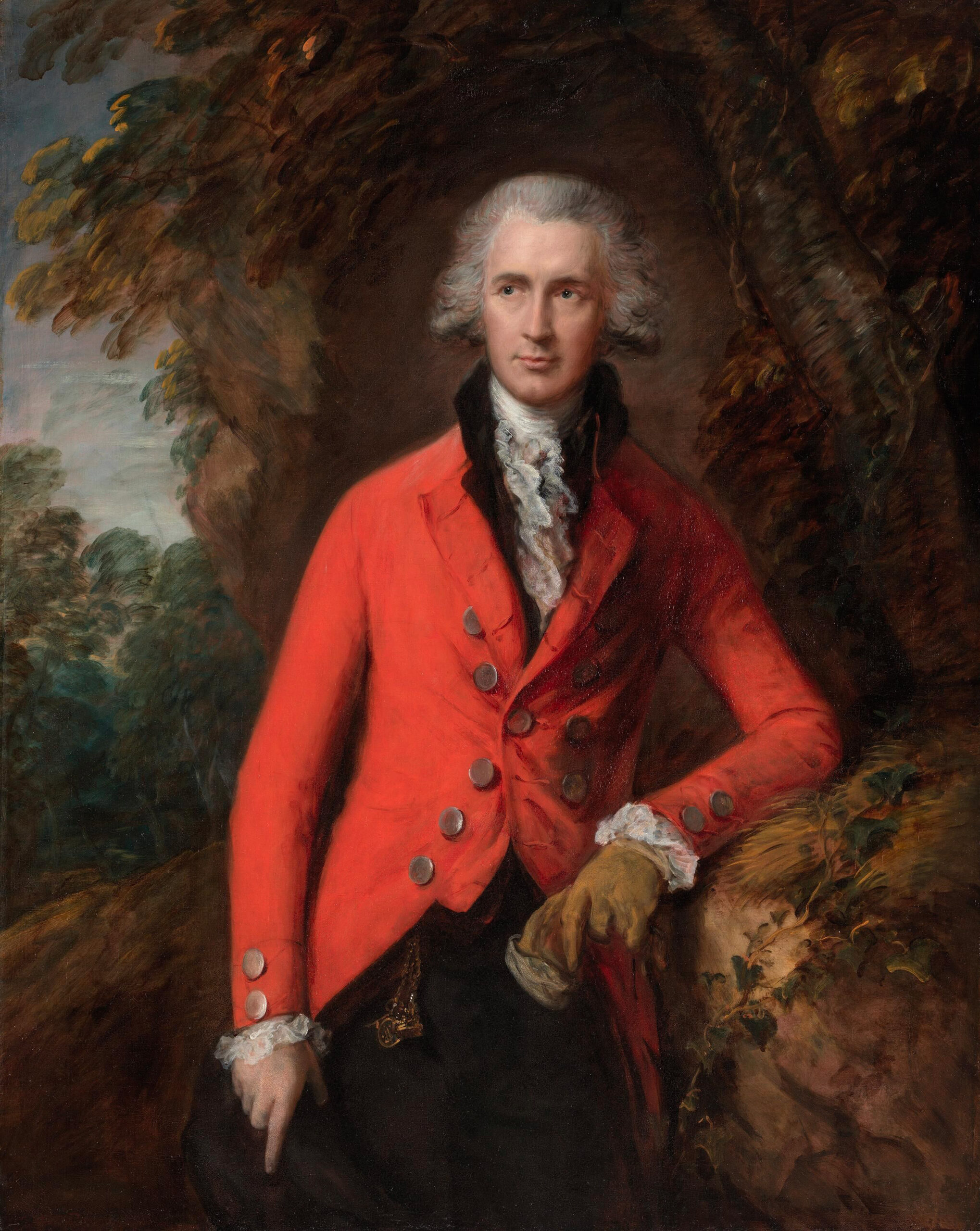
Painted in 1785 by Thomas Gainsborough, the portrait of Thomas Hibbert belongs to the English painter’s late period. At the time, Gainsborough was, alongside Joshua Reynolds, one of the favourite portraitists of London high society in the Georgian era. The sitter, a merchant whose family had grown rich through Caribbean trade linked to slavery, poses in a red coat against an English landscape. The painting forms a pair with the portrait of his wife, Sophia Hibbert, painted in 1786. Acquired in 2022 by the Pinakotheks-Verein, it belongs to the Neue Pinakothek in Munich. While the museum is being renovated, it is displayed at the Alte Pinakothek alongside its pendant. It brings together society portraiture and landscape, the two poles of Gainsborough’s art.
Gainsborough is a great English portraitist of the 18th century. He was Joshua Reynolds’s great rival, but he was more interested in natural detail than in grandiose poses, with unusual colour harmonies and very loose brushwork. Here we see Thomas Hibbert, and there is also a pendant portrait of his wife, Sophia, painted in 1786. The couple had married in 1784 and commissioned both portraits shortly after the wedding. I came across an amusing anecdote: they separated in 1796, but each of them kept the other’s portrait! The two paintings are now reunited in Munich. Sophia’s portrait entered the collection as early as 1977, thanks to the Pinakotheks-Verein. Her husband’s joined it in 2022, bringing the collection’s number of Gainsboroughs to five, more than any other European museum outside the British Isles. A small detail I appreciate: the museum had a new frame made for Sophia’s portrait, modelled on her husband’s, so that the two paintings once again form a true pair.
I love the very classical, even relaxed, style of this work. You immediately sense the sitter’s social rank: the red coat, the broad-brimmed hat held in his hand, the lightly powdered hair. Yet at the same time there is the simplicity of a portrait set against an English landscape, with its hills, its trees and its pond. What strikes me most is the face, rendered in very delicate pastel tones. That is where you see Gainsborough’s virtuosity. I find that this portrait conveys the easy life of a man firmly established in the high society of his day. It is an ease that deserves to be viewed with some distance, however: the Hibbert fortune came from trade with the Caribbean, and therefore from the slave economy. Thomas himself worked in the family business in Kingston, Jamaica, from 1766 to 1780. The museum states this clearly, and I find it makes the painting all the more interesting to look at.
You are standing in front of a yellow glove. It hangs, almost limp, in a hand resting on an ivy-covered bank. The gesture looks careless. It isn’t. When a man sits for his portrait, nothing is left to chance.
What the portrait of Thomas Hibbert tells us
Look at the red first. The coat blazes against a vault of brown foliage. Yet the paint stays light, almost whipped. Notice the silver buttons: two or three pale touches are enough to make them gleam. The lace jabot dissolves into nervous strokes. Up close, the canvas seems unfinished. From a distance, everything comes together. This is the paradox of Gainsborough’s loose brushwork. The face, by contrast, escapes this speed. It is modelled in finely graded pastel tones. Beneath his left hand, the hat almost melts into the shadow. The man leans against nature. Nature, however, remains a stage set.
What the era tells us
This portrait has a double. Sophia Hibbert, painted a year later, adopts almost exactly the same format: 127 by 101.5 centimetres. The two canvases were designed to answer each other across a wall. They answer each other once again, in the same room of the Alte Pinakothek. The couple, meanwhile, separated in 1796. The painting holds fast a union that life undid. The museum’s official catalogue entry also names the source of the fortune: Jamaica and slavery. The elegance is real. So is its price.
Thomas Gainsborough grew up in Suffolk. He made his name as a portraitist in Bath, then in London. Portraiture paid the bills. Landscape remained his passion. Here, the two coexist without ever being reconciled.
News: the Gainsborough tercentenary
This portrait is a recent acquisition: it was bought on the art market in 2022 by the Pinakotheks-Verein, the friends’ association of the Pinakotheken. Visitors will not find it at the Neue Pinakothek itself, however, which has been closed to the public since January 2019 for renovation. The work focuses mainly on removing harmful substances, fire safety, technical and climate-control systems, energy efficiency and accessibility. Reopening is expected around 2030. In the meantime, a selection of masterpieces from the collection is on display on the ground floor of the east wing of the Alte Pinakothek and at the Sammlung Schack. The painting hangs in Room III on the ground floor of the Alte Pinakothek. Its presence in Munich is no small matter: the Pinakotheken own five paintings by Gainsborough, more than any other European museum outside the British Isles.
As for the artist, the tercentenary of his birth is the occasion for a series of major exhibitions. In Berlin, on 14 May 2027, exactly 300 years after the painter’s baptism, the Gemäldegalerie will open an exhibition of around 50 works, billed as the central contribution to the Gainsborough year on the European continent, running until 12 September 2027. In London, Tate Britain will bring together more than 120 paintings and drawings from 20 May to 10 October 2027. It will be the first major retrospective devoted to the artist in more than twenty years. This autumn, from 15 October 2026 to 7 February 2027, the National Gallery is pairing Gainsborough’s Mr and Mrs Andrews with the sculpture by Yinka Shonibare that reinterprets it.
Source: visitBerlin.
A question for you
Set against Reynolds and his Grand Manner, was Gainsborough’s loose brushwork a weakness of execution, or a step ahead of his time?
About this work
- Thomas Hibbert
- Thomas Gainsborough
- 1785
- Oil on canvas
- 127 x 101.6 cm
- Bayerische Staatsgemäldesammlungen, Neue Pinakothek, Munich
- On display at the Alte Pinakothek, Room III
- https://www.sammlung.pinakothek.de/de/artwork/53470gv8x9/thomas-gainsborough/thomas-hibbert