Key facts
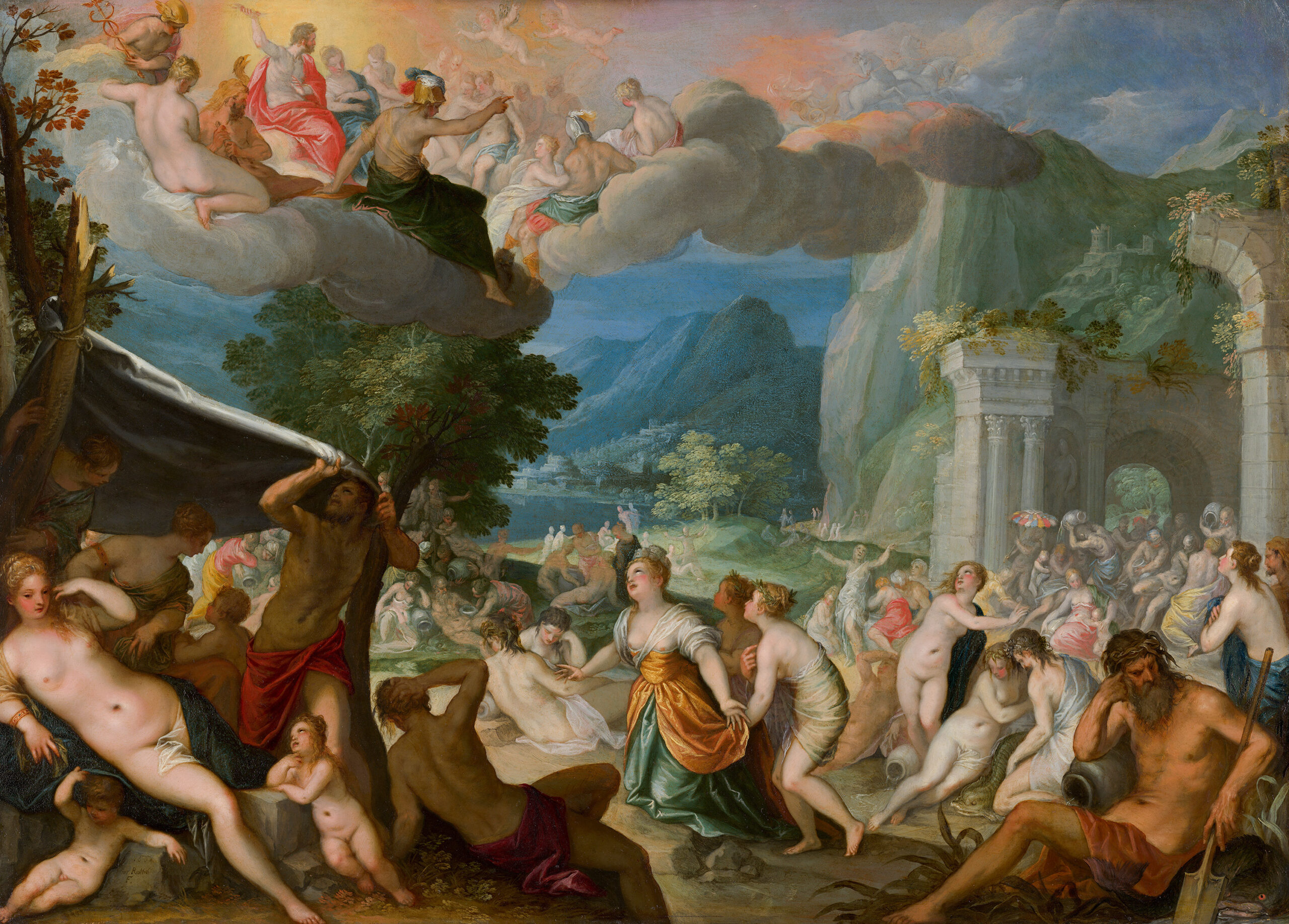
Painted in 1604 by the German artist Hans Rottenhammer (1564-1625), The Fall of Phaeton is an oil on copper in the collection of the Mauritshuis in The Hague. It illustrates an episode from Ovid’s Metamorphoses: Phaeton loses control of the Sun’s chariot, the Earth overheats, and Jupiter strikes him down with a thunderbolt. Rottenhammer focuses above all on the victims of the drought, nymphs and humans searching for shade. The painting is a cabinet picture, a small-format genre in which Rottenhammer was the first German specialist. Trained in Munich and later active in Venice, he combined the Venetian compositions of Tintoretto and Veronese with the Northern landscape tradition, somewhere between late Mannerism and early Baroque. Once part of the collection of Prince William V, the work entered the Mauritshuis in 1822.
I love these small oils on copper, so rich and with such brilliant colours, like those painted by Jan Brueghel the Elder, for example. The comparison is no coincidence: Rottenhammer knew Brueghel in Italy, in Rome, and the two painters sometimes even worked together on the same picture. With its perfectly smooth surface, copper allows a precision of the brush and a luminosity of colour that are hard to achieve on canvas. That is what gives these works their jewel-like quality. This one, The Fall of Phaeton, was painted by Hans Rottenhammer in 1604, at the very start of the 17th century. Its mythological subject, taken from Ovid’s Metamorphoses, strikes me as particularly relevant today. Phaeton, son of the Sun, has persuaded his father to let him drive his chariot for one day. But he cannot control the horses, which bolt. The chariot comes too close to the Earth and makes it overheat: rivers dry up, vegetation burns, and humans and animals alike suffer from the crushing heat. To stop the disaster, Jupiter has no choice but to strike the reckless young man with a thunderbolt. It is hard not to think of the climate change our planet is going through today: an Earth that heats up because a human hand could not master a force greater than itself. Four centuries later, the myth seems more meaningful to me than ever. Whatever the case, this small painting, barely 39 x 54.5 cm, is extraordinarily delicate, and I admire it greatly. I encourage you to look very closely to discover every detail. Click on the image to enlarge it.
Look closely at the bottom left corner. On a grey stone, tiny letters: “1604”, “Rottnh”, then an “F” for fecit. The painter signs his name at a child’s height, right next to a sleeping putto. Now raise your eyes. An ember-like light floods the upper part of the copper. It falls back onto bodies that are naked, sweating, overwhelmed.
The Fall of Phaeton
Copper does not soak up paint. Its smooth surface holds every brushstroke on the metal itself. The Mauritshuis’s page on the work points this out: this support lends itself to fine detail and vivid colour. Look at the orange and green dress of Mother Earth. The silk almost seems to rustle in the heat. She looks up at Jupiter and begs for mercy. Above, the god draped in red is already raising his thunderbolt. Mercury grips his caduceus. All of Olympus is in turmoil on ash-coloured clouds.
Below, everyone is looking for shade. A man stretches a dark cloth above a reclining woman. Beneath the Corinthian ruins, someone opens a multicoloured parasol. Nymphs carry jugs. A bearded old man leans on his, his head in his hand. Look at the flesh tones: pink on the cheeks, pearly on the shoulders. The heat can be read on the skin. A split tree rises on the left. In the distance, a mountain smokes. The gods, meanwhile, do not sweat.
And Phaeton? Look for him at the top right. A tiny team of white horses dissolves into a reddened sky. The title announces a fall. The painting mostly shows those who suffer its consequences. The catastrophe is painted with jewel-like gentleness.
The Mauritshuis holds another revealing work, Rest on the Flight into Egypt, dated 1595: Rottenhammer painted the figures. Jan Brueghel the Elder then added the wooded landscape, the flowers and the donkey. Nine years later, Rottenhammer signs alone. The figures fill the entire foreground. The landscape is no longer a peaceful refuge. It becomes the victim of the story.
This small copper has also travelled a great deal. Prince William V acquired it in 1768. The French seized it in 1795. It spent twenty years in Paris, at the Musée Napoléon. It joined the Mauritshuis in 1822.
Hans Rottenhammer and his time
Hans Rottenhammer was born in Munich in 1564. After training with Hans Donauer the Elder, he left for Italy. In Rome, he met Jan Brueghel the Elder and Paul Bril. In Venice, he studied Tintoretto and Veronese. Their influence shows in these swirling bodies and shimmering fabrics. From them he drew an art that was new for a German: the cabinet picture. Small format, extreme finish, religious or mythological subjects. He was the first German painter to specialise in it. Brueghel, back in Antwerp, sent him copper plates with the landscape already painted. Rottenhammer added the figures in Venice, then sent them back. In 1606, he settled in Augsburg. He died there in 1625, in poverty. His art stands on the threshold of the Baroque, still carried by the momentum of Mannerism.
Mauritshuis news
This year has also been a year of transformation for the Mauritshuis. The museum was closed to the public from Monday 24 August to Sunday 20 September 2026 for building work. During that time, its most famous painting, Vermeer’s Girl with a Pearl Earring, was on show at the Nakanoshima Museum of Art in Osaka. It was a major event: the painting is one of the main reasons people visit the Mauritshuis, and it is lent only in highly exceptional circumstances. It had not travelled abroad since its world tour of 2012-2014. In Osaka, the painting hung alone against a deep blue wall, in a darkened main hall. It was surrounded by other Golden Age works, including another Vermeer, Diana and Her Nymphs, as well as paintings by Rembrandt, Jan Steen and Frans Hals. The choice of Japan makes sense: every year, thousands of Japanese tourists come to the Mauritshuis to see the painting. The director, Martine Gosselink, even spoke of an opportunity to share it with the Japanese public “perhaps for the very last time”. The loan also plays a financial role, as it did in 2012-2014, when the tour drew 2.2 million visitors and helped pay for the museum’s major renovation. Support from the Japanese media group Asahi Shimbun is funding this year’s building work as well as the fitting-out and running of the building on Korte Vijverberg. This building, very close to the Mauritshuis, was opened by the museum on 1 December 2025. The Mauritshuis plans to create an education centre there by 2028.
Source: Mauritshuis.
A question for you
These bodies in motion come from Venice, from Tintoretto and Veronese. Can you see them in the fleeing nymphs?
About this work
- The Fall of Phaeton
- Hans Rottenhammer
- 1604
- Oil on copper
- 39 x 54.5 cm
- Mauritshuis, The Hague
- https://www.mauritshuis.nl/en/our-collection/artworks/284-the-fall-of-phaeton