Key Facts
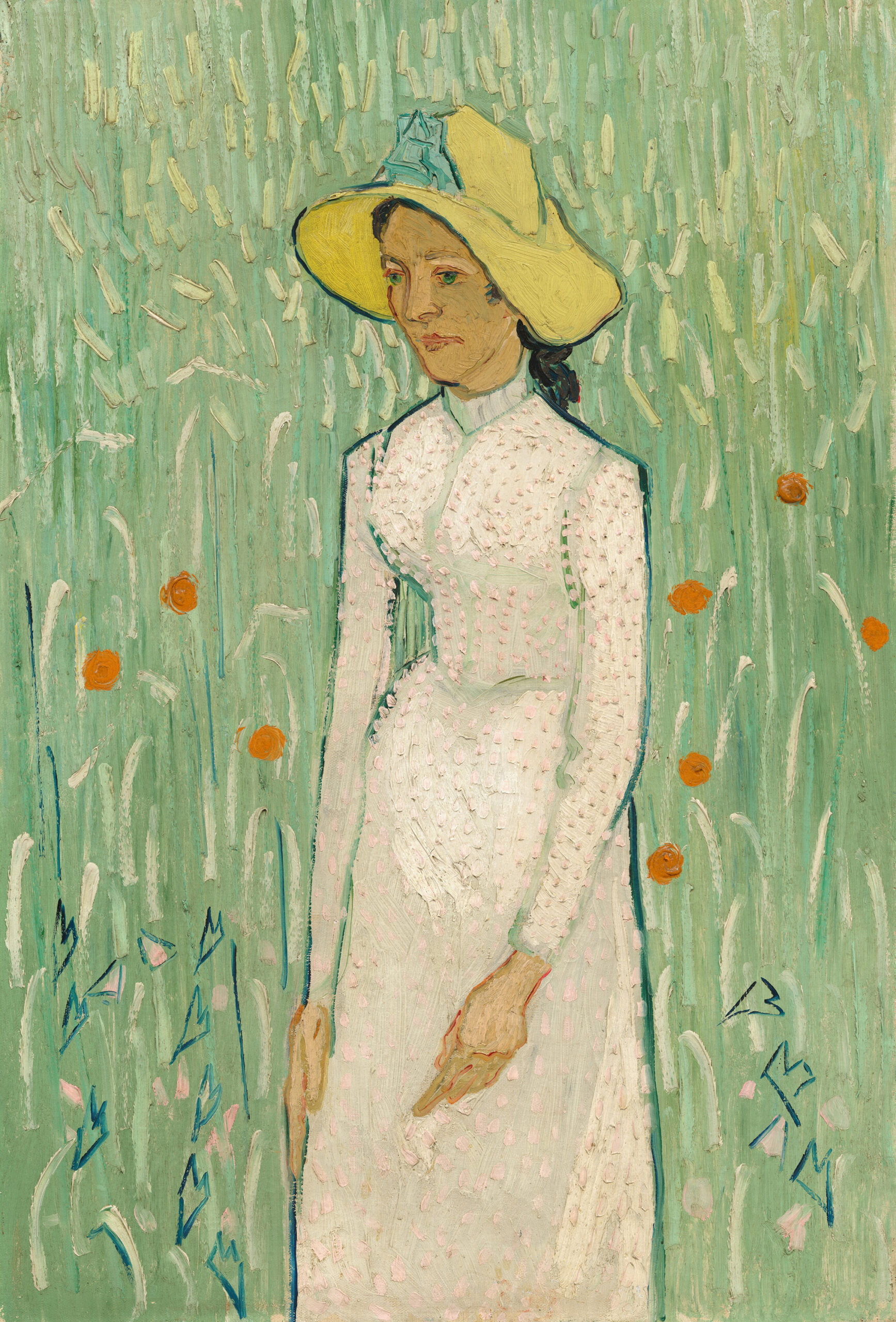
Girl in White is a portrait painted by Vincent van Gogh in 1890, during the final months of his life. The Dutch artist depicts a young peasant woman standing in a wheat field, using a technique characteristic of his late period: flattened forms, complementary colours, and the influence of Japonisme. This oil on canvas, measuring 66.7 x 45.8 cm, belongs to the Chester Dale Collection and is now held at the National Gallery of Art in Washington, D.C. The work is part of the Post-Impressionist movement.
This is a painting of great gentleness, offered to us here by Van Gogh. I find in it, with real pleasure, the influence of the Japanese prints he so admired: that flattened expanse of foliage and orange blossoms in the background, almost abstract, which refuses classical perspective and plays instead on decorative surface rather than depth. The young girl’s face, sketched in a few restrained strokes, makes no attempt to meet our gaze: she seems elsewhere, lost in thought. There is, in this economy of means, few lines, few details of the face, an almost Japanese-inflected precision, where the essential is said through restraint. A Van Gogh at peace, far from the torments so often ascribed to him.
We stand before a half-open hand, left almost limp at her side. Van Gogh paints it with a few strokes, like a held pulse. The gesture is simple. Yet it says a great deal.
What This Girl in White Tells Us
Her white dress is not quite white. Pink and grey dots run through it, laid down in small touches. Van Gogh outlines the figure with a blue-green line, in the manner of a Japanese print. Around her, the wheat field is reduced to vertical strokes, almond green and pale yellow. No shadow models the body. The painter chooses flatness over volume. Orange dabs, poppies or wildflowers, punctuate the canvas like isolated notes. The contrast with the dominant green is stark: two complementary colours set side by side, without transition. The straw hat, bright yellow, is tied with a sky-blue ribbon. She stands slightly bent, as though interrupted mid-stride. Van Gogh paints quickly, in short impasto strokes, yet the composition remains calm. Nothing moves. Everything is suspended.
What the Period Tells Us
Van Gogh painted this canvas in 1890. A near-twin painting exists, in which the same young woman holds a bouquet instead. In a letter, he describes his model as a peasant woman, wearing a large yellow hat tied with a sky-blue ribbon. Van Gogh had been collecting Japanese prints since his years in Paris. Their influence shaped his tendency to simplify form and flatten space. The painting later passed through several hands before entering the Chester Dale Collection, bequeathed to the National Gallery of Art in 1963.
Vincent van Gogh
Vincent van Gogh was born in 1853 in the Netherlands. Born in Groot-Zundert, he grew up in the household of a pastor. He trained himself, late, as a painter. Arles, then Saint-Rémy, marked years of crisis and relentless work. At Auvers, in his final months, his painting grew calmer on the surface. He died on 29 July 1890, at the age of thirty-seven. This Girl in White is among his last portraits.
Current News
The Château d’Auvers-sur-Oise is presenting, from 18 April 2026 to 3 January 2027, an exhibition titled Van Gogh Influenceur, héritages en mouvement. Curated by Wouter van der Veen, a specialist on the artist, it traces Van Gogh’s sources of inspiration, from Millet to Delacroix, as well as his influence on later artists such as David Hockney and Damien Hirst.
Source: Château d’Auvers
A Question for You
If you had to date this canvas without its label, which moment in Van Gogh’s career would you place it in: his darker early years, or his sunlit maturity?
About This Work
- Girl in White
- Vincent van Gogh
- 1890
- Oil on canvas
- 66.7 x 45.8 cm
- National Gallery of Art, Washington, D.C.
- https://www.nga.gov/artworks/46505-girl-white