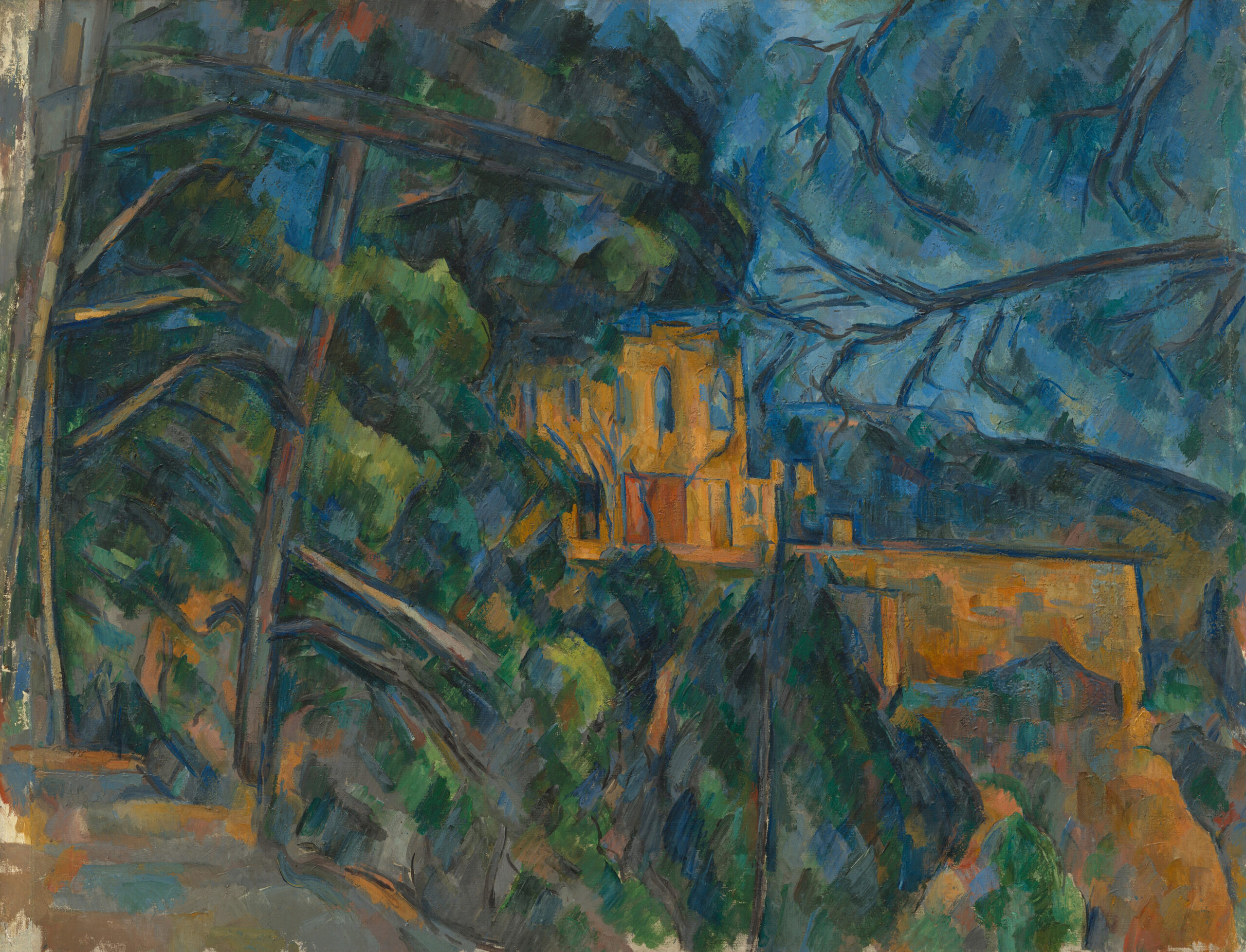
What strikes me most deeply about this Château Noir is the way Cézanne dismisses illusion in favor of something truer. His juxtaposed color planes, those small zones of dark green, ochre, and blue-grey laid side by side, make no attempt to imitate Provençal light: they construct it. Each brushstroke negotiates with its neighbor, and it is from this silent tension that form emerges. The château is not painted so much as assembled, almost architected, as though Cézanne were thinking the landscape at the very moment he saw it. What I find so arresting is that this method is never cold. There is a vibration in these chromatic strata, something that pulses. Color does not illustrate light, it is the light. And in this dense, near-threatening forest that closes around the building, one senses the full intensity of a man who has looked at this landscape scores of times and is still searching, relentlessly, for the right sensation.
A Gothic window cut into ochre. A forest folding the canvas back upon itself. Cézanne returned to the Château Noir repeatedly between 1900 and 1904. This version, held in the collection of the National Gallery of Art, Washington, is among the darkest of the series.
Formal and Technical Analysis
Observe the chromatic construction: tightly packed planes of deep green, violet-tinged blue-grey, mineral orange. Each zone holds its neighbor in place. None recedes in service of atmospheric effect. The sky is not aerial — it bears down, weighted by green and violet touches. The ochre façade pushes back, burning, almost incongruous against the surrounding cold. Cézanne worked en plein air, before the motif, in the discipline inherited from Camille Pissarro. Yet the aim is not Impressionist. The goal is to réaliser — Cézanne’s own term — a total perception: vision, temperament, and thought fused into a single pictorial surface. The short, oblique stroke builds form without drawing it. Post-Impressionism here reaches its furthest frontier.
Historical and Artistic Significance
This painting belongs to Cézanne’s late period, after 1895. Spaces compress. Light darkens. The site itself carries weight: once known locally as the Château Diable, it stands with its Gothic windows and unfinished walls in austere isolation. Cézanne recognized something of himself in it. Order and dissolution contend across the canvas without resolution. That unresolved tension points directly toward what Cubism would become. Picasso and Braque were paying attention.
Paul Cézanne (Aix-en-Provence, 1839–1906) broke with Impressionism to establish a painting of structure. Solitary and uncompromising, he remains a foundational reference for the whole of Western modern art.
Cézanne in Focus: 2025–2026
Cézanne’s work has attracted particular attention over recent months. Aix-en-Provence, the painter’s birthplace, served as the epicenter of a major cultural season under the banner Cézanne 2025, including an international exhibition at the Musée Granet (28 June – 12 October 2025) and the exhibition Aix et Cézanne at the Musée du Vieil Aix, extended through 5 January 2026. The year also saw the progressive restoration and reopening of the painter’s family home and final studio, alongside a dedicated itinerary through the Bibémus quarries. In 2026, marking the anniversary of Cézanne’s death, the Jas de Bouffan estate and its grounds will be fully open to the public, establishing Aix-en-Provence as the place where one can walk, quite literally, in the master’s footsteps.
Source: france.fr/fr/evenement/cezanne-2025
A question for you
💭 If you could carry only a single sensation from this painting with you, which would it be?
About this work
- Château Noir
- Paul Cézanne
- 1900/1904
- Oil on canvas
- 73.7 × 96.6 cm
- National Gallery of Art, Washington DC
- https://www.nga.gov/artworks/45866-chateau-noir