Key facts
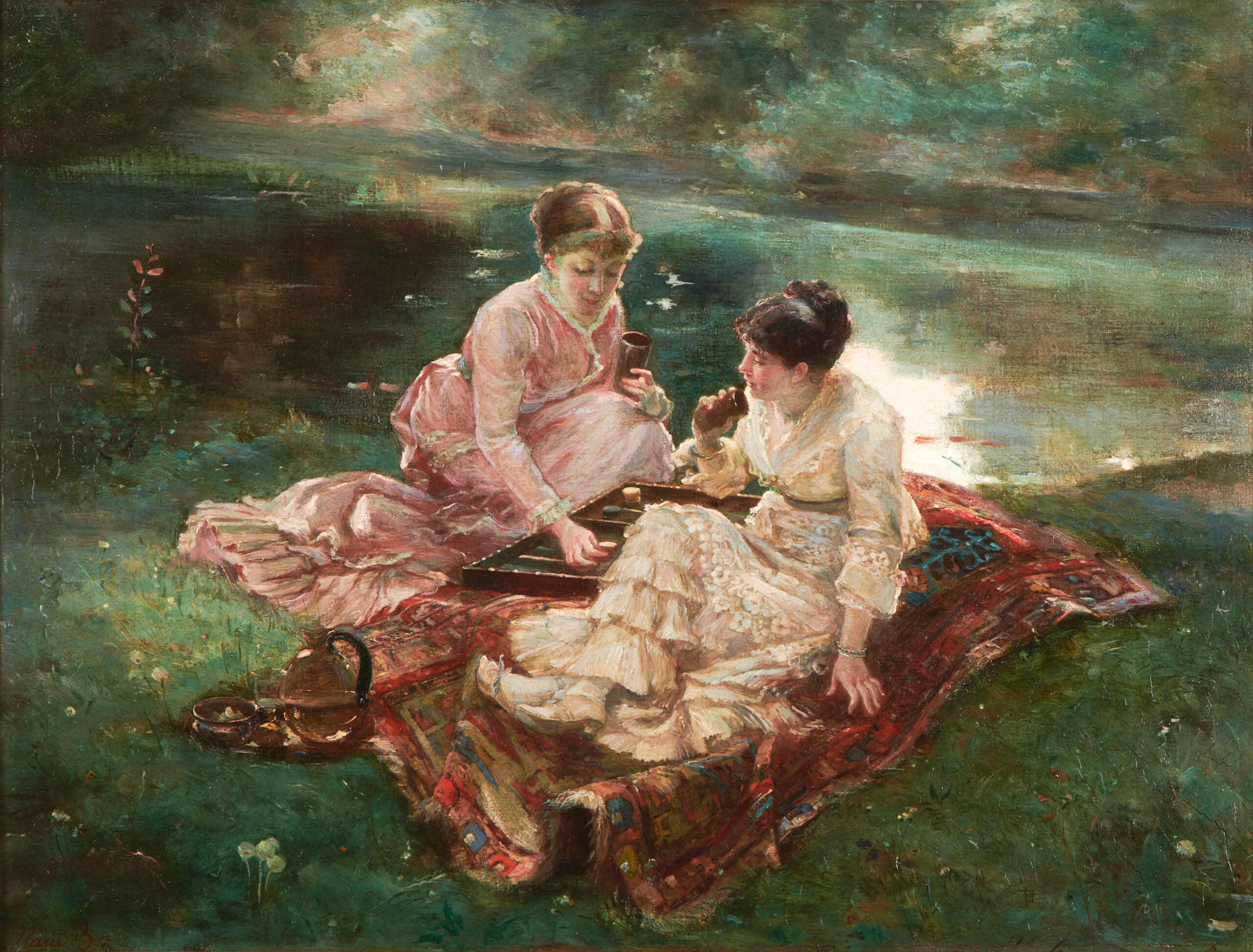
The Backgammon Players (Les joueuses de jacquet) is an oil on canvas painted by Marie Bracquemond between 1870 and 1875. Two young women are playing a game of jacquet, seated on a rug at the water’s edge. The painting dates from the artist’s years of academic training, before she took part in the Impressionist exhibitions of 1879, 1880 and 1886. It combines precise modelling of the figures with a landscape rendered in loose brushstrokes, a sign of her move towards Impressionism. The work remained in the artist’s family until 2024. It has since been held at the Clark Art Institute in Williamstown, Massachusetts.
This game of jacquet is in full swing. Jacquet is a game of dice and checkers very close to backgammon. Both belong to the same very old family of table games, and jacquet is something like its French cousin, popular in the 19th century. The game unfolding before our eyes takes place in a rural setting, most likely a garden. I find this staging interesting because it shows these young women at leisure, caught in a moment of relaxation, far from the bourgeois interiors where they are so often depicted. What strikes me is how natural the scene feels: it doesn’t look posed. It looks like a moment caught on the fly, as if we had quietly crept closer to follow the move being played. The handling of the painting is lively and colourful. The brushwork is free, at times quick, and you can already sense Marie Bracquemond’s close attention to light, several years before she exhibited alongside the Impressionists. You can feel the sun nearby, filtered through the branches of the trees, scattering patches of light over the dresses and the grass. The ladies sit on a rug beside a stream that reflects the light, and these reflections give the whole scene room to breathe, a peaceful sense of depth. The whole is bucolic and inviting. For me, it is a painting that makes you want to sit down beside them. It is also a reminder of how long a woman painter’s view of the lives of the women of her time was underestimated.
You are standing before a dark dice cup. A young woman in white holds it against her lips, motionless. She is hesitating, or savouring the moment. Opposite her, her partner in pink is already moving a checker.
What The Backgammon Players Tells Us
Look at the light first. It does not come from a single source. It filters in from everywhere, softened, as if through invisible foliage. On the right, it turns the water white, like a sheet of metal. Then it slides over the flounces of the cream dress, layer after layer. Marie Bracquemond paints this lace almost thread by thread. Every ruffle catches a point of light. The pink dress stays more fluid, more powdery. The faces are as smooth as porcelain. Each woman holds her own dice cup, ready to throw. Beneath the players, a red and blue Oriental rug glows warm against the cool grass. You can almost feel its coarse wool under your palm. The board, set at an angle, opens up a diagonal. The rug folds in the foreground, its fringes biting into the turf. On the left, an amber carafe, a bowl and some cups wait in the grass. Lower down, a few dandelion clocks tremble close to the ground. Now look at the background. No detail at all. The far bank dissolves into broad green, pink and milky strokes. The water is nothing but a series of reflections laid down in quick scumbles. Two kinds of painting share this canvas. In front, precise modelling inherited from the studio. Behind, free brushwork chasing the light of the open air. The canvas does not choose.
What Marie Bracquemond’s Era Tells Us
The painting dates from 1870 to 1875. By then, Marie Bracquemond has a solid academic training. She studied with Auguste Vassort, then with Ingres. While working as a copyist at the Louvre, she met the engraver Félix Bracquemond, whom she married. In 1875 she is still exhibiting at the official Salon, with La Lecture (Reading). Yet Impressionism is taking shape just a few streets away. She joins the group later, at the exhibitions of 1879, 1880 and 1886. This scene therefore stands on a threshold. Its subject belongs to the elegant painting of the day: fashionable dresses, a parlour game carried out into the garden. The landscape, however, is already looking towards Claude Monet. The figures obey the studio; nature slips out of its grasp. A precious detail: the canvas stayed in the artist’s family until 2024. The Clark Art Institute acquired it that year, at a sale held by Artcurial in Paris.
Born Marie Quivoron in 1840 in Finistère, Brittany, Marie Bracquemond grew up in modest circumstances. This was a far cry from the upper-middle-class world of Berthe Morisot or Mary Cassatt. She painted, drew and decorated earthenware. She also worked at the Haviland studio in Auteuil, alongside her husband. The critics of her day counted her among the three great women of Impressionism. She died in Sèvres in 1916. After decades of neglect, her works are returning to museum walls today, in France as well as in the United States.
Marie Bracquemond in the News
Autumn 2026 confirms the rediscovery of Marie Bracquemond. In Paris, the Musée d’Orsay is devoting a display to her decorative art from 22 September to 6 December 2026. It features a series of studies for her large slip-painted earthenware panel, The Muses of the Arts, shown at the 1878 Exposition Universelle. The display was made possible by major gifts of drawings and paintings by Félix and Marie Bracquemond, given to the museum by their descendants in 2024. At the Petit Palais, the Eva Gonzalès retrospective, open from 15 September 2026 to 24 January 2027, also shows works by Berthe Morisot, Mary Cassatt and Marie Bracquemond that shed light on the intertwined careers of these artists. In the United States, the Saint Louis Art Museum is presenting “Women Impressionists and the Land” from 17 October 2026 to 10 January 2027. It is the first exhibition devoted to landscapes by women Impressionists, and it will then travel to the Minneapolis Institute of Art. The market is following the same trend: the artist’s prices have soared since a record-breaking auction sale in 2024.
Sources: Musée d’Orsay and Saint Louis Art Museum (SLAM).
A Question for You
If you had to hang this painting next to a Monet or an Ingres, which would you choose to show what is new about it?
About this work
- The Backgammon Players (Les joueuses de jacquet)
- Marie Bracquemond
- 1870–1875
- Oil on canvas
- 55.9 × 78.1 cm (22 × 30 ¾ in.)
- Clark Art Institute, Williamstown, Massachusetts
- https://www.clarkart.edu/ArtPiece/Detail/The-Backgammon-Players-(Les-joueuses-de-jacquet)