Key facts
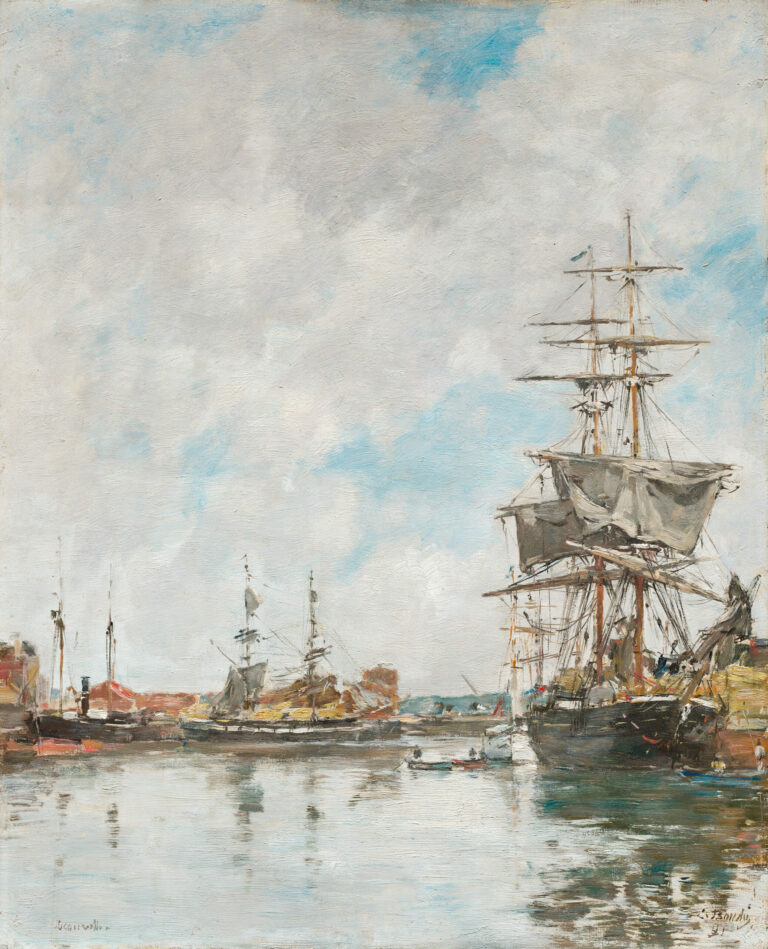
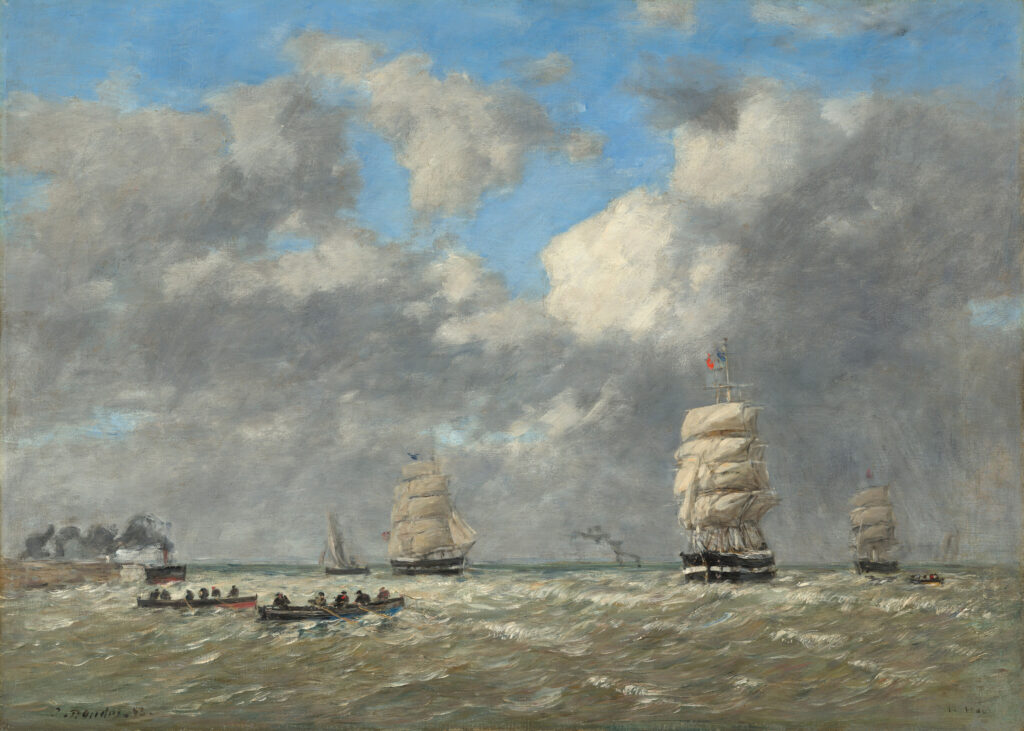
Le Havre is an oil on canvas painted in 1883 by Eugène Boudin (1824–1898), a Norman painter regarded as one of the forerunners of Impressionism. This seascape shows the approaches to the port of Le Havre beneath a cloudy sky that fills roughly three quarters of the composition, with three-masted ships, a steamer and rowing boats. Boudin grew up in Le Havre, where in 1858 he guided the young Claude Monet toward painting directly from the motif, before taking part in the first Impressionist exhibition in 1874. Having passed through the Durand-Ruel gallery, the Walker collection and then the Corcoran Gallery of Art, the canvas has belonged to the National Gallery of Art in Washington since 2015.
The sea and the skies were Eugène Boudin’s favourite subjects, the painter who encouraged the young Claude Monet to go outside and paint en plein air. With Le Havre, this forerunner of the Impressionists already gives us a painting of light and of the impression of the moment. And he knew this port intimately. He grew up here, and as a child he already worked on a boat running between Le Havre and Honfleur. I can fully feel the maritime atmosphere, the tones of a rough sea and a heavy sky that leaves little room for blue. A large part of the canvas is given over to the sky, and it is there that Boudin, nicknamed “the king of skies” by Corot, shows his full mastery. I love the realism that emerges from this canvas, so deeply rooted in its time: tall sailing ships sit alongside steamships, witnesses to a port in full transformation at the end of the 19th century. The boats laden with rowers head out to the ships for a departure I imagine is imminent. The flags snap in the wind, and you can almost hear the port stirring.
Looking at Le Havre
A thread of red, barely a stroke, edges the hull of a rowing boat. Look at the lower left. Rowers bend over their oars in water the colour of cloudy jade. The foam breaks into white commas, pearly with pink and gold. Further off, a steamer belches black smoke along the jetty. On the right, a curtain of rain is already swallowing the last three-master.
Understanding the work
The horizon sits a quarter of the way up. Everything else belongs to the sky. Boudin layers leaden greys and creamy whites, laid on thickly across the great cumulus. The brushwork stays visible throughout, quick, almost nervous. The sailing ships, however, keep their rigging, their shrouds, their tricolour flag. The steamer is no more than a silhouette and a trail.
In 1883, Eugène Boudin is fifty-nine. It was here, in Le Havre, that he took Claude Monet out to paint from the motif in 1858. In 1874, he exhibits alongside him at the first Impressionist exhibition. Eleven years before this seascape, Monet painted Impression, Sunrise in this very port. Same estuary, same watery light. Yet Boudin never dissolves his ships into the mist.
The painting’s fate also reflects the taste of an era. In 1899, a year after the painter’s death, it enters the stock of Durand-Ruel, the Impressionists’ dealer. It then crosses the Atlantic to join the collection of Edward and Mary Walker, between Ontario and Washington. Bequeathed to the Corcoran in 1937, it joins the National Gallery of Art in 2015. Like many of his canvases, it owes its place to American collectors.
Feeling
The canvas is called Le Havre. Yet of the town, all we glimpse is a stretch of jetty. The real subject floats above. Feel the wind filling the sails and hollowing the swell. Salt stings the lips, the air smells of coal. The rowers struggle, the three-masters stand there, indifferent. Everything moves forward, nothing arrives. Look at the brilliant white of the great cloud: it is the only warmth in the painting. It never touches the sea.
News: the Friends of the Musée Eugène-Boudin in Honfleur
In the painter’s hometown, the Musée Eugène-Boudin is paying tribute until 3 January 2027 to the Société des Amis du Musée Eugène-Boudin (SAMEB), which is celebrating its 70th anniversary with an exhibition that opened on 28 August 2026. Founded in 1956, the association set out to support the development of the municipal museum, enrich its collections and enhance the works through restoration and framing. In particular, it helped extend the collection toward the 19th-century forerunners and acquire 20th-century works that complement the holdings of artists already represented in the museum. Throughout the exhibition, SAMEB members present it to the public every Saturday at 4:30 p.m. Themed tours are also scheduled, along with a trail devoted to the works donated by SAMEB over the years. Founded in 1868, the museum brings together around Boudin the painters of the Seine estuary, including Courbet, Monet, Jongkind, Dubourg and Cals.
Source: Musée Eugène-Boudin, Honfleur.
A question for you
In 1976, an American exhibition presented this canvas among the painters of the Saint-Siméon school, alongside Jongkind: looking at it today, would you place it on the side of Realism or of Impressionism?
About this work
- Le Havre
- Eugène Boudin
- 1883
- Oil on canvas
- 52.39 × 72.87 cm (20 5/8 × 28 11/16 in.)
- National Gallery of Art, Washington, D.C.
- https://www.nga.gov/artworks/195115-le-havre