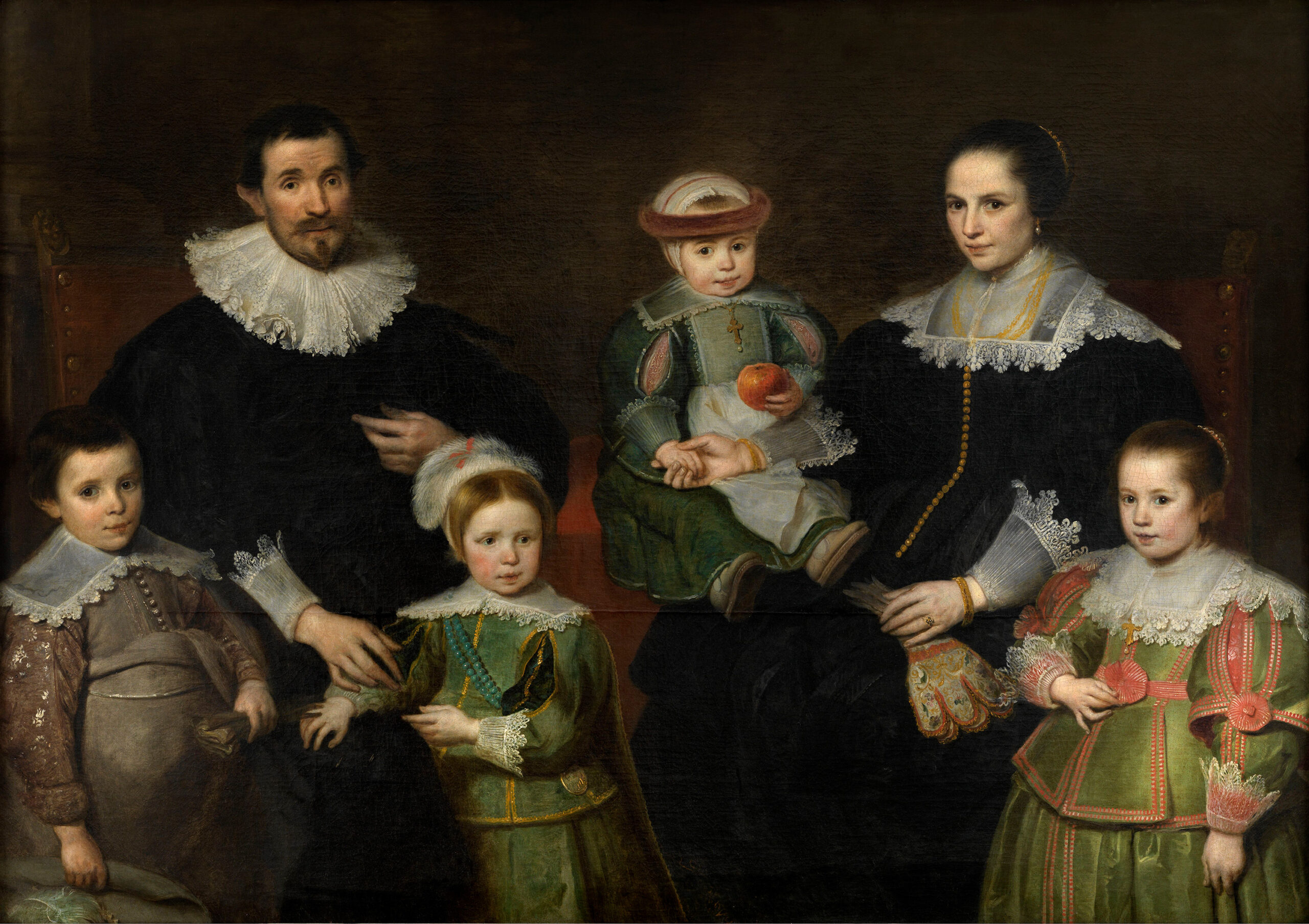
The family portrait is a relatively rare genre in the history of art, and this one caught my attention immediately. What strikes me most is the way the children are depicted. In the seventeenth century, the convention was to paint them as small adults, same rigid postures, same gravity. Here, De Vos departs from that norm. The children have children’s faces: a gentle, almost candid presence that speaks to an uncommon sensitivity for a portraitist of his time. Take a moment, too, to study the costumes, lace collars, dark fabrics with subtle sheen. Every sartorial detail is a precious document on fashion and social standing in the Spanish Netherlands of the 1630s.
Antwerp, around 1632. Cornelis de Vos receives a bourgeois family in his studio. He observes, arranges, and waits for the right gaze. He sees them, at last, as they truly are. The father, in his black doublet, rests a hand on his eldest son’s shoulder. A simple gesture. Genuine. The mother holds the youngest on her lap. The child clasps a red apple in his small hand, unaware of what it signifies: fertility, the promise of a lineage. De Vos knows. His contemporaries will read the symbol without effort. But what holds his attention is the gaze of the girl in green, directed straight at him. Direct. Curious. Not the gaze of a small adult dressed for posterity. The gaze of a child. Rubens paints gods. Van Dyck paints princes. De Vos paints what he sees: people who love one another, and wish that to last.
A composition in service of the group
Cornelis de Vos structures the canvas with precision. The parents frame the children without overwhelming them. The luminous greens of the ceremonial dress stand against the severe blacks of the adults. Light models each face with restraint. The rendering of textiles, satin, lace, embroidered velvet, achieves a remarkable exactitude. De Vos does not seek the ideal. He seeks the true.
Cornelis de Vos, portraitist of the Antwerp bourgeoisie
Born in Hulst around 1584, De Vos settled in Antwerp and was admitted to the Guild of Saint Luke in 1608. A friend and collaborator of Rubens, he built his reputation between 1620 and 1640 as the preferred portraitist of the city’s merchant families. He died in Antwerp in 1651.
Currently in Ghent
The MSK Ghent, which holds this Family Portrait, presents until 31 May 2026 the exhibition “Unforgettable: Women Artists from Antwerp to Amsterdam, 1600-1750”, rehabilitating more than 40 female artists of the Golden Age. A resonant counterpoint to this painting, in which the mother occupies a central place : silent, and sovereign.
Source: mskgent.be/en/exhibitions/inoubliables
A question for you
💭 Looking at this painting, do you see a family posing for posterity, or a moment of life caught on the wing?
About this work
- Family Portrait
- Cornelis de Vos
- c. 1630-1635
- Oil on canvas
- 143.5 × 204.5 cm
- Museum of Fine Arts Ghent (MSK)
- https://www.mskgent.be/fr/collection/1958-i