This painting moves me deeply, and I believe I understand why it continues to resonate today. Fleeing a dictatorship, a war, an epidemic: these realities remain the daily experience of millions. What strikes me about Gawell is his capacity to paint flight without pathos, with an almost cruel tenderness. The cold palette establishes a heavy silence that I read as a lucid resignation, more harrowing still than any cry.
This melancholic gaze is undoubtedly inseparable from the artist’s own experience: Gawell himself fled Nazi Germany in 1938. He knew what it meant to leave with almost nothing, and that sincerity is felt from the very first glance. At a time when the world’s instability intrudes upon our screens daily, Refugees asserts itself as a work that does not age.
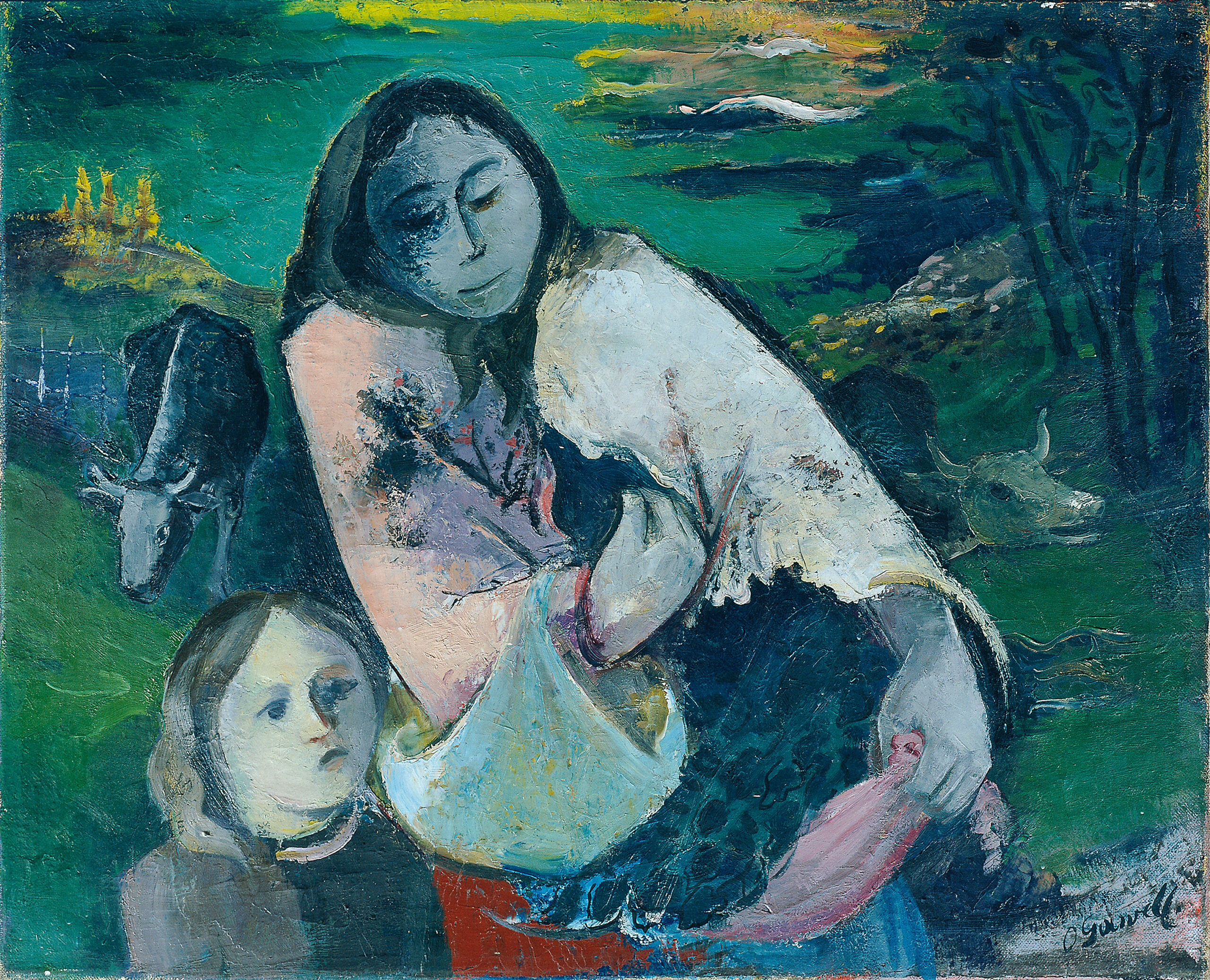
You are looking at a hand. Just a hand. The woman’s hand, resting with a gentleness that contradicts everything around it. The canvas vibrates with an almost violent green, a landscape that is itself receding into the distance. Oskar Gawell places his figures in the foreground, massive, against no reassuring horizon.
What the canvas tells us
Look at the surface. The paint is thick in places, scraped, laid in broad Expressionist passages. The faces do not seek your gaze. The peasant woman tilts her head in an instinctive, almost animal gesture. Behind her, a grey cow barely separates itself from the background: a mute presence, companion in wandering. Gawell works colour against emotion: the green of the landscape is almost festive, and therein lies the tension. The painting’s chromatic beauty refuses to mourn what it depicts.
What the period tells us
Oskar Gawell painted this scene during a troubled time. A student of Lovis Corinth in Berlin, close to the Die Brücke group, and a member of the Vienna Secession, he lost his Berlin professorship under Nazi pressure. In 1938, he fled. He arrived in Vienna, a refugee himself. This undated canvas may bear the intimate weight of that experience of dispossession. The oil on canvas, 69 × 84.5 cm, is today held in the collection of the Belvedere, Vienna. Oskar Gawell (1888–1955), born in East Prussia, trained in Breslau, Weimar, and Berlin. A lyrical Expressionist, and a largely overlooked figure in post-war Austrian art.
A resonance that does not fade
The title Refugees reverberates differently across eras, and it has never ceased to be current. The autobiographical dimension of this work, documented by Gawell’s biographers, lends it a rare sincerity. The Belvedere Vienna, which holds this canvas, is one of Europe’s most active museums in 2026, with several major exhibitions running through the autumn.
A question for you
💭 If you were to place this canvas within a museum, somewhere between a Renaissance Pietà and a Käthe Kollwitz from the 1920s, where, precisely, would you put it?
About this work
- Refugees, Peasant Woman and Child
- Oskar Gawell
- Undated
- Oil on canvas
- 69 × 84.5 cm
- Belvedere Museum, Vienna
- https://sammlung.belvedere.at/objects/3468/fluchtlinge