Key facts
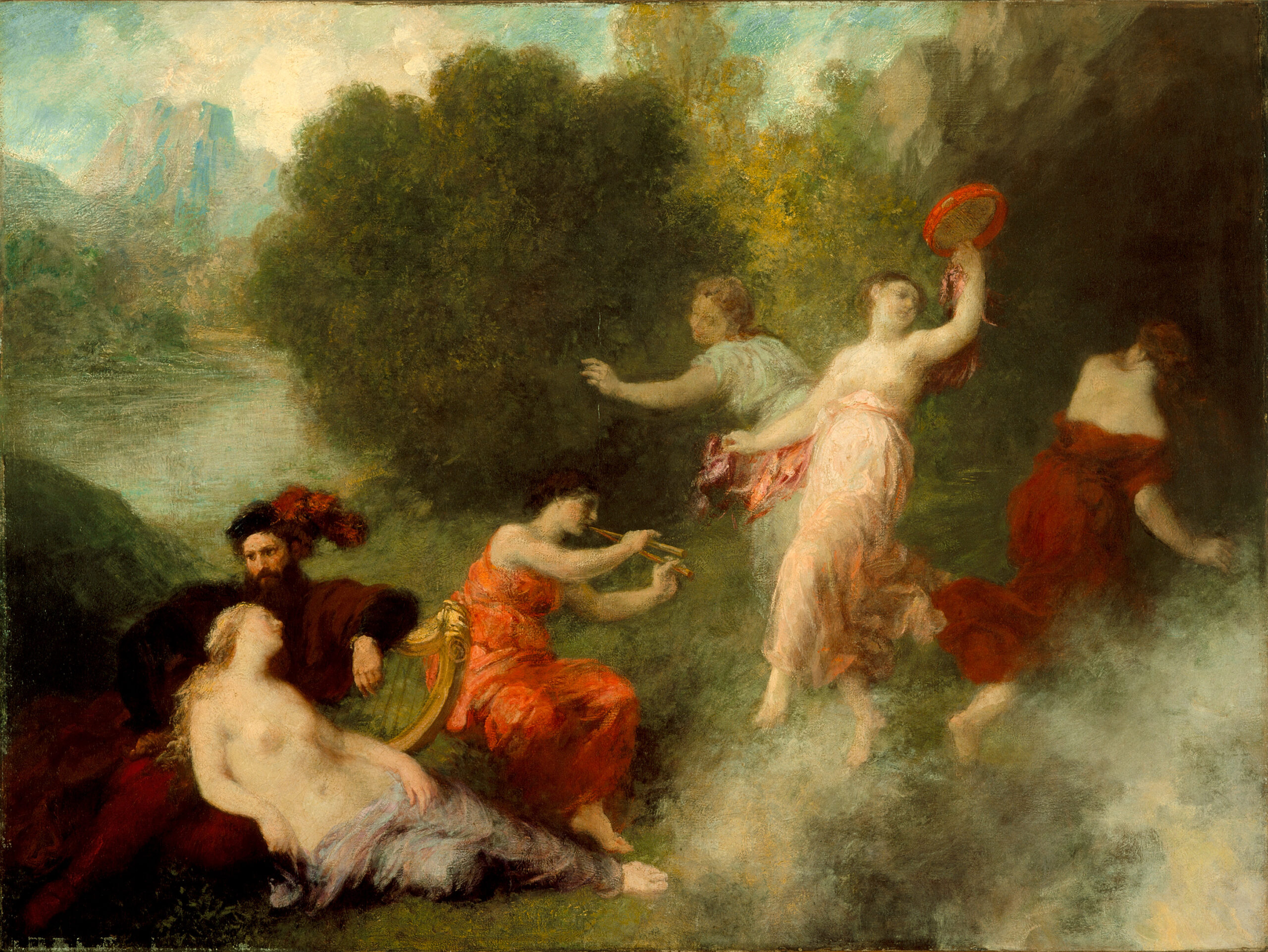
Tannhäuser on the Venusberg is an oil on canvas painted in 1864 by the French painter Henri Fantin-Latour (1836–1904). Inspired by Richard Wagner’s opera Tannhäuser, the painting shows the knight beside Venus, surrounded by nymphs playing music and dancing. The artist’s first work of imagination, it seeks to translate musical emotion into colour, in the spirit of Baudelaire’s correspondences. Shown at the Salon of 1864, it was poorly received, and Fantin-Latour long judged it harshly. Yet it opened the dreamlike, Wagnerian vein that the painter would pursue, notably in lithography, between late Romanticism and Symbolism. The work is held at the Los Angeles County Museum of Art, thanks to a gift from Mr. and Mrs. Charles Boyer.
I am a great Wagner fan, and Tannhäuser is one of his operas I love most. It is also one of the best known. So it was only natural that I stopped at this painting while browsing LACMA’s online collections. It moved me because it shows Tannhäuser at the very beginning of the story, still Venus’s prisoner on the Venusberg. We know what comes next: the knight, weary of pleasure, will long to return to the world of men, and Venus will not let him go without anger. Fantin-Latour chooses not to show this drama. He freezes the moment before, the moment of the idyll, when Tannhäuser still belongs entirely to the goddess.
This choice speaks to me all the more because Fantin-Latour was himself a fervent Wagnerian, at a time when defending Wagner in Paris was far from obvious. In 1861, the Paris premiere of Tannhäuser at the Opéra turned into a scandal, and the work was withdrawn after three performances. Painting this subject three years later, and showing it at the Salon of 1864, meant taking a stand. Fantin would return to it throughout his life, notably in his many lithographs inspired by Wagner’s operas.
What strikes me most is the atmosphere. The forms seem bathed in a golden, misty light, the outlines stay blurred, as if the scene already belonged to dream or memory. To me, Fantin-Latour’s interpretation is strongly marked by the style of his time, which I would personally call late Romanticism, or a Romanticism in transition: you can still feel the legacy of Delacroix, whom Fantin admired, but also a foretaste of the Symbolism he would drift toward at the end of his career. It is this music, more than the story, that he seeks to put into paint. And that is probably why, as a Wagner lover, I feel so at home in it.
A golden harp rests against Tannhäuser’s arm. No one plays it. Its strings stay silent, within the knight’s reach.
Seeing Tannhäuser on the Venusberg
Look at the flesh first. Venus abandons herself against the knight, naked to the hips, her face raised toward him. A lilac drape slides over her legs. Tannhäuser wears a dark doublet and a hat with red plumes. He does not look at her. His eyes are fixed on a point beyond the canvas. Beside them, a musician draped in orange blows into a double flute. Further off, the nymphs dance barefoot. One raises a red tambourine. Another, dressed in crimson, hurries toward the rock face. The palette sets warm reds against the deep greens of the grove. In the distance, a river and blue peaks close the horizon. In the lower right, a white mist swallows the bodies. The brushwork stays visible, almost sketched. Outlines dissolve into vapour.
Understanding Henri Fantin-Latour
Henri Fantin-Latour did not attend the Paris premiere of Tannhäuser in 1861. He discovered the opera in fragments, at a concert given by Pasdeloup the following year. As early as 1862, he drew from the subject his first lithograph, commissioned by the publisher Cadart. Then, sketch after sketch, he searched for the place of each figure. The Musée de Grenoble holds a study from 1864, in a far more modest format. LACMA owns the large version, an oil on canvas given by Mr. and Mrs. Charles Boyer.
Shown at the Salon of 1864, the canvas met with indifference at best, incomprehension at worst. Fantin himself long regarded it as a failed attempt, a youthful mistake. That same year, however, he presented his Homage to Delacroix, a realist group portrait. On one side, friends in black frock coats. On the other, a naked goddess in the mist. This is his first work of imagination. In it, he pursues what Baudelaire called correspondences: carrying music over into colour. Wagner would never leave him. In 1876, he travelled to Bayreuth to hear the Ring.
Feeling
Move closer to the mist. It seems warm, almost damp. It swallows the dancers’ ankles and erases the ground. Nothing here has weight. Only the two lovers stay anchored in the grass, heavy with red and flesh. Everything else floats. Listen to the flute, imagine the tambourine. You are in a bacchanal, but a silent one. The harp is still silent.
Wagner’s libretto confines the knight inside the mountain. Fantin places him in the open air, between river and blue peaks. An open paradise or a prison without walls? Venus sees only him. He looks elsewhere.
News: Impressionism in the spotlight, Tannhäuser in storage
Until January 3, 2027, LACMA is presenting the exhibition Collecting Impressionism at LACMA in the Resnick Pavilion, which opened on December 21, 2025. Rather than a simple stylistic survey, it tells the story of how the museum built its collections. It focuses on acquisition choices and on the tastes of the donors who gradually made Impressionism the face of the late 19th century. The show brings together more than 100 works, from the first acquisitions of American and California Impressionism to gifts of Degas and Pissarro from major Hollywood collectors. It all began in 1929, when real estate developer William Preston Harrison gave the museum ten paintings by Childe Hassam. The exhibition also features recent acquisitions, such as Monet’s The Artist’s Garden, Vétheuil (1881) and Tarascon Stagecoach (1888), the first painting by Van Gogh to enter LACMA’s collection. It is curated by Leah Lehmbeck, curator and head of the departments of European Painting and Sculpture and American Art, with David Bardeen. For anyone discovering Tannhäuser on the Venusberg, it is a chance to place Fantin-Latour, a friend of Manet and the future Impressionists who nonetheless kept his distance from the movement, within the history of taste that shaped the museum.
Source: LACMA.
A question for you
Looking at this scene, what stays with you first: the bodies, the mist, or the music?
About this work
- Tannhäuser on the Venusberg
- Henri Fantin-Latour
- 1864
- Oil on canvas
- 97.63 × 130.33 cm (38 7/16 × 51 5/16 in.)
- Los Angeles County Museum of Art (LACMA)
- gift of Mr. and Mrs. Charles Boyer (acc. no. 59.62)
- https://collections.lacma.org/object/20926