Florence, circa 1500. Filippino Lippi composes a mysterious painting where ancient mythology meets the grace of the Renaissance.
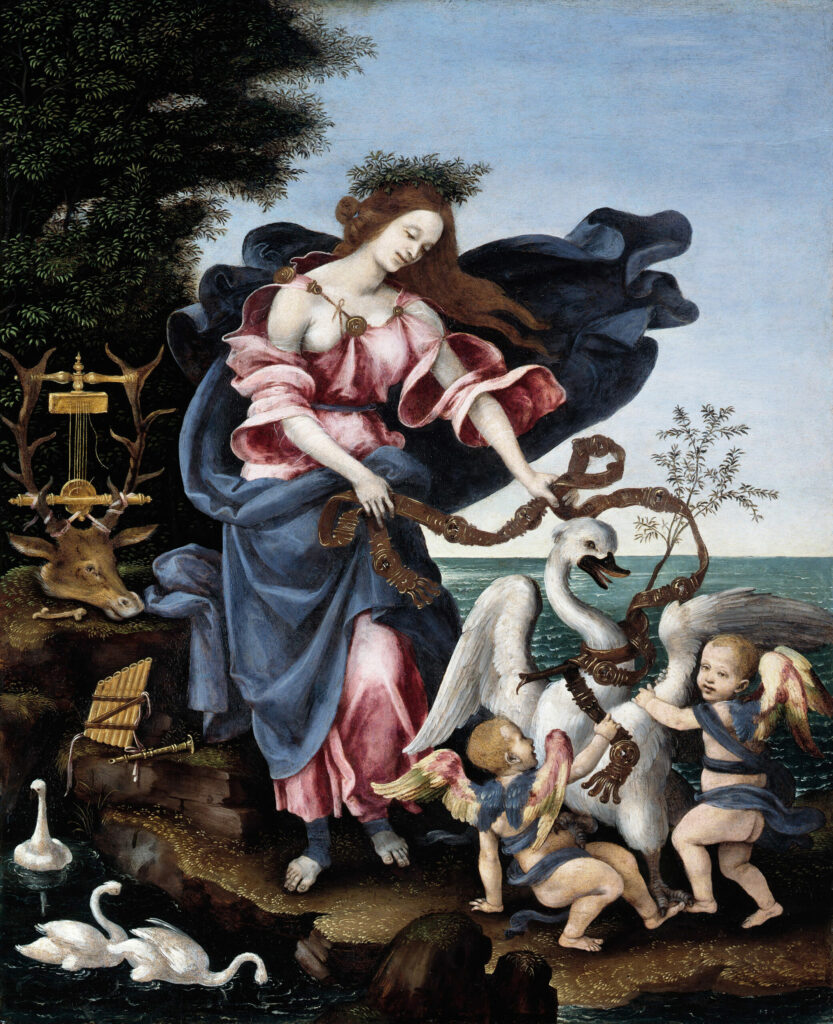
A young woman stands on a shore, dressed in rose and deep blue. Her auburn hair floats in an invisible breeze. She holds a long golden ribbon that two putti use to bind a majestic swan. Three smaller swans swim toward the left. Every detail reveals Lippi’s virtuosity: the reflections on the white feathers, the silky folds of the fabrics, the light caressing Erato’s pale skin.
A Poetic Allegory of Creation
On a rock rest the muse’s attributes: a Pan flute, a shawm, and a lyre stretched between a stag’s antlers. These instruments evoke lyric poetry, of which Erato is the protector in Greek mythology. The swan, symbol of Apollo and beauty, reinforces this celebration of the arts. Filippino Lippi paints on poplar wood, each element forming a visual rebus that Florentine humanists loved to decipher.
The Refinement of the Renaissance
This period sees Florence become the beating heart of humanism. Artists rediscover classical Antiquity and transform myths into sophisticated meditations. Lippi belongs to this generation that marries naturalistic observation with poetic imagination.
Filippino Lippi, Heir to Botticelli
Filippino Lippi (1457-1504), son of the painter Fra Filippo Lippi, trained under Botticelli. He developed an elegant, energetic style rich in symbolic details. This Muse Erato perfectly illustrates his ability to create dreamlike worlds where formal beauty and intellectual depth converge.
Think about it
💭 Which instrument would you choose to accompany this poetic scene by the water?
About This Work
- The Muse Erato
- Filippino Lippi
- circa 1500
- Oil on poplar wood
- 62.5 × 51.8 cm
- Gemäldegalerie, Staatliche Museen zu Berlin
- https://recherche.smb.museum/detail/866844/die-muse-erato