Holland, Spring 1886: Monet’s Hesitation. Invited by a French diplomat to discover the tulip fields of Sassenheim, Monet initially hesitated. He feared that oil paint could never truly capture the brilliance of such vibrant, living colors.
Light as Raw Material
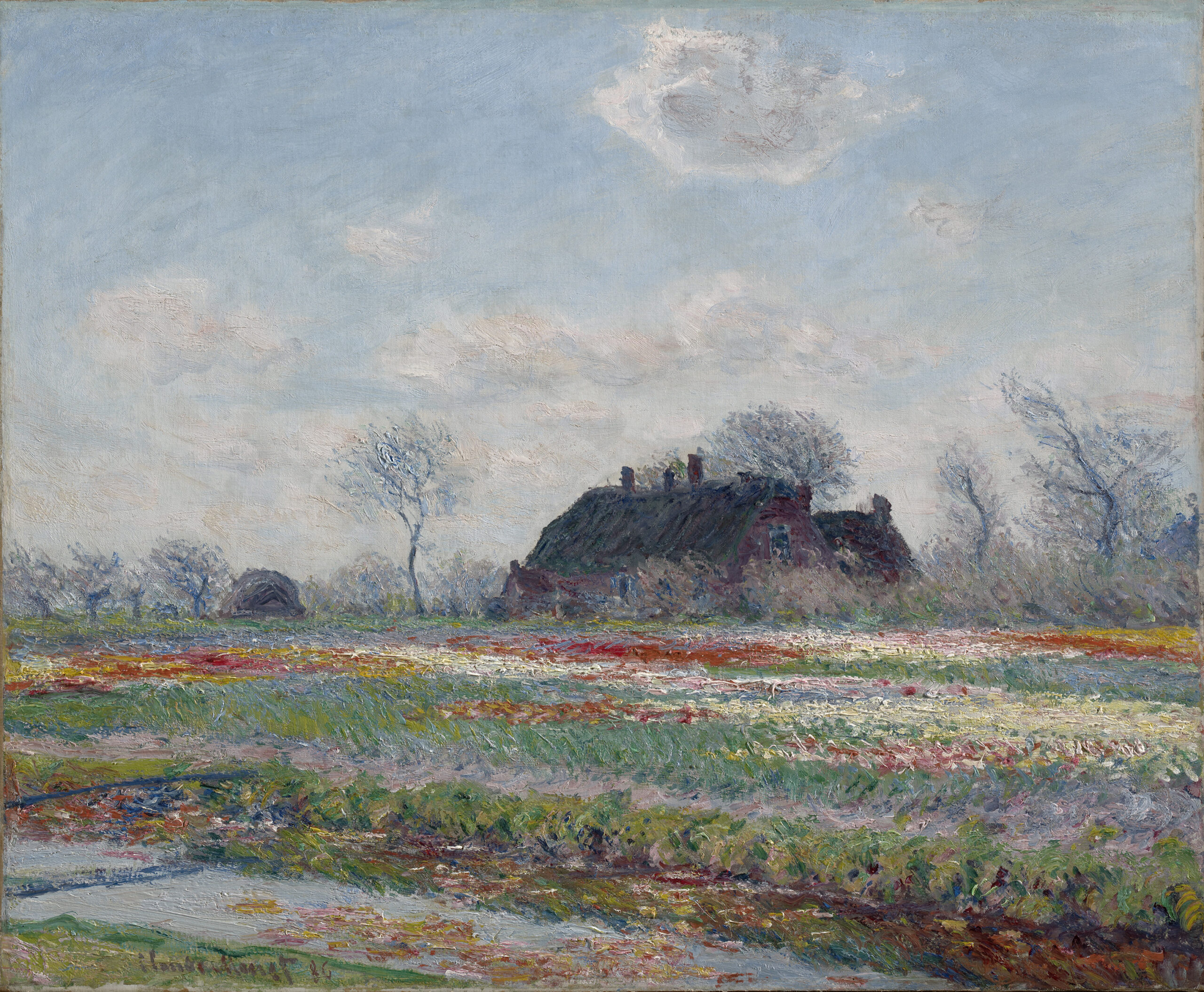
Observe the foreground: bands of vivid red, yellow, violet, and cream stretch across the canvas in parallel brushstrokes. The application is generous; the flowers seem to vibrate under the spring sun. At the center, a Dutch farmhouse anchors the composition while bare trees quiver in a light breeze. The pale blue sky, streaked with white clouds, diffuses a light that is simultaneously soft and cool. Monet constructs the space through successive horizontal strata.
An Impressionist Challenge Overcome
By 1886, Impressionism was already an established revolution. Claude Monet was now exploring new territories, turning the Dutch tulip fields into a chromatic laboratory. This work foreshadows his great future series: the same obsession with shifting light, the same dissolution of detail into pure color. Sterling Clark acquired the canvas in 1933 directly from Paul Durand-Ruel, Monet’s historic dealer.
Claude Monet
Claude Monet (1840–1926) is the undisputed leader of French Impressionism. Trained in Gleyre’s studio, he quickly broke away from academic traditions to paint en plein air (outdoors). His technique revolutionized Western painting: he did not merely represent objects; he captured the light reflecting off them at a precise moment. From the Water Lilies of Giverny to the Rouen Cathedrals, he pioneered the concept of the pictorial series. Tulip Fields is a vital milestone in this trajectory.
Think about it
💭 These rows of explosive color have traveled through time intact. Which hue catches your eye first—and why?
About This Work
- Tulip Fields at Sassenheim
- Claude Monet
- 1886
- Oil on canvas
- 59.7 × 73 cm
- Clark Art Institute, Williamstown (Ref. 1955.615)
- https://www.clarkart.edu/ArtPiece/Detail/Tulip-Fields-at-Sassenheim
The Challenge of Painting Pure Colour
Before painting the Dutch tulip fields during his 1886 trip, Monet expressed his concern: how could oil paint possibly capture the brilliance of such chromatic saturation? The horizontal bands of red, yellow, violet, and cream that make up the foreground of this canvas answer the question through the brushwork itself, generous, direct, applied with a confidence that belies the declared hesitation. A modest farmhouse anchors the centre of the composition, surrounded by bare trees, while a pale sky streaked with clouds diffuses a cool spring light. Sassenheim is a village in the Leiden region, a few kilometres from the large bulb-growing operations that make Holland the world capital of cut flowers. The canvas was acquired in 1933 by American collector Sterling Clark directly from the dealer Durand-Ruel, before entering the collection of the Clark Art Institute in Williamstown, Massachusetts.
1886: Monet Between Two Revolutions
This Dutch visit came at a pivotal moment in Monet’s career. By 1886, he was already an accomplished Impressionist, but he was also in the process of moving beyond Impressionism in the strict sense to explore serial painting: how does a single motif transform under different light, at different times of day, across different seasons? Tulip Fields at Sassenheim anticipates this method: the colour bands are less a description of a specific field than an exploration of how pure colour, in repeated strips, creates a visual rhythm independent of the motif. It is the same logic that would lead Monet to the haystacks, the cathedrals, and ultimately the Water Lilies.