Key facts
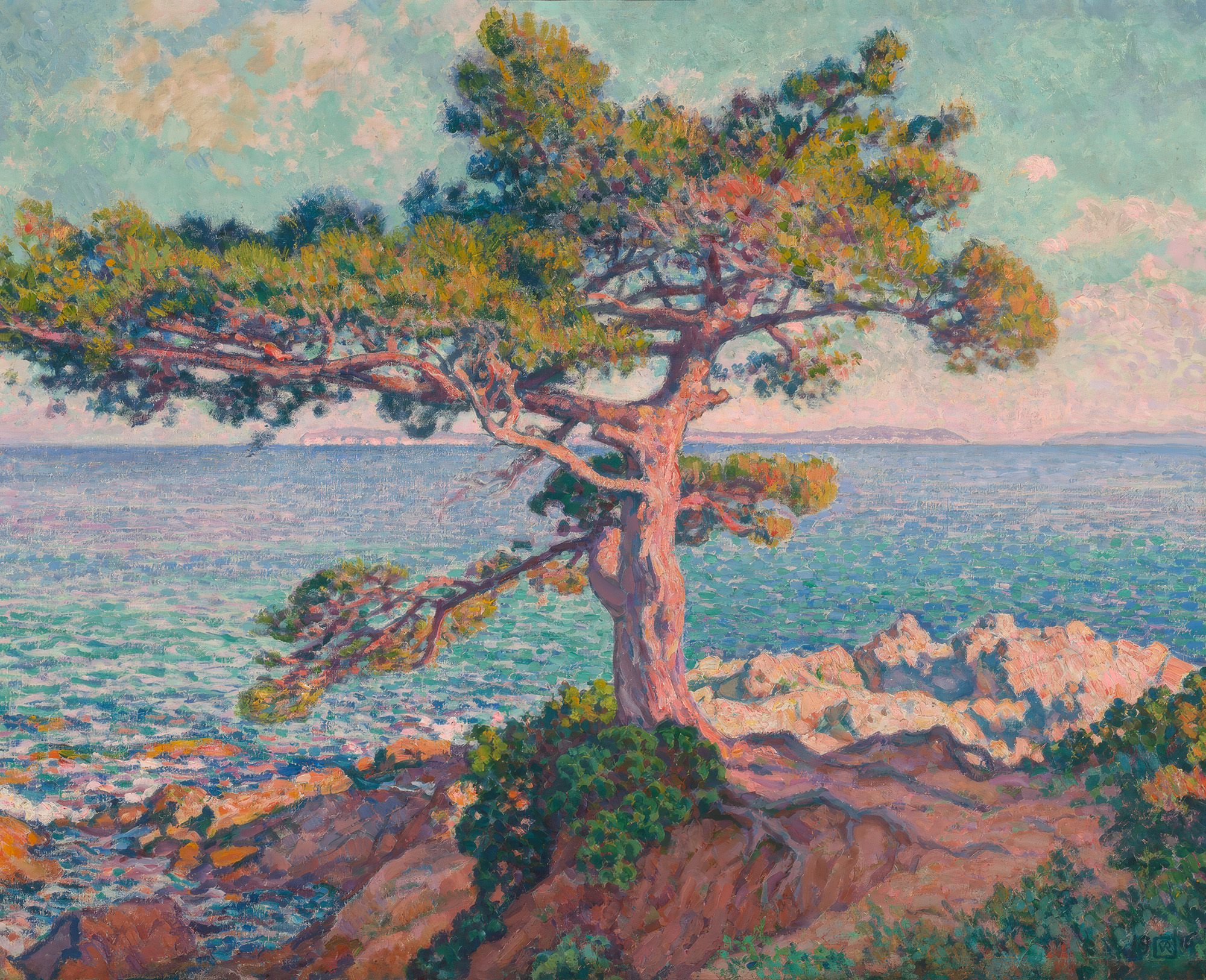
Painted in 1916 by the Belgian artist Theo van Rysselberghe, born in Ghent in 1862 and died in Le Lavandou in 1926, Paysage du Midi (Southern Landscape) depicts a pine tree standing on the rocky coast of Saint-Clair, facing the Mediterranean and the islands of Le Levant and Port-Cros. The canvas belongs to Divisionism, or Neo-Impressionism, of which the painter was a leading figure in Belgium. It dates from his southern period, during which he adapted the division of tones inherited from Seurat into longer, freer brushstrokes. A co-founder of Les XX in Brussels, Van Rysselberghe devoted the final part of his career to the coast of the Var. The work is held at the Centraal Museum in Utrecht.
Theo van Rysselberghe is a major exponent of Divisionism in Belgium, and this canvas is a fine demonstration of it. When I first discover it, the technique is what strikes me: the landscape is not painted in flat areas of colour; it is built from a multitude of small, juxtaposed touches of colour that the eye recombines on its own from a distance. By 1916, the painter had taken liberties with the rigour of Seurat’s pointillism: the brushstroke lengthens and loosens, and that is what gives the scene room to breathe. The canvas seems to capture the end of the day over the Mediterranean, in a light that makes the sea and the rocks vibrate. The Centraal Museum’s catalogue entry quotes a letter that pinpoints the viewpoint: we are in Saint-Clair, in Le Lavandou, with the Île du Levant on the left and the Île de Port-Cros on the right. Knowing that van Rysselberghe painted this landscape from his own home, on a coast he had made his own, changes how I read the painting: this is not a passing view but a familiar, almost intimate gaze. What I love above all is its vibrant rendering. Up close, you see only a web of brushstrokes; step back, and everything comes together into a wide, richly coloured view of the Var coastline. That is the advice I would give anyone looking at this work, even in reproduction: take the time to move back and forth between the detail and the whole.
Look first at the trunk. It is not brown. It is pink, salmon, almost flesh-coloured, streaked with mauve in its hollows. At its foot, the roots creep across red earth like exposed veins. The light settles there, on the bark, before it reaches the sea.
A brushstroke for every material
Notice how Theo van Rysselberghe changes his gesture depending on what he paints. The sea breaks into small horizontal strokes of turquoise, cobalt and white. It shimmers without a single reflection being described. The sky is laid down in pale commas of eau-de-nil and pink. The trunk receives long strokes that follow its twist. On the right, the rocks are arranged in pale facets, almost carved. Seurat’s round dot has disappeared. The Divisionist principle remains: pure colours, placed side by side, which the eye blends from a distance. Look at the pink of the pine against the blue-green of the water. These complementary colours answer each other and warm the surface. The shadows are never black; they turn violet.
Theo van Rysselberghe: the painter from Ghent and his shoreline
Born in Ghent in 1862, Theo van Rysselberghe co-founded Les XX in Brussels, a hub of the avant-garde. His encounter with Seurat steered him towards the division of tones. The coast of the Var later became his subject. Yet the title names no place. It takes a letter from K.A. Citroen, dated 29 August 1995 and cited in the Centraal Museum’s catalogue entry, to locate the view in Saint-Clair. A label from the art dealer G.J. Nieuwenhuizen Segaar in The Hague preserves a trace of the canvas’s Dutch journey. And the pine stands there, in front of the horizon the letter describes.
News: the centenary at Villa Théo in Saint-Clair
2026 marks the centenary of the painter’s death: he died on 13 December 1926 in the villa in Le Lavandou that now bears his name. To mark the occasion, Villa Théo in Saint-Clair is holding a tribute exhibition from 10 October 2026 to 6 March 2027, open Tuesday to Saturday, 10 am to 12 pm and 2 pm to 5 pm. It is co-curated by Raphaël Dupouy and Natacha Payen. The exhibition brings together around thirty works, mostly from private collections, alongside loans from the Fondation des Treilles and the Musée Georges-Borias in Uzès. It explores the Ghent-born painter’s role as a go-between: a co-founder of Les XX in Brussels, he was one of the key links between the Belgian and Parisian avant-gardes, and his southern work, to which this 1916 Paysage du Midi belongs, grew out of his move to this stretch of the Var coast. It is a rare chance to see his coastal landscapes in the very place where they were conceived.
Source: Le Lavandou Tourist Office.
A question for you
Monet would probably have painted this shoreline in a few quick strokes; van Rysselberghe builds it touch by touch. Which approach speaks to you more?
About this work
- Paysage du Midi (Southern Landscape)
- Theo van Rysselberghe
- 1916
- Oil on canvas
- 81 x 100 cm
- Centraal Museum, Utrecht
- https://collectie.centraalmuseum.nl/details/collection/18407