Key facts
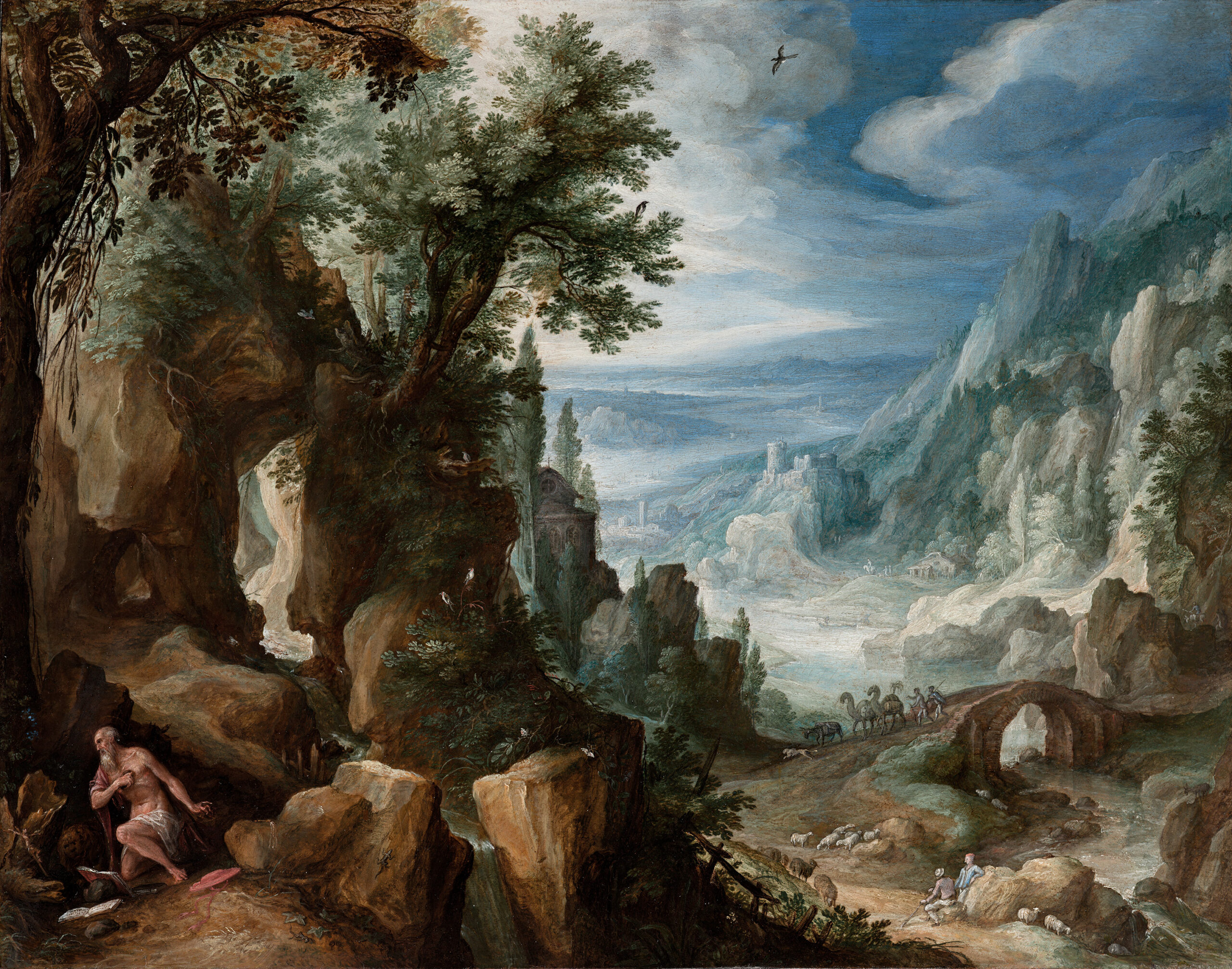
Mountainous Landscape with Saint Jerome is an oil on copper painted in 1592 by Paul Bril, a Flemish landscape painter born around 1554 who settled in Rome around 1575. Signed with the monogram “PB”, the painting shows the hermit at prayer in a corner of the foreground, set within a vast imaginary landscape in the Flemish tradition. It belongs to the first small landscapes on copper that Bril painted for private collectors in the 1590s, the period of his friendship with Jan Brueghel the Elder, to whom the work was once attributed. Acquired in 2013 by the Mauritshuis in The Hague, it illustrates Bril’s role in the birth of the Roman ideal landscape, later developed by Claude Lorrain.
Saint Jerome seems above all to be a pretext for painting this imaginary landscape, and that is precisely what I like about this picture. The hermit saint takes up only a small space: you find him in the lower left corner, with his lion and his cardinal’s hat, almost unobtrusive in the face of the immensity around him. This sense of scale reminds me of Bruegel the Elder, whose religious subjects often disappear into vast panoramas, or of the Flemish “world landscape” tradition inherited from Joachim Patinir. You can feel that Paul Bril, an Antwerp native settled in Rome, brought this Northern way of seeing with him. I love these landscape views that seem to open onto infinity in the distance, where the eye moves from the warm tones of the foreground to the hazy blues of the horizon, as if you could walk endlessly into the painting. What amazes me most is the wealth of detail visible despite the small size of the work, barely larger than a sheet of A4 paper. The copper support plays a big part in this: its smooth surface allows for very fine painting and gives the colours an almost enamel-like luminosity. It is the kind of painting you have to look at closely, and for a long time, to take in all its riches.
A red spot, barely larger than a fingernail. Your eye finds it before the saint himself. It is Jerome’s cardinal’s hat, left lying in the dust. The rest of the scene still escapes you. A cold light falls from the mountains and draws you into the distance.
A skin of metal beneath the paint
First, rest your eyes on the foreground. The rock there is brown, almost warm. Jerome kneels at the entrance to his cave, bare-chested, one hand on his breast. Before him lie open books. In the shadows, the lion’s head barely emerges. Then your eye slides to the right. A waterfall gushes between two blocks of stone. A caravan of camels approaches an arched bridge. Sheep graze, and two shepherds rest by the roadside. Further on, a castle crowns its rocky spur. A church shelters beneath the trees. In the far distance, a town dissolves into blue. Brown, green, then blue: three zones of colour take turns. Aerial perspective makes the space recede without a single vanishing line.
This precision comes from the support. Here Paul Bril paints in oil on a copper plate. Unlike wood, metal does not warp with humidity. The brush glides over a perfectly smooth surface. The brushstroke can then become minute. Look at the white birds perched in the branches: each one is made of just two or three touches of paint. The colours keep a density, a smooth brilliance that canvas rarely achieves.
The painting bears a saint’s name. Yet it banishes him to a shadowy corner. Jerome has fled the world. The world, meanwhile, keeps passing just a few steps away.
A Bril once taken for a Brueghel
The connection with the Brueghels is more than an impression. In 1947, this copper went up for sale at Christie’s in London. At the time, it was attributed to Jan Brueghel the Elder, son of Pieter. The confusion has a history. Jan lived in Rome from 1592 to 1594 and became friends with Bril there. The two Flemings worked together and shared a taste for small, highly detailed formats. This copper, dated 1592, comes from the very moment they met. Look at the signature: a discreet “PB” monogram, lower left. On the back, the painter incised “PB / 1592” into the metal. The Mauritshuis acquired the painting in 2013, under the name of its true author. Its full catalogue entry is available on the Mauritshuis page for the work.
Paul Bril and his time
Born around 1554 and trained in Antwerp, Paul Bril settled in Rome around 1575. With his brother Matthijs, he painted vast landscape frescoes for the Vatican and Roman palaces. In the 1590s, he also turned to small paintings on copper for private collectors. In them, he revisited subjects he had already treated on a large scale, such as hermits in the wilderness. In 1621, he became head of the Accademia di San Luca. His ideal landscape paved the way for that of Claude Lorrain.
News: 400 years since Paul Bril’s death
The year 2026 marks the 400th anniversary of Paul Bril’s death: the painter died in Rome on 7 October 1626 and was buried in the church of Santa Maria dell’Anima. His work continues to attract the interest of scholars and the market, with several paintings to be included in the catalogue raisonné of Bril being prepared by Luuk Pijl, and notable museum acquisitions such as that of the Rubens House in Antwerp, where a landscape by Bril, visible in the famous Art Gallery of Cornelis van der Geest, is now displayed alongside that painting. As for the Mauritshuis, which brought this Mountainous Landscape with Saint Jerome into its collection with the support of the BankGiro Loterij and a private donor, the news comes from Spain: in autumn 2026, the museum and the Museo Nacional Thyssen-Bornemisza are exchanging part of their collections for the first time. The exhibition Thyssen-Bornemisza ❤️ Mauritshuis – Masters from Madrid runs in The Hague from 15 October 2026 to 17 January 2027 and brings together Italian, Spanish, German and Flemish masters from the 15th to the 17th century, including Jan van Eyck, Albrecht Dürer, El Greco, Bronzino, Antonello da Messina and Piero della Francesca. In return, the Mauritshuis is lending 25 of its key works to the Madrid museum.
Source: Masterworks Academy.
A question for you
Brown, green or blue: which part of the painting holds your gaze the longest?
About this work
- Mountainous Landscape with Saint Jerome
- Paul Bril
- 1592
- Oil on copper
- 25.7 x 32.8 cm
- Mauritshuis, The Hague
- https://www.mauritshuis.nl/en/our-collection/artworks/1204-mountainous-landscape-with-saint-jerome