Weimar, 1924. László Moholy-Nagy, twenty-seven years old, steps into the workshops of the Bauhaus. He teaches, experiments, dreams of fusing art and industry. He paints his convictions.
Geometry as a Universal Language
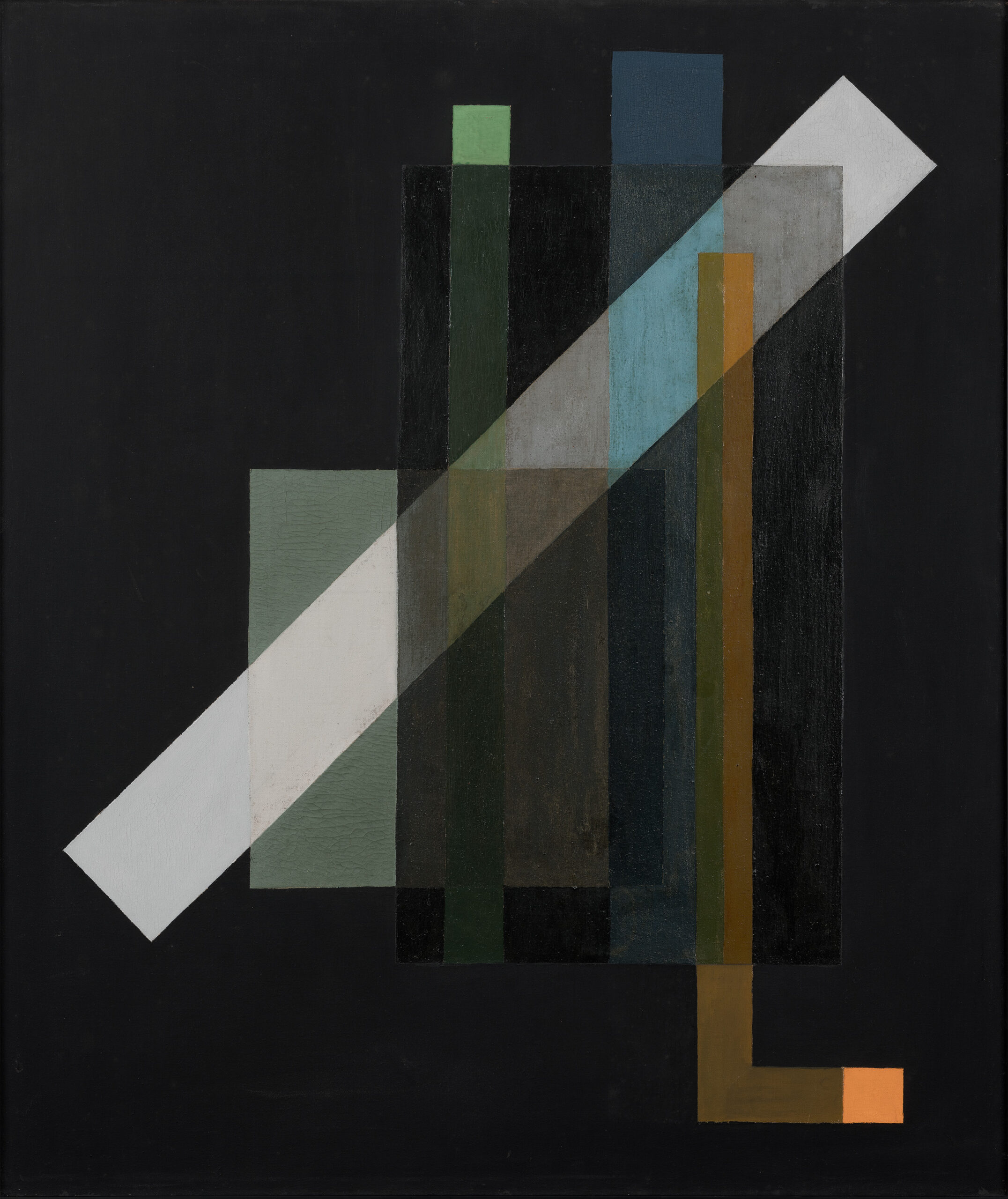
Against an absolute black ground, vertical rectangles assemble in silent harmony. Moss green, steel blue, golden ochre, dense black: the colours converse without clashing. A white-grey diagonal bar crosses the composition from the upper right corner to the lower left. It cuts. It energises. It breaks the stillness of the vertical forms with a physical force. The handling is smooth, controlled, almost industrial. Moholy-Nagy erases every trace of the hand. Painting becomes cold, precise, intentional matter. In the lower right, a small orange square detonates like an unexpected final note.
The Constructivist Utopia in Action
In 1924, the Weimar Bauhaus is forging a new vision of the world. Art must serve society, ally itself with technology, refuse superfluous ornament. Moholy-Nagy embodies that ambition more fully than anyone. Influenced by Russian Constructivism and De Stijl, he seeks a universal visual language. Construction is not decoration: it is a silent manifesto. Every form asserts that beauty and function are not opposites.
László Moholy-Nagy
László Moholy-Nagy (1895-1946) was born in Hungary. A passionate autodidact, he experimented with photography, light sculpture, cinema and design. A visionary teacher at the Bauhaus, he went on to found the New Bauhaus in Chicago in 1937. His painting translates his deepest conviction: the artist is an engineer of the senses.
A Question for You
💭 In 1924, Kandinsky is teaching just a few workshops away. Two visions of abstraction coexist at the Bauhaus. Which one, in your view, left the deeper mark on 20th-century art?
About this work
- Construction
- László Moholy-Nagy
- 1924
- Oil on canvas
- 78 × 66 cm
- Städel Museum, Frankfurt am Main
- https://sammlung.staedelmuseum.de/en/work/construction