Key facts
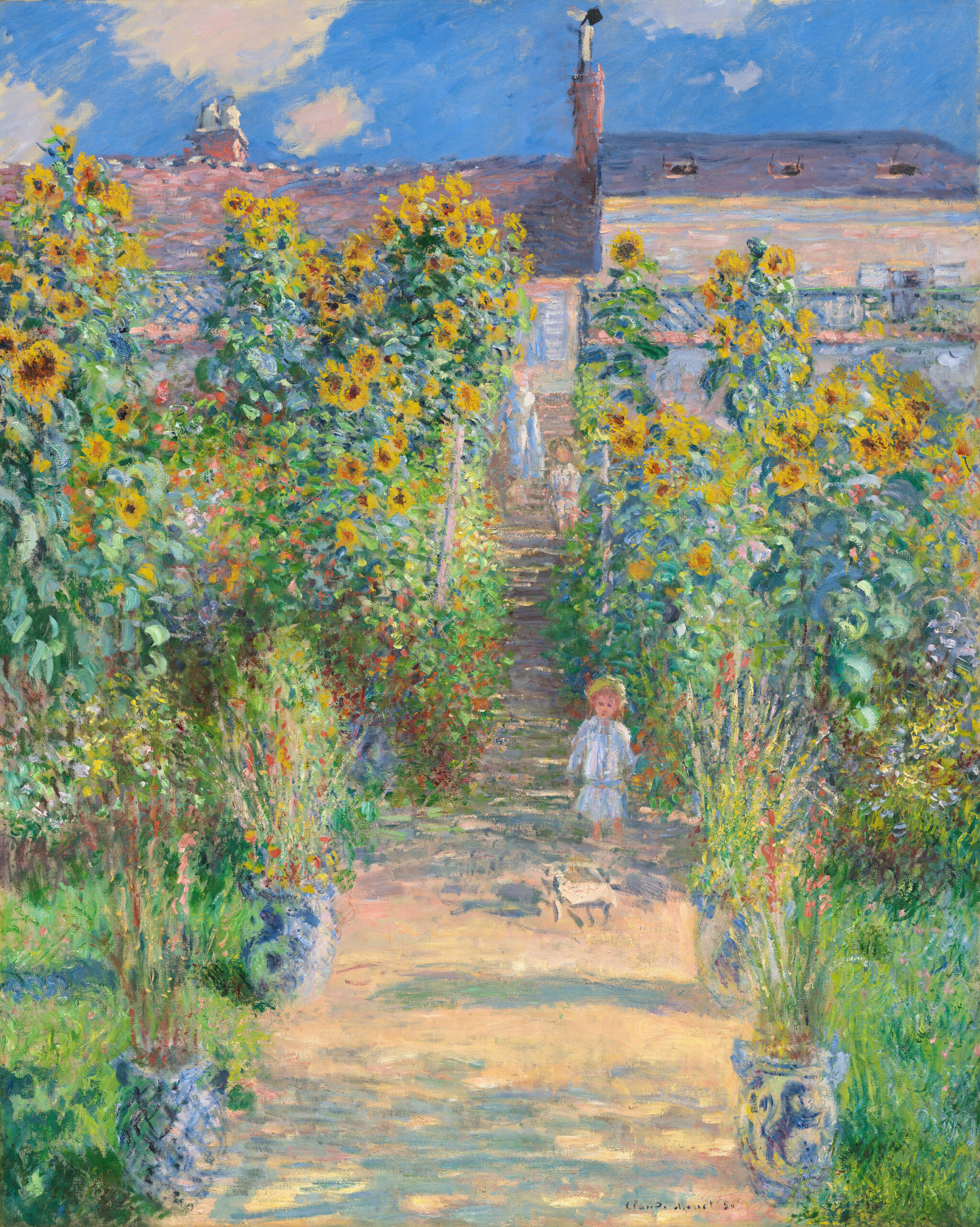
Painted by Claude Monet in the summer of 1881, The Artist’s Garden at Vétheuil shows the sunflower-lined path of the house he rented in this village on the Seine. The painter’s young son stands in front, while other members of the household stand on the steps. Monet made four versions of this motif. The largest is held by the National Gallery of Art in Washington. This Impressionist oil on canvas belongs to the early 1880s, when Monet was more concerned with the painted surface than with the fleeting effect of light. Its high horizon and thick paint give the brushstrokes a value that is more decorative than descriptive.
A Monet full of colour and summer warmth. The subject is the garden of the house Monet rented in Vétheuil. A few figures stand in it or pass through. In the foreground, a child stands on the path. Further back, a woman and another child appear, half hidden by the flowers. They bring a human presence that, to my mind, strengthens the feeling of luminous happiness the canvas gives off. This is what I love here: the discreet human presence heightens the light that transfigures this garden landscape. Monet is not painting a family portrait. The figures are set down in a few strokes, almost melting into the greenery, and that is precisely what makes them feel alive.
The house stands behind, in the background. It tells us we are in the garden, just like the blue pots lining the path. They give rhythm to the composition and lead the eye towards the façade. The tall sunflowers on either side form a kind of guard of honour rising above the figures. The vertical format strengthens this impression: you feel very small, surrounded by flowers, like these children.
What also moves me is the context. In 1881, Monet was emerging from very difficult years in Vétheuil: poverty, paintings that would not sell, and the death of Camille in 1879. And yet he painted this radiant summer scene. I see in it a moment of respite, a light regained. The brushwork is quick and vibrant, especially in the flowers, where the brush goes straight to the colour rather than to detail. What stays with me is the yellow of the flowers and the blue of the sky, answering each other across the whole picture, with the blue of the pots as the link between them.
The Artist’s Garden at Vétheuil
Move closer to the pot at the bottom right. The blue and white comes apart. Green slips in, a reflection of the nearby grass. Elsewhere, a veil of gold or pink. Now walk up the path. Sunlight strikes the sand. The shadows turn blue, plum, several shades of green. A little boy on the path. His face is just a few strokes. Higher up, steps block the way.
Claude Monet
Claude Monet rents this house in Vétheuil from 1878. He lands the terraces down to the Seine. The large pots belong to him. They follow him from one garden to the next. The child in front is his young son. Other members of the household stand on the steps. In the summer of 1881, he paints four versions of the motif, this one being the largest. The Norton Simon Museum’s canvas was long regarded as its sketch. Examining the two paintings, brought together in 2018, has called this hierarchy into question. In the early 1880s, the fleeting effect of light matters less to Monet. The painted surface matters more.
Making way for colour
Stand back. Everything is summer, light, childhood. Now step closer. The paint thickens, the brushstroke becomes pattern. The very high horizon holds you inside the canvas. The steps close off any escape. You do not walk through this garden. You stay on its surface, in the relief of the paint and in the colour. Nature provides the subject. Decoration takes over. Joy overflows, and yet this house is just emerging from mourning.
News: 2026, the Monet centenary year
A hundred years after his death, Claude Monet is being celebrated throughout France and beyond. The painter died at Giverny in December 1926, and in 2026 Normandy and the Île-de-France region are marking the centenary of his death. Vétheuil, where The Artist’s Garden was painted, is taking part in this tribute: the house where Monet lived is opening to the public for the occasion, with a trail devoted to his stay from 1878 to 1881, “between shadows and light”. This was a pivotal period in his career: Monet painted around two hundred canvases there in three years, at a time when Impressionist painting sold very poorly and his wife Camille was seriously ill. In Paris, the Musée de l’Orangerie is presenting “Monet, Painting Time” until 25 January 2027, an exhibition bringing together nearly forty paintings, mainly from the collections of the Musée d’Orsay and the Musée Marmottan Monet, around the theme of time and the Water Lilies cycle. Meanwhile, the Musée Marmottan Monet is showing the master’s influence on contemporary artists, from Monet to Hockney, until 31 January 2027.
Source: Musée de l’Orangerie & Musée Marmottan Monet.
A question for you
Before Van Gogh’s sunflowers, weren’t Monet’s already paving the way for a kind of painting in which the flower becomes pure colour?
About this work
- The Artist’s Garden at Vétheuil
- Claude Monet
- 1881
- Oil on canvas
- 151.5 x 121 cm
- National Gallery of Art, Washington D.C.
- https://www.nga.gov/artworks/52189-artists-garden-vetheuil