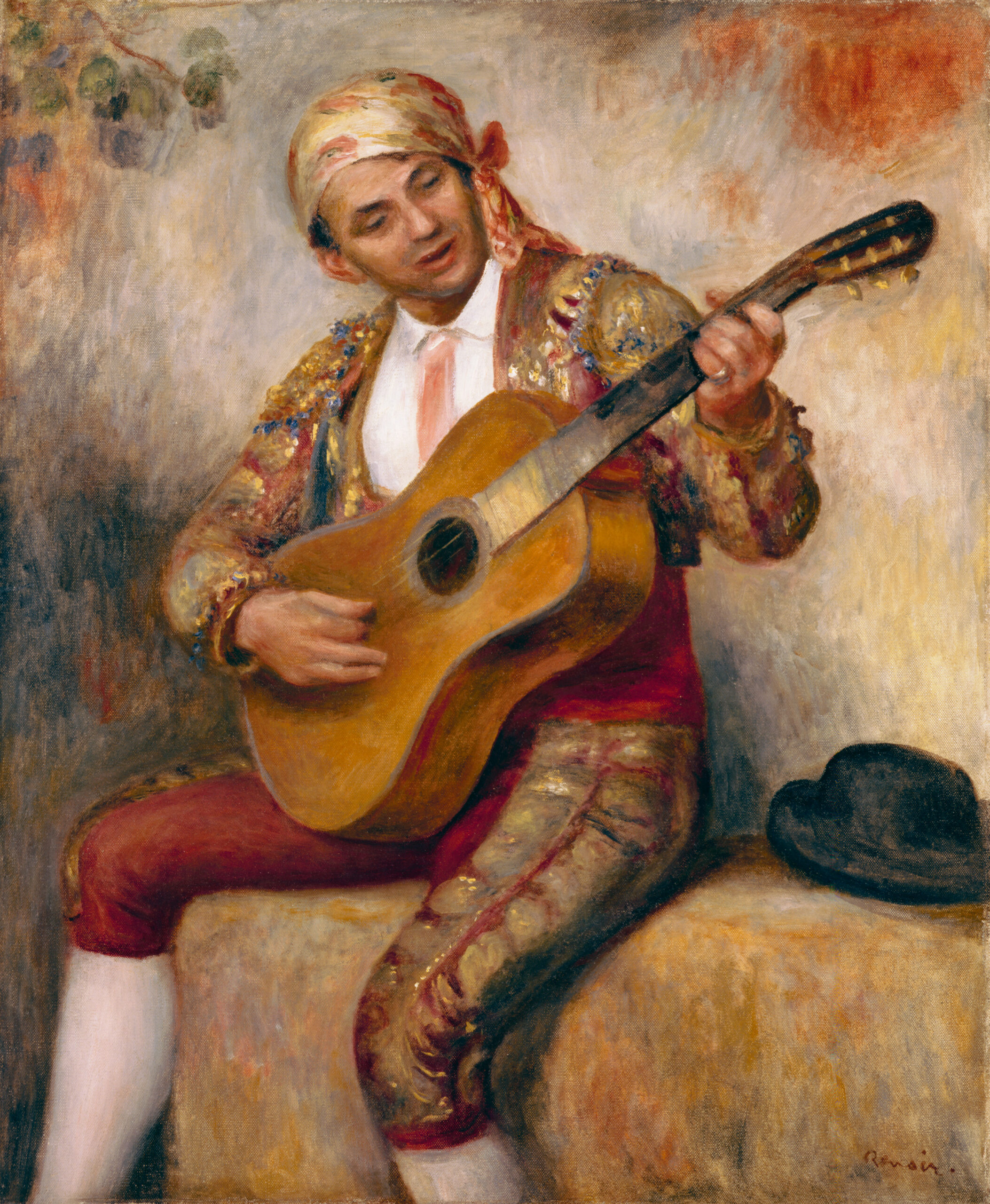
I’ll admit it: I was expecting just another Renoir. One of those warm, familiar paintings you recognise from across the room and no longer truly see. Then this hand stopped me cold. That suspended gesture over the strings. That slightly parted mouth. It took me a moment to realise I was holding my own breath. The costume came next, the precision of the embroidery, the intensity of the red, and confirmed that Renoir was not being casual here. A painter content with an exotic pretext does not work at this level of detail.
One hand plucks the strings. The other presses the neck. Eyes half-closed, mouth barely open. In 1894, Pierre-Auguste Renoir sets down his brush on a suspended moment, the one just before the note sounds.
An Explosion of Matter and Light
Look at the costume. The deep red of the trousers. The gold and blue embroidery crackling across the jacket. The scarf tied high on the skull, striped in pink and ochre. Renoir applies the embroidery with thick, almost sculptural pigment. The paint overflows, vibrates, sings in its own way. The guitar’s soundboard catches all the central light of the composition. The background dissolves into blurred, golden greys, almost immaterial. The dark hat set to one side waits. The musician, for his part, is elsewhere. This tension between the precision of the costume and the dissolution of the face runs through the entire canvas, and never resolves.
The Dreamed Spain of a French Painter
In 1894, Renoir is 53. Impressionism is behind him. He is searching for a more constructed, more physical painting. Spain captivates an entire generation of French artists and composers at this time. Manet had opened the path. Renoir takes it in his own way: not through ethnographic realism, but through pure sensation. The flamenco guitarist’s costume becomes a pretext for chromatic explosion. This musician in traditional dress, painted by a Frenchman who never lived in Spain, rings true nonetheless. Perhaps too true. Therein lies the paradox of this canvas: an imagined Spain that moves us more than the real one might have.
Pierre-Auguste Renoir
Born in Limoges and trained in Paris under Gleyre, Renoir (1841-1919) stands as one of the founding figures of Impressionism. By 1894, he is navigating a period of formal renewal. His touch grows firmer. His colour, more assertive. The Spanish Guitarist carries both ambitions at once.
Currently on View, Musée d’Orsay
The Musée d’Orsay is currently presenting a major retrospective devoted to Renoir, on view until 19 July 2026: Renoir and Love. The Joyful Modernity (1865–1885). The exhibition brings together masterworks from his first two decades, the formative period that shaped the artist who would paint, ten years on, this Spanish Guitarist now held in Detroit. Further information: musee-orsay.fr
A Question for you
Renoir painted this guitarist in 1894, the very year Debussy was composing his early Estampes drawn from the Orient: was late nineteenth-century France seeking in the elsewhere what it could no longer find at home?
About this work
- The Spanish Guitarist
- Pierre-Auguste Renoir
- 1894
- Oil on canvas
- 65.4 × 54.6 cm
- Detroit Institute of Arts
- https://dia.org/collection/spanish-guitarist/58279