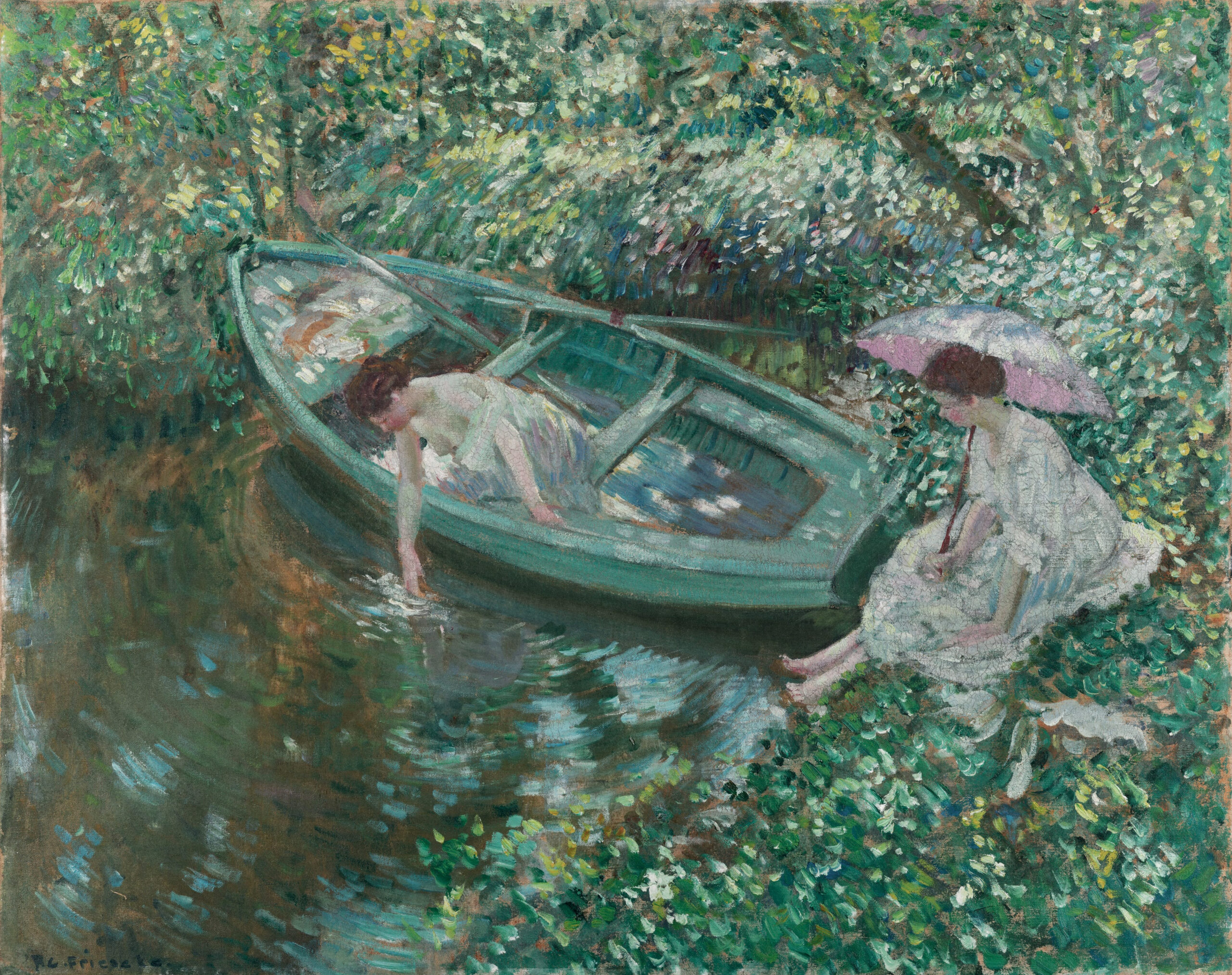
Browsing the LACMA online collections, I made a wonderful discovery: Repose at Noonday by Frederick Carl Frieseke, an American painter who settled in France in 1898, a neighbor of Monet in Giverny and a Chevalier of the Legion of Honor. A major figure of American Impressionism I had not encountered before.
What struck me first was the light. It does not fall; it wraps. Filtered through the foliage, it bathes the two women resting by the water in an almost tangible softness. You can feel the still heat of summer, the silence of the afternoon. Frieseke works here with a palette of greens, whites, and iridescent golds characteristic of his Giverny period, applied in light, vibrant strokes that animate the entire surface of the canvas.
What moves me most in this work is the balance between the joy of color and the quietness of the scene. Nothing anecdotal, nothing demonstrative: just life suspended, a moment of rest captured with great refinement. A work that rewards the time you give it.
See
A hand grazes the water. Fingers hang, languid, over the side of a green rowboat. The water responds: brief ripples, copper-toned reflections. Around them, the foliage bursts in short strokes, acid greens, muted yellows, white blossoms. Two women. One leaning over the bow of the boat, the other seated on the bank, a pink parasol resting on her shoulder. They are not speaking. They are simply breathing. Look at the surface of the canvas: no firm contour anywhere. Everything trembles slightly, like warm air.
Understand
Around 1911, Frederick Carl Frieseke had been painting in Giverny for several years. In 1906, he had rented the house next door to Monet’s. He knew this landscape intimately: the reflections of the river Epte, the dense vegetation, the filtered light of summer afternoons. The American Impressionism he practiced was not a copy of the French school. It was an adaptation, more decorative, more attentive to the female figure, less concerned with atmospheric transience than with the fullness of a moment. Frieseke said so himself: it was sunshine that interested him, not society. The scene looks peaceful. Yet the boat is not moored. It could drift.
Feel
The heat is physical. You sense it in the white of the dresses, in the green shade that shelters without enclosing. Frieseke paints repose as something almost fragile. The two women are still, and yet nothing is fixed: the water moves, the leaves stir, the light shifts. The oil on canvas holds this unstable equilibrium between rest and wakefulness. Notice how little it would take to disturb it. A single breath would be enough.
On view at LACMA through January 2027
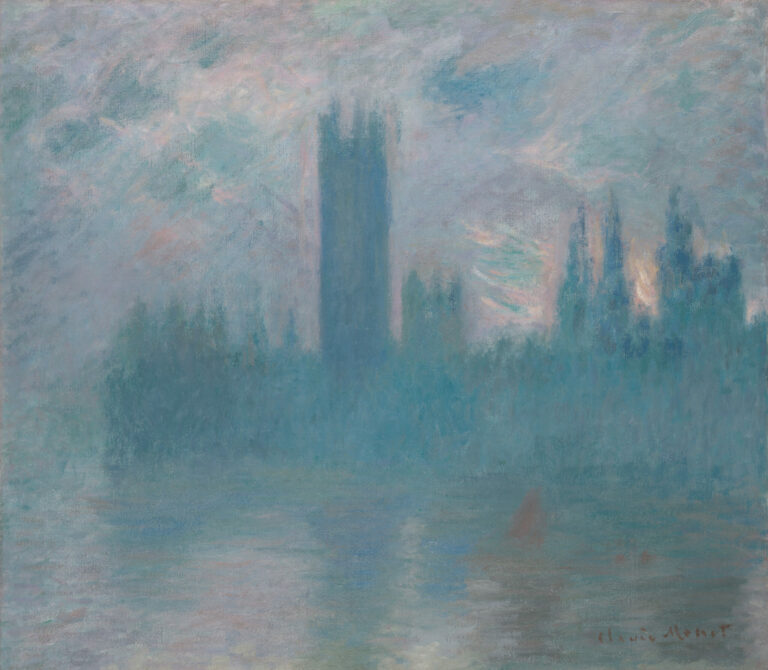
Repose at Noonday resonates with particular force right now. The Los Angeles County Museum of Art is currently presenting “Collecting Impressionism at LACMA,” an exhibition tracing the history of the museum’s Impressionist holdings, on view through January 3, 2027. Inaugurated on December 21, 2025, it brings together paintings, prints, photographs, and decorative objects, alongside recently acquired works by Claude Monet and Vincent van Gogh. A rare opportunity to encounter Frieseke alongside the French masters he had known firsthand in Giverny.
Source: lacma.org
A question for you
💭 Can we still speak of American Impressionism, or does that label obscure precisely what makes Frieseke’s work so singular?
About this work
- Repose at Noonday
- Frederick Carl Frieseke
- c. 1911
- Oil on canvas
- 26 x 32 in. (66.04 x 81.28 cm)
- Los Angeles County Museum of Art (LACMA)
- collections.lacma.org/object/213853