Key facts
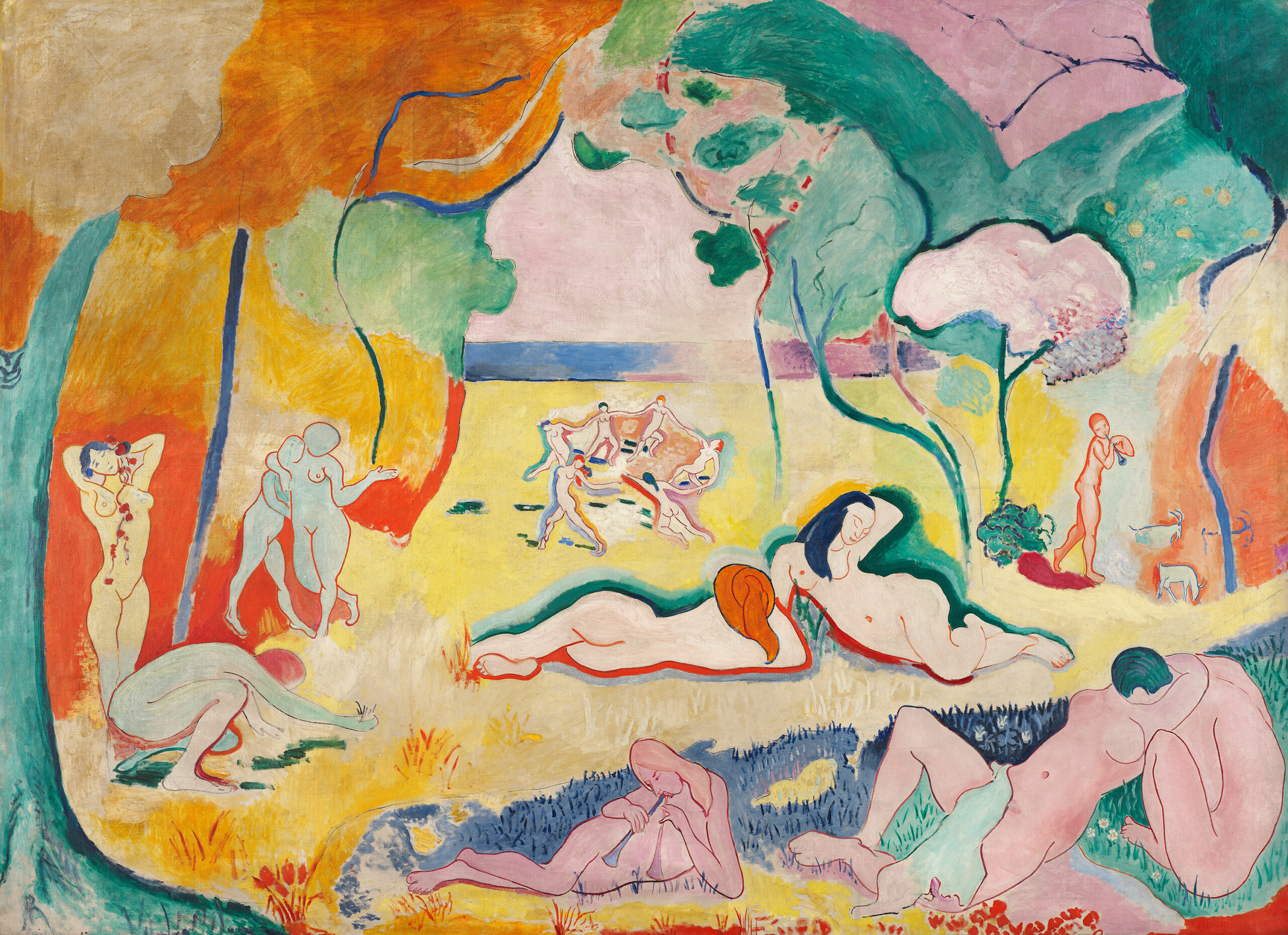
Painted by Henri Matisse between October 1905 and March 1906, Le Bonheur de vivre (The Joy of Life) ranks among the founding works of Fauvism and of modern painting. First shown at the 1906 Salon des Indépendants, it depicts an Arcadia peopled with nudes, rendered in flat areas of pure colour and sweeping arabesque lines. Its mix of styles, scales and perspectives breaks with the classical unity taught at the École des Beaux-Arts. The canvas was acquired by Leo and Gertrude Stein, and Picasso saw it in their home. That encounter is generally seen as the start of the rivalry between the two artists. Its ring of dancers anticipates The Dance (1909-1910). The painting is held at the Barnes Foundation in Philadelphia.
Here is a work that left a deep mark on everyone who saw it at the 1906 Salon des Indépendants. And it struck me when I came across it while exploring the collections of the Barnes Foundation. Between scandal and rapture, passions ran high: even Paul Signac, who had once championed Henri Matisse, was deeply irritated. The subject, an Arcadia peopled with reclining nudes, is a classic one in art history, from Titian to Ingres’s The Golden Age. Yet the way it is handled was entirely new and baffling to the upholders of classical Beaux-Arts training. And that is exactly what I love about this canvas, nearly two and a half metres wide. The figures come from a variety of stylistic traditions and are painted in unexpected colours and poses: pink trees, bodies outlined in arabesques, a perspective that no longer tries to imitate reality. An almost musical rhythm unfolds, and the eye keeps moving from one group to the next, all the way to the ring of dancers in the background, which Matisse would take up again a few years later in The Dance. Leo and Gertrude Stein noticed the canvas and soon bought it. For years it held pride of place in their apartment on rue de Fleurus, a meeting point for the whole Parisian avant-garde. I love knowing that it was there, standing before it, that Picasso took the measure of his rival. This convention-defying painting threw down a real challenge to him, and Les Demoiselles d’Avignon, painted the following year, is often seen as partly his answer.
Paris, Salon des Indépendants, March 1906. Visitors expect a peaceful idyll. They get nothing of the kind. Before these 240 centimetres of Arcadia, the public laughs, bristles, lingers. Henri Matisse’s paradise unsettles.
Le Bonheur de vivre, a paradise that refuses unity
Look first at the far centre. A ring of dancers whirls there, tiny yet magnetic. The eye catches on it, then moves on. In the foreground, a reclining figure plays the flute. The arabesque line seems to carry the sound onward. It outlines the bodies, runs through the tree trunks, and binds together sixteen figures that everything else keeps apart. For nothing agrees here. On the left, the embracing couple merges into a single head. A sinuous line springs from the hand of a standing figure, like a discharge of energy. Halos ring the two central figures. Scales diverge, perspective slips away, styles intermingle. The nudes are laid down in flat pinks, greens or yellows, without modelling. The surface stays smooth, rarely impasted. Look at the upper left quarter: the oil, thinned to a wash, lets the white ground show through. Around the hair of the two central figures, by contrast, the paint thickens and turns opaque. It is an oil on canvas, yet it has the matte finish of a mural. To study these details, open the work’s entry on the Barnes Foundation website. One last contradiction lies hidden there. The painting sings of eternal joy. Its cadmium yellows, however, are slowly deteriorating, turning white or brown in places.
From Saint-Tropez to scandal
Matisse paints the canvas from October 1905 to March 1906. In 1905, at the Salon d’Automne, the critic Louis Vauxcelles dubs Matisse and his friends fauves, “wild beasts”. The painter could tone things down. He does the opposite. He summons the pastoral tradition, then dismantles its rules. Compare it with Luxe, calme et volupté, painted in 1904 after a summer in Saint-Tropez alongside Paul Signac. The subject is already an idyllic seaside bathing scene. The handling, however, still follows the divided brushstroke of Neo-Impressionism. Signac, in fact, buys that canvas in 1905. A year later: the same dream, the opposite method. The dot gives way to flat colour and the continuous line. Hence Signac’s annoyance: he feels that Matisse has lost his way. The challenge is also aimed at the École des Beaux-Arts and its dogma of classical unity. Rupture or loyalty? Both at once. Matisse shatters the manner but keeps the grand pastoral subject. When the Salon closes, he hangs the canvas himself on rue de Fleurus, at the home of Leo and Gertrude Stein. Between 1906 and 1914, every visitor to the Steins can see it. The young Picasso discovers it there. His reply is called Les Demoiselles d’Avignon, in 1907.
Henri Matisse (1869-1954) is in his mid-thirties when he paints this canvas. He is no longer a beginner, but not yet a recognised master. Gertrude Stein would later write that here he invents a new formula of colour. The ring of dancers in the background bides its time. Matisse enlarges it in 1909-1910 for The Dance, commissioned by the Russian collector Sergei Shchukin. The detail becomes a manifesto.
News: the Barnes Foundation this winter
If you go to see Le Bonheur de vivre in Philadelphia this winter, the Barnes Foundation is also showing “Noguchi to Asawa: Designing Postwar America”, from 20 September 2026 to 10 January 2027. The exhibition is devoted to the sculpture and design of two generations of Japanese American artists. It places 20th-century art and design in the context of the incarceration of Japanese and Japanese Americans during the Second World War. In the Annenberg Court, visitors can see “Red metal dust” by the Native American artist Sky Hopinka, an installation of 11 photographic panels on view until 18 January 2027. The leadership has also changed. On 8 September 2026, Connie H. Choi, who comes from the Studio Museum in Harlem, became the foundation’s chief curator, in a new vice-president role that brings curatorial work and education together.
Source: Barnes Foundation.
A question for you
Did you spot the ring of dancers in the background? It is the seed of The Dance, painted three years later.
About this work
- Le Bonheur de vivre (The Joy of Life)
- Henri Matisse
- between October 1905 and March 1906
- Oil on canvas
- 176.5 × 240.7 cm
- The Barnes Foundation, Philadelphia
- https://collection.barnesfoundation.org/objects/7199/Le-Bonheur-de-vivre-also-called-The-Joy-of-Life/