Key facts
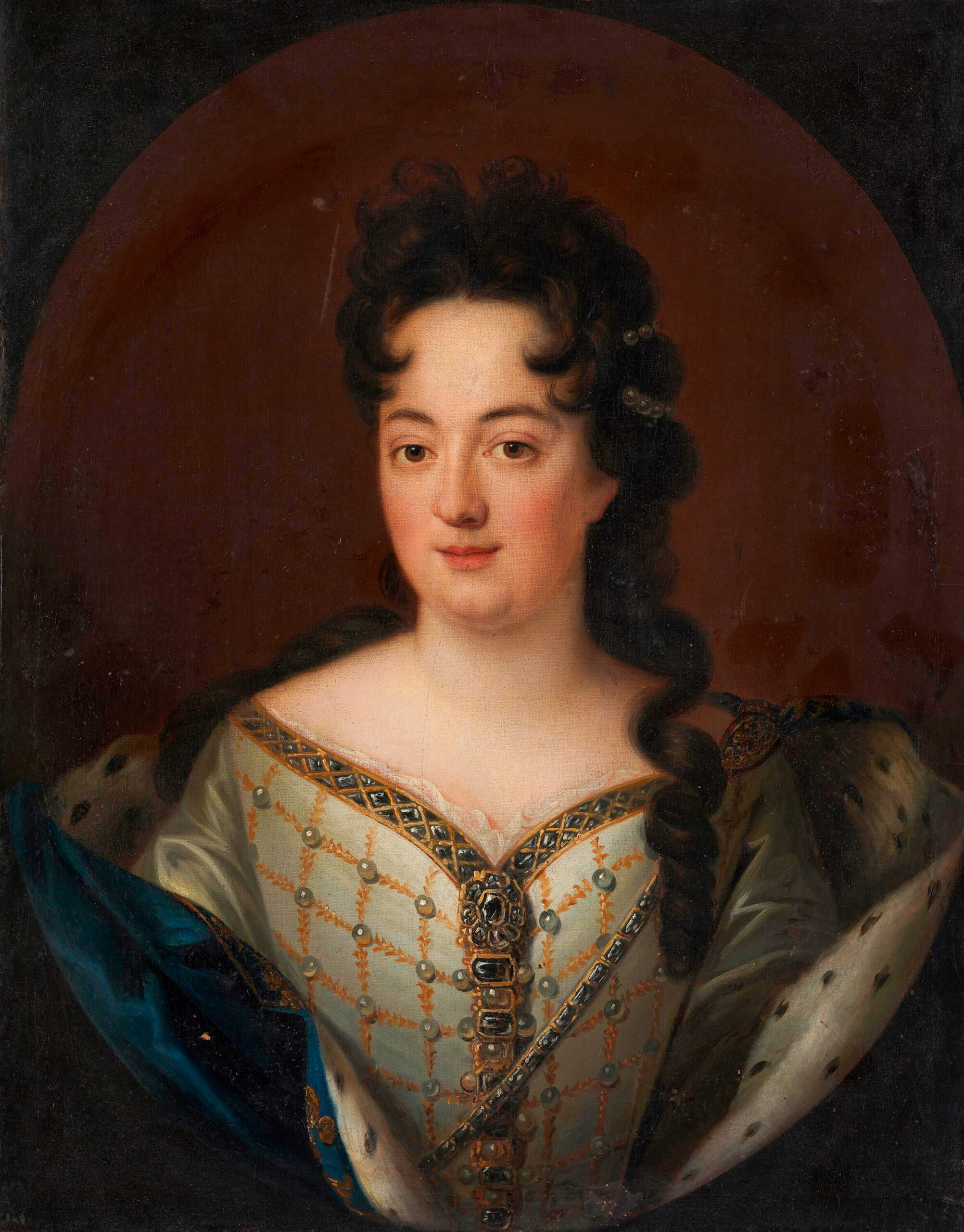
Painted around 1700 by an artist from the circle of François de Troy (1645-1730), the portrait of Maria Anna Christina, Dauphine of France (1660-1690), belongs to the tradition of French court portraiture at the end of Louis XIV’s reign. It is held by the Bayerische Staatsgemäldesammlungen at the Alte Pinakothek in Munich and comes from Dachau Palace. A Bavarian princess and sister of Max Emanuel, Maria Anna Christina married the Grand Dauphin, son of Louis XIV, in 1680 and died in 1690. The blue mantle strewn with fleurs-de-lis and lined with ermine signals her rank. Painted some ten years after her death, this posthumous likeness reflects the dynastic ties between Bavaria and France.
I personally feel that we are looking at a portrait typical of François de Troy’s manner, even though the museum cautiously attributes it to his circle, meaning a painter from his workshop or close entourage. It has everything that gives his court portraits their charm: a simple pose, a tight bust-length framing, and as much attention paid to the face as to the fabrics. It depicts the Dauphine of France, as the mantle around her shoulders makes clear, with its blue colour, its embroidered fleurs-de-lis and its ermine lining. This mantle is not simply ceremonial dress: it is a true mark of rank, reserved for members of the royal family, and it is enough to identify the sitter before you even read the title. She is a young woman seen from the front, richly dressed, with a warm gaze and a faint smile. What strikes me is the contrast between this gentleness and the symbolic weight of the costume, as if the painter had wanted to show both the princess and the woman. One detail makes this painting particularly moving: dated around 1700, it was painted about ten years after the death of Maria Anna Christina, who died in 1690 aged only 29. It is therefore a posthumous portrait, probably based on earlier models, which preserves for posterity the image of a Bavarian princess who became Dauphine of France and mother of three princes, including the future King Philip V of Spain. Its presence today in Munich, her birthplace, takes on its full meaning.
You are looking at a handful of pearls. They are pinned into dark curls, near the temple. At first, you don’t notice them. Look at them, though. In a portrait made to display rank, they are the only intimate touch of coquetry.
What the portrait of Maria Anna Christina, Dauphine of France, tells us
The face is shown head-on, within a painted brick-red oval. The spandrels remain dark, like a window opening onto the princess. The cheeks are pink, the mouth barely lifted. Her brown eyes follow you without insisting. A long curl slips over her shoulder, supple as a ribbon. Then the eye moves down to the costume. The ivory satin bodice bears a trellis of golden foliage. Pearls are sewn at every intersection. A band of dark stones set in gold traces the V-shaped neckline. A thin lace edging softens the neckline. A massive clasp holds the centre. Ermine, speckled with black tails, wraps the shoulders. The blue velvet of the mantle appears only on the left, almost out of frame. Look closely at the flesh tones: the weave of the canvas shows through the paint layer. The handling is quick on the skin and meticulous on the jewels. This bust-length format, set in an oval, lends itself to replicas. The painter takes as much care over rank as over likeness.
What the period tells us
Maria Anna Christina was born in Munich in 1660. She is the elder sister of the future Elector Max Emanuel. In 1680, aged nineteen, she marries the Grand Dauphin, son of Louis XIV. The marriage seals an alliance between Munich and Versailles. She gives France three sons. One of them will become Philip V of Spain. She dies at Versailles in 1690. Yet the French court considered her dull and sickly. This face, however, is gentle, almost radiant. Which should we believe?
One detail sheds light on the question. Another likeness of the Dauphine, attributed to Joseph Vivien, bears the same date, around 1700. It is kept at Schleissheim Palace. Our canvas comes from Dachau Palace, as stated in the Alte Pinakothek’s online record. Two posthumous portraits, the same decade, two Wittelsbach residences. The Bavarian family seems to have wanted to hold on to a face gone too soon.
François de Troy
François de Troy was born in Toulouse in 1645 and died in Paris in 1730. A leading portraitist of Louis XIV’s reign, he also served James II in exile at Saint-Germain-en-Laye. He became director of the Académie Royale de Peinture et de Sculpture. Rigaud and Largillière long overshadowed him. The Musée Paul-Dupuy in Toulouse devoted an exhibition to him in 1997.
News: French painting at the Alte Pinakothek
From 26 November 2026 to 4 April 2027, the Alte Pinakothek in Munich is holding its first major exhibition devoted to its collection of French painting, one of the richest in Germany. Entitled Liaisons Françaises: French Painting in Bavaria from Claude Lorrain to François Boucher, it brings together works by around fifty artists, supplemented by loans from Germany and abroad. It traces how the Wittelsbachs built up this collection through dynastic alliances, political exchanges and courtly taste, including through French portraitists active in Munich. The portrait of Maria Anna Christina, daughter of Elector Ferdinand Maria of Bavaria and wife of the Grand Dauphin, perfectly illustrates these Franco-Bavarian “liaisons”. The exhibition draws on extensive research into the some 390 early French paintings in the Bayerische Staatsgemäldesammlungen, with a view to a complete catalogue.
Source: Alte Pinakothek, Munich.
A question for you
The ermine, the pearls, the gold-set stones… Which detail of the painting tells you first that she is a princess?
About this work
- Maria Anna Christina, Dauphine of France (1660-1690)
- François de Troy (circle of)
- c. 1700
- Oil on canvas
- 72.6 x 57 cm
- Bayerische Staatsgemäldesammlungen, Alte Pinakothek, Munich
- https://www.sammlung.pinakothek.de/de/artwork/k2xnB9bxPd/francois-de-troy/maria-anna-christina-dauphine-von-frankreich-1660-1690