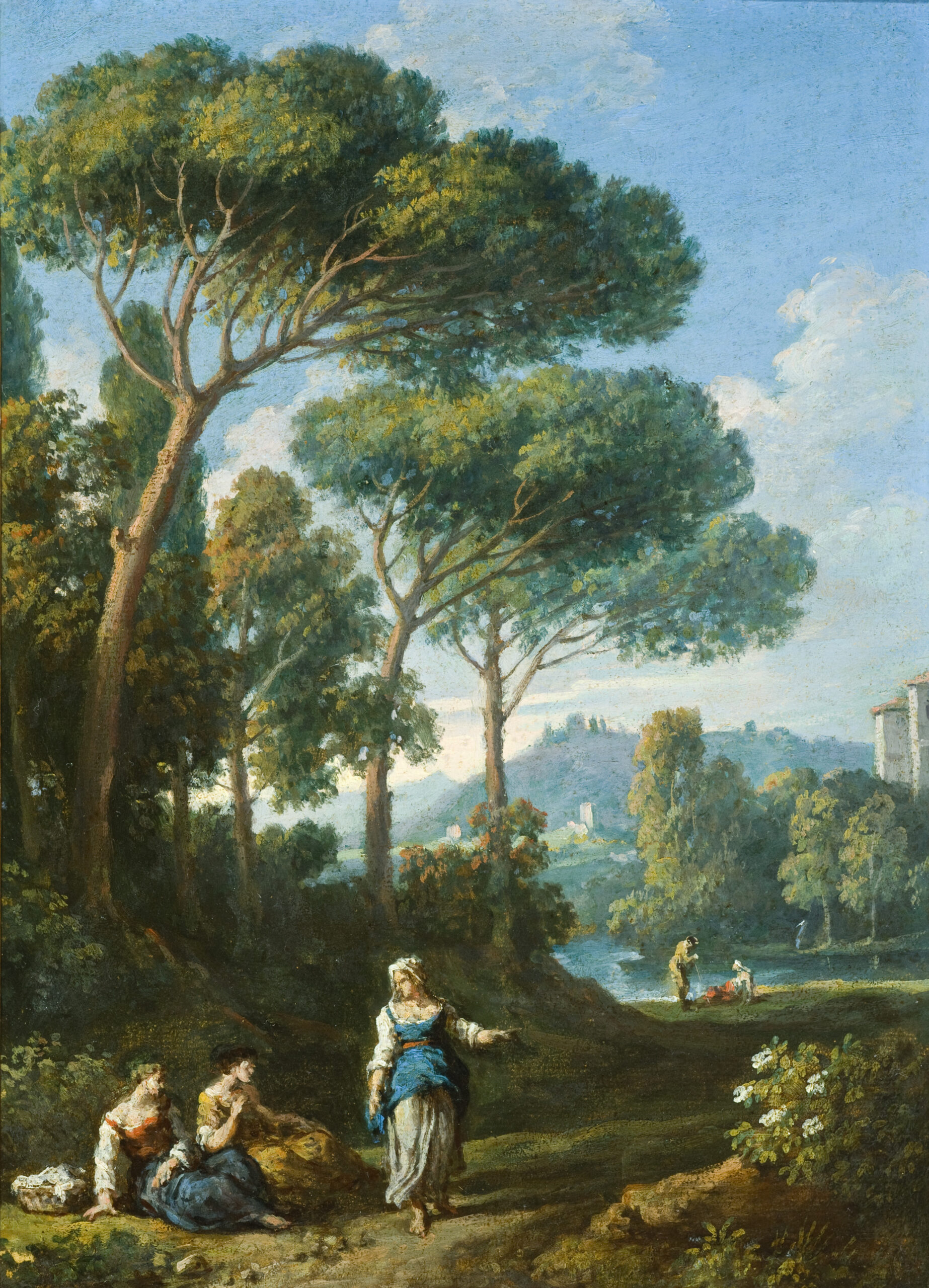
What I offer you today on VMuseum is a bucolic vision of the Roman countryside. The light is warm and golden, characteristic of the atmospheric treatment that earned Van Bloemen his nickname Orizzonte, “the horizon” in Italian. A few figures in conversation animate the scene without ever dominating it: they are a pretext for space, not for narrative. The generous vegetation, the distant hills, and the buildings barely sketched on the horizon together create that sense of quiet immensity so particular to this artist. What strikes me most here is the technique itself, oil on paper laid down on canvas, an unusual support that gives the work an almost sketched lightness, as if Van Bloemen had caught an impression on the spot before setting it for eternity. An invitation to travel and to contemplation, everything I love in this artist’s landscapes.
The first thing you see is the stone pine. Immense. It occupies the full height of the canvas, its russet trunk set against a pale sky. Beneath its branches, the air feels almost warm.
Beneath the Surface
Look again. The woman in the blue bodice turns toward the two others seated on the bank. She extends her arm. Toward what? Toward whom? Van Bloemen does not answer. That suspended gesture carries the entire tension of the picture. The oil is laid on paper mounted on canvas, a rare support that gives the brushwork an almost dry vibration. The light does not caress: it strikes the foliage in yellow-green bursts, carves shadow beneath the trees, then escapes toward hills the color of dust. Jan Frans van Bloemen builds his compositions in superimposed planes. Each layer breathes. In the distance, ruins and a grey-blue waterway. The campagna romana of the late Baroque: Arcadian, never quite real.
The Artist and His Time
Flemish, born in Antwerp in 1662, Van Bloemen arrived in Rome around 1689 and never left. His contemporaries gave him the nickname Orizzonte, “the horizon,” for his mastery of atmospheric distance. He painted for the Roman nobility, working within the tradition of Claude Lorrain and Gaspard Dughet. A Baroque painter, admired, yet never admitted to the Academy.
LACMA Enters a New Era
After two decades of transformation, LACMA inaugurated its new David Geffen Galleries on April 19, 2026, designed by Peter Zumthor. More than 10,000 square meters on a single level, with no hierarchy of medium or period. It is in this renewed museum that this View of the Roman Countryside is held today.
Source: lacma.org
A Question for you
💭 A Fleming spent his entire life in Rome painting Italy better than the Italians. Do we always see more clearly what we have chosen than what we were given?
About This Work
- One of a Pair of Views of the Roman Campagna with Figures Conversing
- Jan Frans van Bloemen (called Orizzonte)
- c. 1725
- Oil on paper laid down on canvas
- 34.29 x 24.77 cm
- Los Angeles County Museum of Art (LACMA)
- collections.lacma.org/object/140690