Key facts
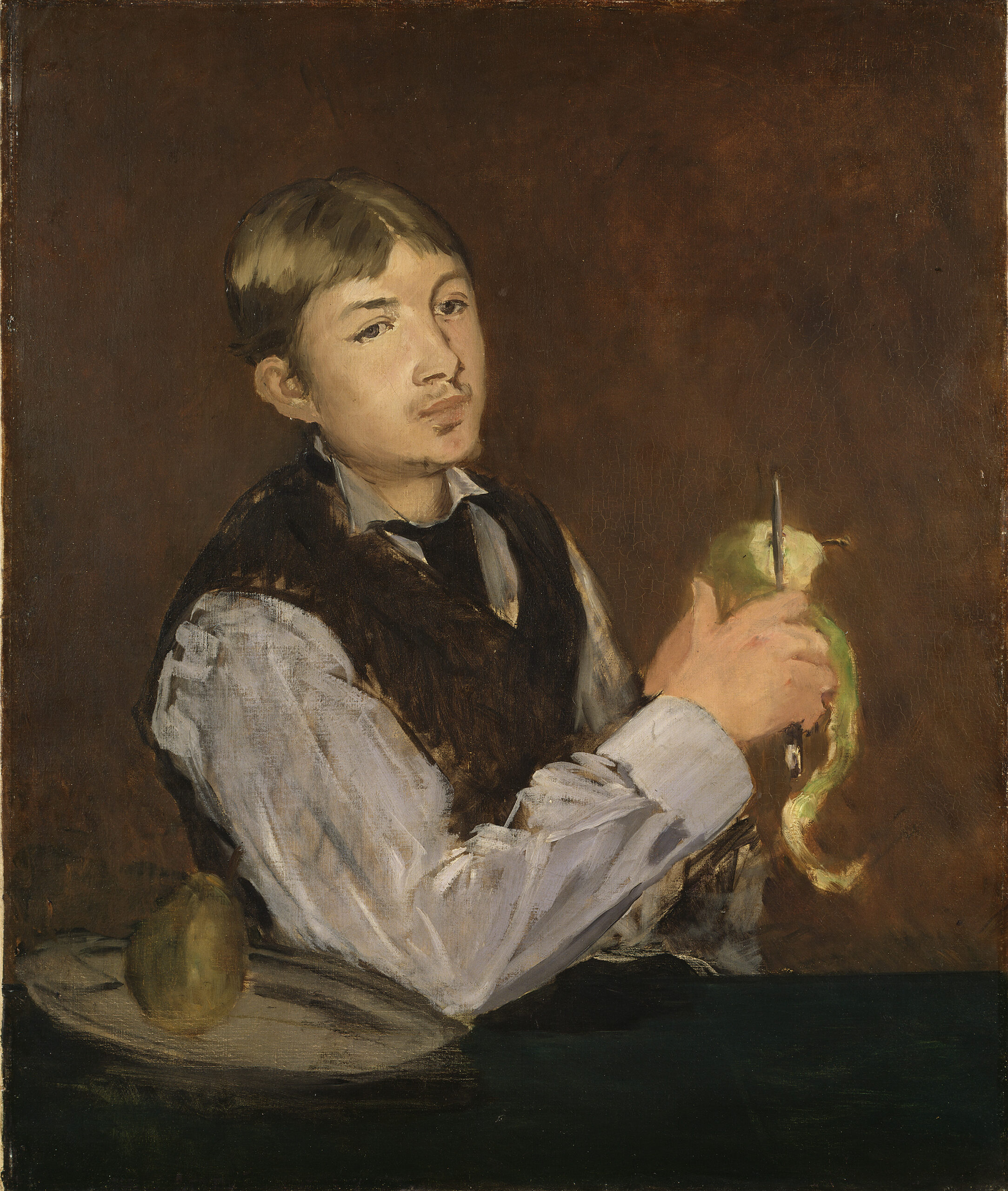
Painted by Édouard Manet (1832–1883), Young Boy Peeling a Pear most likely depicts Léon Leenhoff, son of Suzanne Leenhoff and a model the painter portrayed seventeen times. The painting belongs to Manet’s modern realism, shaped by the lessons of Velázquez: a monochrome brown background, a restricted palette, an everyday subject treated without anecdote. Its broad, almost sketchy handling breaks with the academic painting of its time and anticipates the freedom of the Impressionists, who claimed Manet as their forerunner. The Swedish painter Anders Zorn, who had received it from a friend in Paris, donated it in 1896 to the Nationalmuseum in Stockholm, where it remains today.
An everyday figure painted in the manner of Velázquez: that is what I see first in this canvas. Manet had just returned from his trip to Madrid in 1865, where he had discovered the Spanish master he called “the painter of painters,” and it shows. I find everything I love about him here: the monochrome background in dark brown tones, almost without depth, which makes the figure stand out as if on a stage; the captured moment of a simple, concrete life, a boy peeling a pear, nothing more; and that pensive gaze, lost in thought, which gives an ordinary gesture a kind of inner life. Manet tells no story, he does not moralize as the genre painters of his day would have: he shows, and it is precisely this restraint that moves me. The reduced palette, the whites of the shirt laid down in broad strokes, the black handled as a true colour, all of this comes from the Spanish lesson. Only the plate on the left, shown tilted, breaks this stillness and lends a little movement to the composition, as if Manet were deliberately unsettling the perspective to bring the surface of the painting to life. For me, it is one of those quiet canvases that make you understand why he is considered the father of modern painting.
Young Boy Peeling a Pear
Look at the hands. A few pinkish touches are enough, with no heavy outline. The knife is just a grey stroke. The face, meanwhile, does not follow the gesture. Now look at the waistcoat. Manet rubs in a brown so thin that the weave of the canvas shows through. The sleeves, by contrast, receive a generous layer of paint, in broad white, grey and mauve hatchings. This back-and-forth between thin scumbling and impasto makes the surface breathe. Around 1867, Manet had already painted this boy in Boy Blowing Bubbles. The same dark background, the same seriousness. Here, though, the teenager seems elsewhere. A finished painting or an interrupted study? The canvas does not decide.
When Édouard Manet Paints
The model is generally identified as Léon Leenhoff. He is the son of Suzanne Leenhoff, the painter’s wife. Manet portrays him seventeen times, at every age. In the 1860s, serious painting was expected to be noble. Manet sets down a table, a piece of fruit, a knife. He is the first to make everyday Parisian life a true subject for art. His broad handling breaks with academic finish. Later, the Swedish painter Anders Zorn receives the canvas from a friend in Paris. He gives it to the museum in 1896.
Édouard Manet (1832–1883) shocks the Salons as much as he fascinates young painters. The Impressionists claim him as their own. Yet his modernity often rests on the smallest of subjects. He had only one official pupil, Eva Gonzalès, whose painting Girl with Cherries may have been inspired by Young Boy Peeling a Pear.
On View at the Nationalmuseum This Autumn
If you are passing through Stockholm this autumn, the Nationalmuseum is showing To the Sea! The beach as borderland and summer dream until 7 February 2027. The exhibition traces the rise of seaside tourism from 1870 to the mid-20th century and how art has depicted it, through more than 200 works by artists such as Claude Monet, Anders Zorn, Peder Severin Krøyer, Sigrid Hjertén, Georgia O’Keeffe and Robert Capa. A fitting echo of Manet’s modernity, which the Impressionists claimed as their own. From 23 April 2026 to 28 February 2027, the museum is also hosting an exhibition on 20th-century cultural exchanges between Sweden and Japan, built around a shared desire to unite beauty and function (Wilhelm Kåge and Shōji Hamada).
Source: Nationalmuseum.
A question for you
Chardin might have painted this boy as a lesson in patience, Ribera as an allegory. If you had to say what Manet set out to paint, which word would you choose?
About this work
- Young Boy Peeling a Pear
- Édouard Manet
- Oil on canvas
- 85 x 71 cm
- Nationalmuseum, Stockholm
- https://collection.nationalmuseum.se/en/collection/item/18501/