Key Facts
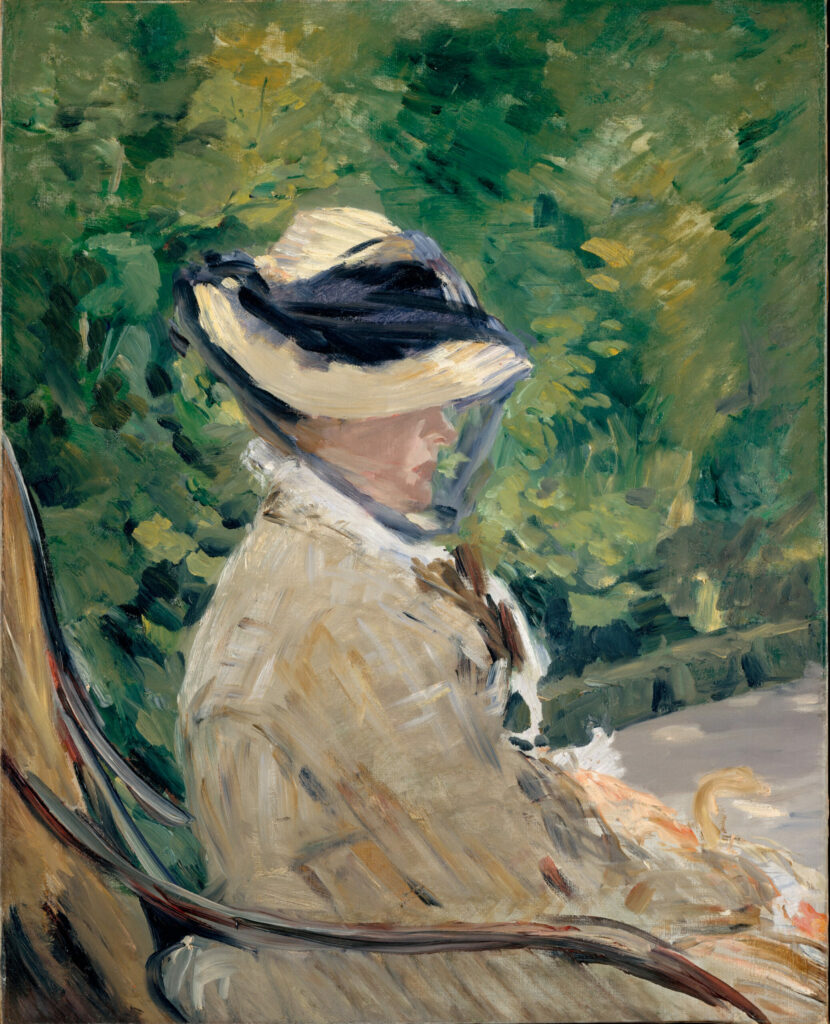
Painted in 1880 at Bellevue, on the outskirts of Paris, this portrait by Édouard Manet depicts his wife, Suzanne Leenhoff, seated in a garden, her face screened by a tulle veil. Executed in oil on canvas, the work is the last portrait the artist devoted to his wife, three years before his death. Its rapid handling and luminous palette align Manet with the Impressionist sensibility, though he never exhibited with the group and remained committed to the Salon. Preceded by several preparatory studies, it is today held at The Metropolitan Museum of Art, New York, where it exemplifies the painter’s late and unconstrained manner.
What presence there is in this painting, which I had the chance to admire at the Met in New York. And yet everything seems brushed in haste, in a few strokes laid down with a sure hand. What strikes me most is that Madame Manet’s profile remains perfectly legible even though it is painted behind a veil: a few pale streaks are enough to suggest the tulle, without ever effacing the face. Here I recognise all of Manet’s genius, that ability to seize a scene in a single breath, without weighing it down. And once we know he made several preparatory studies before arriving at this point, we grasp just how much this apparent spontaneity is in fact mastery. Manet is often linked to the Impressionists without ever having quite belonged among them; yet before this small Bellevue painting, made in 1880, it is precisely this freedom of touch that I admire and that I love, quite simply.
You see the black ribbon first. It frames the straw hat, twisted like a stroke of charcoal. Then the veil descends. Grey tulle drifts across Suzanne Leenhoff’s face. Her profile pierces the green haze of the garden.
Beneath the Surface
The surface looks hurried. Look closely. The pale dress is nothing but a build-up of beige and white touches. The foliage is reduced to green and yellow commas. Nothing is finished, and everything works. That swiftness conceals real labour. The Metropolitan Museum of Art’s label makes this clear. At least two drawings and an oil sketch precede this oil on canvas. Manet seeks the true impression, the light of a summer. We are at Bellevue during the summer of 1880. There he tends to his failing health. There he paints his wife one last time. This portrait closes a long and intimate series.
The Artist and His Time
Édouard Manet is born in 1832. He becomes the pivot of a new kind of painting. Realism forms him, modernity draws him in. He scandalises the Salon with his candid nudes. Suzanne Leenhoff, a Dutch pianist, shares his life from the 1860s onward. She becomes his most faithful model. Close to the Impressionists, Manet nonetheless declines their exhibitions. He dies in 1883, three years after this painting.
In the News: Manet’s Circle in the Spotlight
From 15 September 2026 to 24 January 2027, the Petit Palais devotes its first retrospective to Eva Gonzalès, the only pupil ever admitted to Manet’s studio, before the exhibition travels to the Van Gogh Museum in Amsterdam in 2027. The hanging places her in dialogue with Berthe Morisot and Mary Cassatt.
Source: Petit Palais
A Question for You
💭 Faced with this seemingly hurried handling, at what moment do you stop seeing brushstrokes and begin to see a face?
About This Work
- Madame Manet (Suzanne Leenhoff) at Bellevue
- Édouard Manet
- 1880
- Oil on canvas
- 80.6 × 60.3 cm
- The Metropolitan Museum of Art (MET), New York
- https://www.metmuseum.org/art/collection/search/438002